


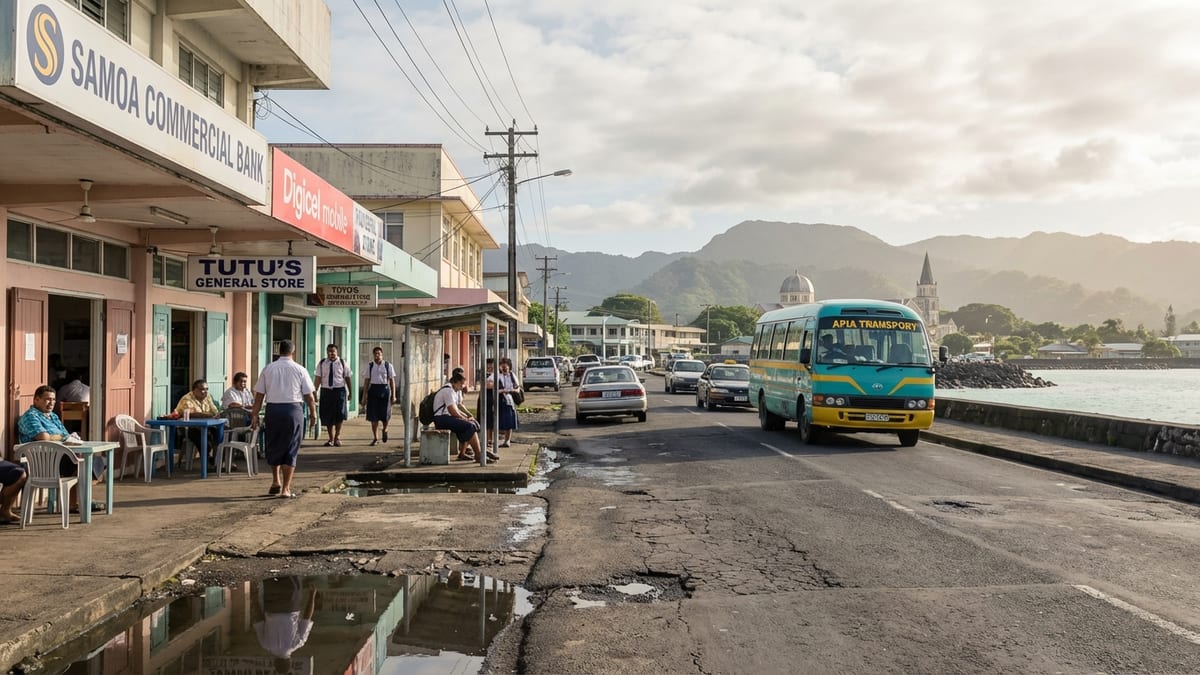
Apia, the compact capital of Samoa on the island of Upolu, is often treated as a brief staging post before visitors dash off to beach fales and waterfall swims. Yet this low-rise, harbourfront town offers more culture, food, and everyday island life than many travellers expect, as well as some very real challenges that matter if you are deciding whether it is worth a stop. From recent power disruptions to its slow-paced rhythm and modest nightlife, Apia is not a polished resort city. It is, however, the best place to understand modern Samoan life, and a surprisingly engaging base for exploring the island if you know what to expect.
First Impressions: What Apia Is Really Like
Apia is a small capital by global standards, with a population that hovers around 40,000 in the urban area. Sitting on a broad, shallow harbour on the north coast of Upolu, it is framed by green hills and the ridgeline of Mount Vaea. The town centre is walkable, a mix of government buildings, churches, markets, and low-key shops that spill out toward the waterfront. Traffic can be busy at peak hours, but there are no high-rises, and the pace of life is generally slow and sociable.
Unlike South Pacific hotspots dominated by resorts, Apia feels like a functional working town first and a tourist destination second. Most visitors will notice the cluster of banks, mobile phone shops, and hardware stores almost as quickly as they see the ocean views. This can be underwhelming if you arrive expecting instant postcard scenery, but it is also what gives Apia its authenticity. Sitting at a roadside café watching schoolchildren in uniform and office workers heading home in shared taxis offers a window into daily Samoan life that beach enclaves rarely provide.
The climate is tropical and humid year-round, with temperatures often in the high 70s to mid-80s Fahrenheit. There is plenty of sunshine, but also heavy showers, especially during the wet season from November to April. Streets can flood briefly, and the air turns thick after rain. For many visitors, these conditions, combined with limited shade in some areas, mean that sightseeing is best planned for early morning and late afternoon, with midday reserved for siestas, pools, or indoor museums.
On balance, your first impression of Apia will depend heavily on your expectations. If you are picturing a manicured South Pacific resort city, you may be disappointed. If you arrive looking for a lived-in town where island traditions coexist with government offices and school runs, Apia’s charm tends to grow on you by the day.
Safety, Practicalities, and the Recent Power Issues
For most travellers, Apia is a safe and relatively straightforward place to visit. The United States currently advises normal precautions for travel in Samoa, and serious crime against tourists in Apia remains uncommon by global city standards. Petty theft can occur, particularly around markets or late at night near bars, so standard urban common sense is appropriate: keep valuables out of sight, avoid walking alone in poorly lit areas, and use licensed taxis after dark.
One of the biggest recent practical concerns has been energy reliability. In early 2025, Samoa experienced a significant power crisis centred on Upolu, where Apia is located. Technical failures at a major power station and faults in a key transmission cable led to weeks of rolling outages, prompting a temporary state of emergency and disrupting everything from hospitals to small businesses. Many larger hotels and some restaurants operate generators as backup, but budget properties and smaller guesthouses were more vulnerable to blackouts that affected air-conditioning, refrigeration, and electronic payments.
By mid-2025, authorities moved to restore more stable supply, but the episode highlighted an underlying reality: infrastructure in Samoa can be fragile, and disruptions from technical failures or cyclones are part of life. Visitors considering Apia should be prepared for occasional service interruptions, especially during or after severe weather. Choosing accommodation with reliable backup power, confirming how they handle outages, and having some cash on hand rather than relying only on cards are practical steps that can make a stay more comfortable.
On the health front, Apia has the country’s main hospital and most of its clinics, which is reassuring for travellers with medical needs. Tap water quality may vary; many visitors prefer to drink bottled water or filtered hotel water. Mosquito-borne illnesses can occur in the region, so using repellent and sleeping in screened or air-conditioned rooms is advisable. As always, travel insurance that covers medical evacuation is prudent given Samoa’s isolation and limited specialist care.
Cultural Heart of Samoa: Why Apia Matters
Apia is not just the administrative capital; it is the cultural and political heart of Samoa. This is where the national parliament meets, where major church denominations maintain prominent cathedrals and headquarters, and where you will find the national museum and cultural village. If you want to understand fa’a Samoa, the Samoan way of life, Apia is the best single place to start.
One standout experience is a visit to a cultural village in the city centre, where local hosts demonstrate traditional practices such as umu (earth oven) cooking, siapo bark cloth making, carving, tattooing, and dance. These sessions are designed for visitors, but they are rooted in living traditions, not staged museum pieces. Watching or joining a siva dance, or observing the intricate pe’a and malu tattoo patterns being explained by a tufuga ta tatau (master tattooist), brings depth to things you might otherwise only glimpse on resort entertainment stages.
Religion plays an outsize role in Samoan public life, and nowhere is this more visible than in Apia’s skyline of spires and domes. The Immaculate Conception Cathedral near the waterfront, rebuilt and reopened in 2014 after damage from an earthquake, is one of the most striking buildings in town, its airy interior lined with polished timber and religious art. Nearby churches of Methodist, Congregational, and Latter-day Saint congregations are equally architecturally bold. Attending a Sunday service, if done respectfully and in modest dress, allows visitors to experience powerful choral singing and a sense of community that underpins Samoan society.
Apia is also the primary stage for Samoan arts and public events. Small galleries showcase local painting, woodcarving, and contemporary Pacific art, while performance spaces host everything from school cultural nights to regional music competitions. Many of these events occur sporadically rather than on a fixed tourist calendar, but simply being in town gives you a chance to stumble across a youth choir rehearsal or a school marching band passing by the harbour.
Top Sights In and Around the City
While Apia is more about atmosphere and everyday life than about a checklist of major monuments, it still offers a number of worthwhile sights that can easily fill two or three days. Within the town centre, the main produce and crafts market is a lively introduction to local foods and handicrafts. Here you will find heaps of taro, breadfruit, and tropical fruit, woven mats, tapa cloth, and the patterned lavalava wraps that many Samoans wear instead of trousers. A separate flea market near the waterfront is geared more toward souvenirs and clothing.
On the edge of town, Palolo Deep Marine Reserve provides some of the best accessible snorkelling near Apia. Just a short taxi or a longer walk from the main hotels, the reserve is reached via a simple beachside entrance where you pay a small fee. At high tide and in calm conditions, a short swim over shallow coral leads to a deeper blue hole with abundant reef fish and coral formations. The currents can be strong and conditions can deteriorate quickly in bad weather, so visitors should be confident swimmers and heed local advice on when to enter the water.
Above the city, Mount Vaea offers one of Apia’s most rewarding hikes. Trails through tropical forest lead up to the tomb of Scottish author Robert Louis Stevenson, who spent his final years in Samoa and is buried overlooking the harbour. The climb is steep and humid, but the views back over Apia and the sea, along with the sense of literary history, make it a highlight for many visitors. The route can be muddy after rain, so sturdy footwear and plenty of water are recommended.
Within a short drive of Apia, additional natural and cultural sites round out the city’s appeal. Piula Cave Pool, northeast along the coastal road, is a beautiful freshwater pool fed by an underground spring beneath a historic Methodist theological college. The clear, cool water offers a refreshing contrast to the warm sea, and small open-sided fales provide shade for picnics. To the south, the rainforests and crater lakes of Lake Lanoto’o National Park offer opportunities for guided hikes and birdwatching, with Apia serving as the logical base for arranging transport and permits.
Food, Nightlife, and the Rhythm of the City
Food is one of the best reasons to spend time in Apia. While resort restaurants around Upolu can be excellent, the capital gathers the widest range of options, from traditional Samoan plates to casual bakeries, Chinese eateries, and more polished international venues. The central produce market is a fine place to sample local snacks during the day, and roadside stalls selling barbecue plates and fried fish cluster along key junctions in the evening.
Traditional Samoan cuisine features root crops such as taro and breadfruit, paired with fresh fish, coconut cream, and leafy greens. Many Apia restaurants and hotel kitchens offer their own interpretations, sometimes alongside Western dishes aimed at travellers. Trying oka i’a, a marinated raw fish dish in coconut cream and citrus, or palusami, taro leaves baked with coconut, is effectively a rite of passage in Samoa. Portions tend to be generous, and mealtimes sociable.
Apia is not a major nightlife destination in the global sense, but it does have a modest evening scene. Several bars and hotel lounges host live bands on weekends, playing a mix of island ballads and covers of international hits. You will also find a scattering of sports bars where locals watch rugby and football, and a few late-opening spots that attract younger crowds. Dress codes are typically relaxed, though smart-casual clothing is appreciated in better hotel venues. Nightlife is compact and can feel quiet outside of Friday and Saturday, so expectations should be tempered if you are used to large-city energy.
The broader rhythm of the city is shaped by working hours, church life, and family commitments. Early mornings are active, with commuters, school drop-offs, and the buzz of the fish and produce markets. Afternoons can feel drowsy as heat builds and offices slow. Sundays in particular are very quiet, with many businesses closed, traffic light, and families gathered for church and the traditional to’ona’i lunch. For visitors, this slower pace can be either restful or frustrating, depending on temperament and plans, but it is central to Apia’s character.
Where Apia Falls Short: Downsides and Dealbreakers
Despite its charms, Apia is not for everyone. The most common disappointment among travellers is the lack of broad sandy beaches right in town. The waterfront is dominated by the harbour, seawalls, and small stretches of coral and rock, with the nearest swimmable beaches a short drive away. If your ideal Pacific holiday revolves around walking from your hotel straight onto a sweeping white-sand beach, staying in Apia itself may feel like a compromise.
The tropical climate, while appealing in photos, can be taxing in reality. Humidity is high, shade is not universal, and many streets lack wide pavements or trees. Walking between sights in the heat of the day can quickly become uncomfortable. Public transport within the city is limited to colourful, often crowded buses and taxis, and while these are inexpensive and part of the experience, they may not suit travellers hoping to rely entirely on walking or air-conditioned transit.
Infrastructure limitations extend beyond transport. The recent power crisis underscored how quickly everyday services can be disrupted by technical failures or storms. Internet speeds can be inconsistent, mobile coverage patchy in some pockets, and road quality variable once you leave the main arteries. Travellers who need fast, constant connectivity for remote work, or who are deeply uncomfortable with occasional outages or delays, may find Apia stressful rather than charming.
Finally, some visitors simply find that the city’s low-key nature gives them less to do than they expected. There are no major shopping malls, high-profile museums, or blockbuster attractions of the type found in larger capitals. Entertainment outside of food and occasional live music is limited. If you thrive on museums, theatre, and dense cultural programming, Apia alone will not sustain you for a long stay. It works best as part of a broader Upolu or multi-island itinerary rather than as a standalone city break.
Who Will Enjoy Apia Most?
Apia tends to delight travellers who are curious about culture and everyday life, patient with a slower rhythm, and happy to trade polish for authenticity. If your interests lean toward understanding how people live, worship, eat, and celebrate in Samoa, the capital is an invaluable base. You can spend mornings at museums or markets, take short excursions to nearby natural sites in the afternoon, and return to town in time for an evening meal and a stroll along the harbour.
It is also a suitable choice for independent travellers and couples who want a mix of comfort and local interaction. Mid-range and higher-end hotels provide air-conditioning, pools, and on-site restaurants, while still placing you within walking or short taxi distance of markets and cultural sites. For solo travellers, Apia’s compact scale and generally friendly atmosphere can feel reassuring, and the presence of embassies, banks, and medical facilities offers practical backup that you do not get in more remote beach areas.
Families can also benefit from basing in Apia at least part of the time, particularly those with younger children. Ready access to pharmacies, supermarkets, and medical care can be a comfort, and day trips to waterfalls, pools, and snorkelling sites can be tailored to energy levels. However, parents should be aware that sidewalks are inconsistent, traffic can be busy in parts of town, and child-focused attractions are limited compared with larger cities.
On the other hand, travellers seeking an exclusively beach-focused escape with minimal logistical friction may be happier staying primarily along Upolu’s south or east coasts or on neighbouring Savai’i, visiting Apia only briefly for shopping or transit. Likewise, digital nomads who rely on stable power and fast internet for work should carefully vet accommodations and perhaps view Apia as a short cultural sidestep rather than a long-term base.
The Takeaway
So, is Apia worth visiting? For many travellers, the answer is a qualified yes. The city does not offer endless white-sand beaches or a polished resort skyline, and it can at times be hot, humid, and affected by infrastructure strains such as power interruptions. Nightlife is modest, shopping is functional more than glamorous, and entertainment options are limited compared with larger capitals.
Yet Apia is also where Samoa’s story is most visible. It is where traditional tattooists and government ministers pass on the same pavements, where cathedral bells ring out over produce markets, and where you can wake to the sound of the harbour while planning a day that might include a museum visit, a hike to a literary grave, a cave pool swim, and a plate of oka at a family-run café. The city’s compact scale, walkable centre, and array of nearby natural sites make it a practical and rewarding base for a few days at the start or end of a Samoa trip.
If you arrive with realistic expectations, prepared for occasional inconveniences and a distinctly unhurried pace, Apia can be a memorable part of a wider Samoan journey. It is not the South Pacific fantasy in itself, but it is the gateway to that fantasy, and the place where the contemporary life of Samoa is most honestly on display.
FAQ
Q1: How many days should I spend in Apia?
Most travellers find that two to three full days in Apia is enough to see the main sights, enjoy the markets and cultural village, and take one or two nearby excursions. If you plan more in-depth hiking or multiple day trips around Upolu, using Apia as a base for four or five nights can also work well.
Q2: Is Apia safe to walk around at night?
Apia is generally safer than many larger cities, but it is still wise to take basic precautions. Walking in well-lit central areas in the early evening is common, but after dark it is better to use taxis, especially if you are alone, carrying valuables, or unfamiliar with the area. Avoid poorly lit side streets and be cautious near bars late at night.
Q3: Do I need a car to explore Apia and nearby attractions?
You can explore central Apia on foot and reach some nearby spots by taxi, but renting a car or arranging guided day tours makes it much easier to visit waterfalls, crater lakes, and coastal pools around Upolu. Buses are inexpensive and atmospheric but are not designed for tourists and can be slow and irregular for sightseeing.
Q4: What is the best time of year to visit Apia?
The drier, slightly cooler months from May to October are generally more comfortable, with lower humidity and less frequent heavy rain. The wet season from November to April can still be enjoyable but brings hotter conditions, more intense showers, and a higher risk of cyclones, which can disrupt travel plans and services.
Q5: Are there good beaches in Apia itself?
Apia’s immediate waterfront is mostly harbour, seawalls, and small stretches of coral or rock, so it is not a classic beach destination. For better swimming and sandy beaches, you will need to travel a short distance outside the city, either along the north coast or to more developed beach areas on other parts of Upolu and Savai’i.
Q6: How expensive is Apia compared with other Pacific capitals?
Apia is generally more affordable than some larger Pacific capitals, especially for local food, buses, and guesthouse-style accommodation. Imported goods, higher-end hotels, and certain activities can still be costly. Overall, costs are moderate, but visitors should budget for the island’s relative isolation, which affects the price of many goods.
Q7: Can I rely on Wi-Fi and mobile data in Apia?
Most hotels, cafés, and some restaurants in Apia offer Wi-Fi, and mobile data networks cover the city, but speeds and reliability can vary, especially during peak times or power disruptions. For basic browsing and messaging, connectivity is usually adequate, but travellers who require consistent, high-speed internet for work should plan for occasional slowdowns.
Q8: What should I wear in Apia to respect local customs?
Apia is relaxed, but Samoan society is conservative in dress, particularly away from resorts and beaches. Light, modest clothing that covers shoulders and knees is appropriate for town, markets, and certainly for churches. Swimwear should be reserved for beaches and pools, and a lavalava or long skirt can be useful for visits to villages and religious sites.
Q9: Is Apia a good base for exploring the rest of Upolu?
Yes. Apia is the main transport hub, with the largest concentration of accommodation, rental car agencies, tour operators, and services. Many popular sites, such as Piula Cave Pool, nearby waterfalls, and inland viewpoints, can be visited on day trips from the city, making it a convenient base if you prefer not to move hotels frequently.
Q10: How has the recent power crisis affected travel to Apia?
The power crisis in early 2025 caused notable disruptions, particularly for smaller businesses and budget accommodations without generators. While supply has since stabilized, the episode highlighted the potential for occasional outages linked to infrastructure or weather. Travellers should check recent conditions before departure, choose accommodation with backup power if possible, and be prepared for the possibility of short-term interruptions in electricity or internet.