

Lake Superior’s shoreline is dotted with dramatic headlands, quiet harbor towns, and protected parks that each claim a piece of North America’s largest freshwater lake. Yet one corner of the south shore stands out: Wisconsin’s Apostle Islands. When travelers weigh a Lake Superior getaway, they often compare these islands to other celebrated destinations such as Michigan’s Pictured Rocks and Isle Royale or Ontario’s Thunder Bay and Sleeping Giant. Understanding what truly sets the Apostle Islands apart helps you choose the Lake Superior experience that matches your sense of adventure, comfort, and remoteness.
The Apostle Islands in Context on Lake Superior
The Apostle Islands National Lakeshore protects 21 islands and a stretch of mainland shoreline off the Bayfield Peninsula in northern Wisconsin. From Bayfield, Madeline Island, and nearby small communities, visitors spread out across sandstone headlands, remote campsites, historic lighthouses, and long sand spits. While Lake Superior destinations all offer big water, wild weather, and powerful scenery, the Apostles blend accessible adventure with a surprising sense of wilderness.
Other Lake Superior hot spots tend to lean strongly in one direction. Pictured Rocks National Lakeshore in Michigan is known primarily for its vertical cliffscapes and boat tours along a relatively compact stretch of coast. Isle Royale National Park, an island archipelago in western Lake Superior, is celebrated as one of the most remote and least visited national parks in the contiguous United States, with all the logistical commitments that entails. Around Thunder Bay and Sleeping Giant Provincial Park on the Canadian shore, the focus is on high cliffs, hiking, and sweeping inland views rather than intricate archipelagos.
What makes the Apostle Islands distinct is how many of these qualities converge in a relatively small, navigable area. You get island-hopping, sandstone sea caves, long sand beaches, old-growth pockets of forest, and a working harbor town base, all without the multi-day ferry rides or international border crossings that other Lake Superior destinations may require. For many travelers they strike a sweet spot between wilderness and convenience.
Geography, Landscape, and Sea Caves
Geologically, the Apostle Islands share some DNA with Pictured Rocks and parts of the Canadian shore. All three are shaped by ancient sandstones carved by waves, ice, and wind. The Apostles, though, are defined by their archipelago form. Islands such as Sand, Devils, Oak, Stockton, Raspberry, and Outer Island punctuate the lake with sheltered bays and headlands. The complex island layout creates a constantly changing horizon for boaters and paddlers that is unique on Lake Superior’s south shore.
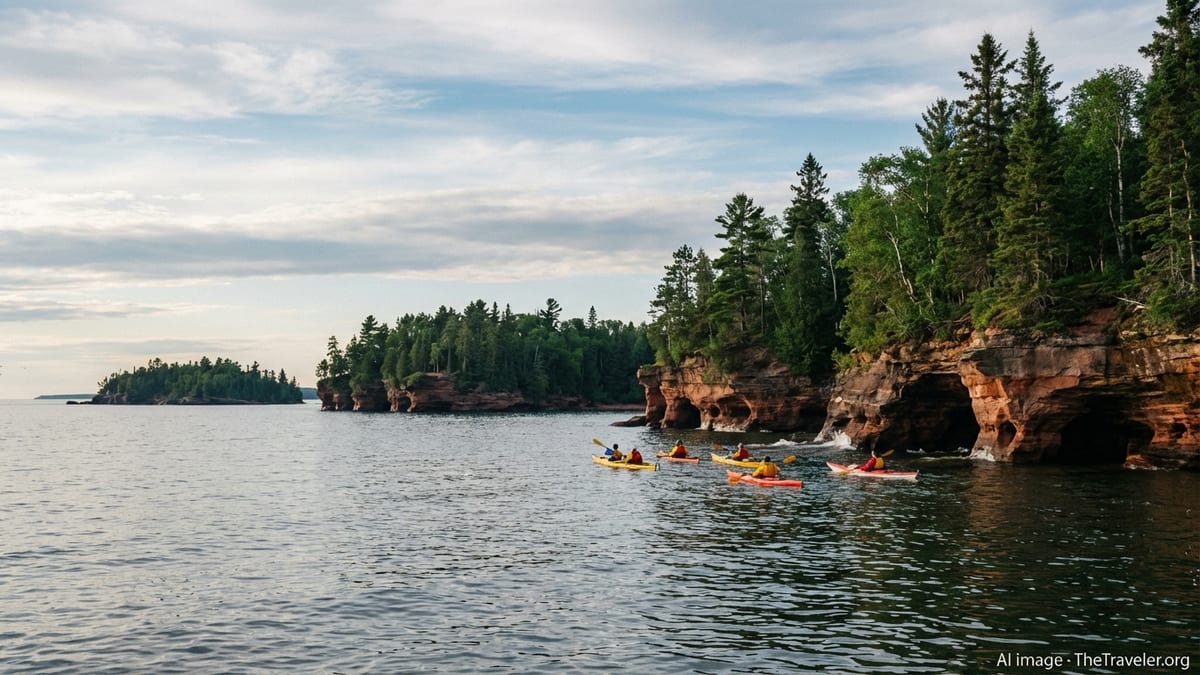
The star attraction for many visitors is the lake-carved sea caves. On the Apostle Islands mainland near Meyers Beach and along the shorelines of Sand, Devils, and other islands, waves have hollowed out arches, chambers, and tunnels in the reddish-brown sandstone. In summer, kayakers weave beneath overhanging ledges and through wave-polished corridors. Compared with Pictured Rocks, where the cliffs soar higher and color striations are more dramatic, the Apostle Islands caves tend to feel more intimate and three dimensional, with closer ceilings, echoing chambers, and narrower passages.
In winter, when conditions are safe, these same formations can transform into the famed ice caves, where frozen waterfalls and blue-tinted curtains of ice line the cliff faces. Access hinges on extended subfreezing weather and stable lake ice, and in recent decades that alignment has been rare. When conditions do line up, the experience of walking out over frozen Lake Superior to explore crystalline caverns is unlike anything else on the lake. Other destinations, including Pictured Rocks and the Canadian shore, see impressive ice formations, but the combination of broad lake ice, walk-in caves, and tall sandstone walls gives the Apostle Islands a singular winter identity.
Access, Logistics, and Seasonality
Compared with some of its Lake Superior counterparts, the Apostle Islands are notably approachable. Bayfield is reachable by road from Minneapolis, Duluth, and Chicago, and serves as the main jumping-off point. From there, regular ferries link the mainland to Madeline Island, while tour boats, private charters, water taxis, and personal craft fan out to the rest of the archipelago. For visitors who want an island escape without committing to a multi-day transit, this relative ease of access is a major advantage.
Isle Royale, by contrast, operates more like an expedition destination. The park is typically open from mid-April to late October and is otherwise closed for the winter. Reaching it requires a several-hour ferry ride, private boat, or seaplane. Once there, visitors find no car traffic, no road network, and limited services. That remoteness is central to Isle Royale’s appeal, but also a barrier for casual travelers or short trips. The Apostle Islands, meanwhile, balance a sense of separation with the reassurance of a mainland base town, drivable access, and day-trip options.
Seasonality also plays out differently across the lake. The main Apostle Islands season runs roughly from late spring through fall, when boat tours, paddling, and camping are all possible. Shoulder seasons can be rewarding but more weather dependent, with cold water and changeable winds lingering well into June and returning by September. In midsummer, the lake often moderates heat, creating pleasant daytime temperatures on the water and in the islands’ shaded forests. Winter visitation, when it happens, is concentrated along the mainland for cross-country skiing, snowshoeing, and occasional ice cave openings, rather than extended stays on the islands themselves.
On the Canadian north shore, including Sleeping Giant Provincial Park and the Thunder Bay region, access is also by road, but distances between trailheads, viewpoints, and small communities can be greater. This can feel more like an extended road trip along a rugged coastline. In contrast, the Apostle Islands experience is more hub and spoke: you settle into Bayfield or Madeline Island, then fan out by boat or paddlecraft to explore.
Recreation: Paddling, Boating, and Hiking
The Apostle Islands are widely regarded as one of the premier sea kayaking destinations in the Midwest. Protected channels between islands and the shelter of the Bayfield Peninsula provide windows of relatively calmer water, though conditions on Lake Superior can still become hazardous quickly. Guided tours concentrate on the mainland caves near Meyers Beach and the shoreline of Sand Island, where paddlers can slip through arches, around stacks, and into echoing grottoes when the waves cooperate.
Compared with Pictured Rocks, where much of the best scenery lines a single exposed cliff section and outfitters often run long linear routes, the Apostles offer more variety in routes and difficulty levels. Novice paddlers may start with short cave-focused outings on calmer days, while experienced kayakers can link multiple islands on overnight trips. Authorized water taxis that drop paddlers and their camping gear on distant shorelines make it possible to reach more remote islands without committing to long open-water crossings entirely under one’s own power.
Boaters also find the archipelago structure compelling. Harbors, anchorages, and sand spits on islands such as Stockton, Oak, and Julian Bay on Stockton Island offer quiet moorings with hiking trails and beaches just steps from shore. In contrast, boaters at Pictured Rocks primarily cruise along a continuous mainland shoreline, and those exploring the Thunder Bay area often focus on shipwreck viewing or harbor-to-harbor hops along a less island-dense coast. The Apostle Islands feel almost built for small-boat wandering, with each island presenting a slightly different combination of coves, cliffs, and forested interiors.
On land, the hiking network in the Apostle Islands is more modest than at destinations like Isle Royale or Sleeping Giant, both known for long-distance routes and dramatic vertical relief. Trails on islands such as Stockton, Oak, and Sand explore boreal forest, bogs, and interior lakes, as well as lighthouse sites and sand spits. The mainland Lakeshore Trail above the sea caves offers cliff-edge vantages and a chance to hear waves booming into the caverns below. While you will not find multi-day ridge traverses with large elevation gains, the combination of shoreline walking and gentle interior routes suits travelers who want day hikes bracketed by time on the water.
Cultural History, Lighthouses, and Working Waterfronts
Human history plays a subtle but significant role in what distinguishes the Apostle Islands. Long before national lakeshore designation, Indigenous communities navigated these waters, and later waves of European and American settlers logged, quarried, and fished in and around the islands. Many of the islands carry the layered evidence of this activity: overgrown homesteads, abandoned quarries, and historic docks gradually reclaimed by moss and forest.
Perhaps the most visually striking legacy is the chain of historic lighthouses that dot the archipelago. Structures on Raspberry, Sand, Outer, Michigan, Devils, and other islands once guided ore boats and freighters through a maze of shoals and channels. Today, several of these lighthouses are among the most concentrated collections of historic beacons in any U.S. national park unit. Visitation often involves short hikes through spruce and fir to reach towers perched on rocky points, where views open across the lake and neighboring islands.
Other Lake Superior destinations showcase maritime heritage too, from the freighter traffic visible off Pictured Rocks to the lighthouse-lined approaches to Thunder Bay and the harbors of Duluth and Two Harbors. What is distinctive in the Apostles is how closely cultural history is woven into the island-hopping experience itself. You might paddle beneath a sandstone arch in the morning, moor in a former fish camp harbor for lunch, then wander past a lighthouse keeper’s residence in the afternoon.
Back on the mainland, Bayfield retains the feel of a working harbor town that has adapted to tourism without losing its maritime roots. Commercial fishing, charter boats, and ferries share the waterfront with sailboats and sea kayaks. Compared with the more highway-oriented access points to Pictured Rocks or the modest service nodes used for Isle Royale ferries, Bayfield’s compact, walkable character makes it easy to transition from dinner on shore to a sunset cruise or evening stroll along the docks.
Comparing Atmosphere: Remoteness, Crowds, and Comfort
Lake Superior destinations tend to be defined as much by their mood as by their scenery. On this front the Apostle Islands occupy a middle ground between the solitude of Isle Royale and the busier corridors of mainland parks and towns. On a sunny July afternoon, tour boats may be busy, and Bayfield’s streets can feel lively, yet a short boat ride can still deliver you to a quiet cove where the only sounds are loons and waves on cobblestones.
Isle Royale delivers a more consistently remote experience. Once you arrive, there are no passenger cars, no towns, and a much smaller daily visitor count spread across a long island and hundreds of smaller islets. Backpackers, long-distance paddlers, and those comfortable with minimal services gravitate there precisely for the sense of isolation. The Apostle Islands, on the other hand, welcome a broader mix of travelers: families on half-day boat trips, day paddlers, car campers on Madeline Island, and seasoned kayakers bound for outer islands. The result is a range of atmospheres, from social marinas to nearly empty beaches.
Comfort levels and amenities differ as well. In the Apostles, many visitors choose to stay in lodging in Bayfield or on Madeline Island and treat the national lakeshore itself as a day-use or overnight backcountry destination. This allows for restaurant meals, hot showers, and easy re-supply between outings. Pictured Rocks similarly offers nearby towns such as Munising and Grand Marais, but the focus there skew more toward scenic cruises and roadside overlooks than multi-island exploration. On the Canadian side, visitors often base themselves in Thunder Bay, a regional hub that feels more urban than any town on the U.S. south shore.
Weather adds another layer to atmosphere. All of Lake Superior is prone to fast-changing conditions, cold water, and sudden wind shifts. The Apostles’ many islands can provide partial shelter and short crossing options, but they can also channel waves and create complex currents. Travelers who appreciate this dynamic, moody character of the lake often find the Apostles particularly engaging, as the same route can feel utterly different from one day to the next.
Wildlife and Natural Quiet
Wildlife is another arena where the Apostle Islands draw quiet comparisons with other Lake Superior destinations. Isle Royale is perhaps the most famous for its wolf and moose populations, and for ongoing ecological research that has followed predator-prey relationships there for decades. Visitors to Isle Royale often frame their trip around chances of seeing moose or hearing wolves, though sightings are never guaranteed and much of the action plays out far from human eyes.
The Apostle Islands do not have the same marquee megafauna, but they do host a rich mix of boreal and northern hardwood species. White-tailed deer, black bears, foxes, and a variety of smaller mammals move between islands and the mainland. Birdlife is especially noticeable in migration seasons, when warblers, raptors, and shorebirds pass through, and during nesting periods for species such as bald eagles and cormorants. The juxtaposition of forest, wetland, and rocky shore across so many separate islands concentrates habitat variety in a relatively tight area.
Natural quiet is, for many travelers, just as important as wildlife sightings. In the Apostles, you can still find long stretches of shoreline where the dominant sounds are wind in the trees and the steady surge of small waves. Even near popular sea cave zones, early morning or late evening visits can feel surprisingly peaceful. In comparison, some roadside viewpoints at Pictured Rocks or heavily trafficked lookouts along the Canadian Trans-Canada Highway can feel busier simply because they are easier to reach by car.
At the same time, the Apostles’ proximity to a mainland town means you rarely feel as completely cut off as you might on Isle Royale, where no quick return to a harbor town is possible once the day’s boats depart. For many travelers, that balance between accessible quiet and not being entirely isolated is precisely what they seek in a first-time Lake Superior island trip.
Planning Your Trip: Choosing the Right Lake Superior Destination
When travelers compare the Apostle Islands with other Lake Superior destinations, they are often really asking which mix of scenery, remoteness, and logistics best suits their style. The Apostles excel for people who want to combine time on the water with the comfort of a mainland base. You can spend one day on a guided kayak tour of the sea caves, another on a lighthouse-themed cruise, and a third relaxing on Madeline Island’s beaches, all while returning each night to a bed in town or a nearby campsite.
If your priority is backcountry immersion with minimal infrastructure, Isle Royale may hold stronger appeal. Multi-day backpacking routes, interior lakes, and the near-total absence of vehicles create an experience closer to a northern wilderness expedition. Those drawn to high cliffs and roadside-accessible drama often gravitate toward Pictured Rocks or the north shore of Lake Superior in Minnesota and Ontario, where scenic turnouts, short hikes, and day cruises deliver big views without complicated logistics.
The Apostle Islands’ particular strengths show up when you look at how flexible a trip can be. Weather turns rough on the open lake? You might shift from a long crossing to island-hopping close to shore, or from paddling to hiking the mainland Lakeshore Trail above the caves. Traveling with a mixed-ability group? Some can join a short, guided cave paddle while others opt for a narrated boat tour or time at a harbor-side café. Few other Lake Superior destinations offer that blend of serious adventure potential and easy fallback options.
Whichever destination you choose, it is important to approach Lake Superior with respect. Water temperatures stay cold through much of the year, wave conditions change quickly, and distances that look modest on a map can feel very different in a small boat in building seas. The Apostle Islands may feel more approachable than a remote national park in the middle of the lake, but the same principles of preparation, weather awareness, and conservative decision making apply.
The Takeaway
Across Lake Superior, each major destination has its own character. Pictured Rocks offers towering, painted cliffs front and center. Isle Royale promises deep solitude and extended backcountry travel. The Canadian north shore adds broad, mountainous headlands and long-distance driving vistas. The Apostle Islands bring something more intricate to the table: a maze of forested islands, sculpted sandstone caves, historic lighthouses, and sheltered coves that are all within reach of a small harbor town and a drivable peninsula.
If you imagine your ideal Lake Superior trip as a blend of exploration and comfort, the Apostle Islands often rise to the top. You can chase sunrise light on sea caves, wander through a lighthouse complex before lunch, and share a meal in Bayfield in the evening. As conditions and your confidence evolve, so can your itinerary, from short day trips to extended paddling and camping journeys among the outer islands.
In the end, what makes the Apostle Islands unique is not a single superlative, but the way they weave together the lake’s defining themes: powerful geology, living maritime culture, changing seasons, and the feeling of being just far enough from shore. For many travelers, it is the place where Lake Superior feels both most alive and most inviting.
FAQ
Q1. Are the Apostle Islands a good first-time Lake Superior destination?
Yes, the Apostle Islands work well for first-time visitors because they combine dramatic scenery with relatively easy access via Bayfield, tour boats, and guided paddle trips.
Q2. How do the Apostle Islands compare with Pictured Rocks National Lakeshore?
Pictured Rocks focuses on a single stretch of tall, colorful cliffs, while the Apostle Islands offer a full archipelago of islands, sea caves, sand spits, and lighthouses to explore.
Q3. Is Isle Royale more remote than the Apostle Islands?
Yes. Isle Royale requires several hours by ferry or a seaplane and has no road network, making it significantly more remote and committing than the Apostle Islands.
Q4. Do I need sea kayaking experience to visit the Apostle Islands?
Experience helps, but is not required. Novices can join guided tours that choose routes and distances suited to conditions and skill levels, or opt for scenic boat cruises instead.
Q5. When is the best season to visit the Apostle Islands?
Most visitors aim for late spring through early fall, with July and August offering the most reliable warm weather and the widest range of tours and services.
Q6. Can I see ice caves at the Apostle Islands every winter?
No. The mainland ice caves only open when lake ice and weather conditions meet strict safety thresholds, which has happened rarely in recent decades.
Q7. Are there lighthouses to visit in the Apostle Islands?
Yes. Several historic lighthouses on islands like Raspberry, Sand, and Devils can be visited on certain tours or reached by private boat, offering classic Lake Superior views.
Q8. How do the Apostle Islands differ from Lake Superior’s Canadian north shore?
The Canadian north shore emphasizes long, rugged coastlines and high headlands, while the Apostle Islands focus on a compact archipelago ideal for island-hopping by boat or kayak.
Q9. Is camping available in the Apostle Islands?
Yes. Designated campsites and backcountry zones are scattered across several islands, reachable by private boat, water taxi, or kayak, with permits required for overnight stays.
Q10. Do I need a passport to visit the Apostle Islands?
No. The Apostle Islands lie entirely in U.S. waters off Wisconsin, so U.S. citizens do not need a passport unless their broader trip includes crossing into Canada.