

More news on this day
Thousands of travelers have been left stranded at airports across the United States in early April 2026, as a surge of spring storms collides with record Easter demand and a tightly stretched airline system, triggering cascading delays and cancellations at major hubs from Chicago and Dallas to New York, Atlanta and Los Angeles.
Get the latest news straight to your inbox!
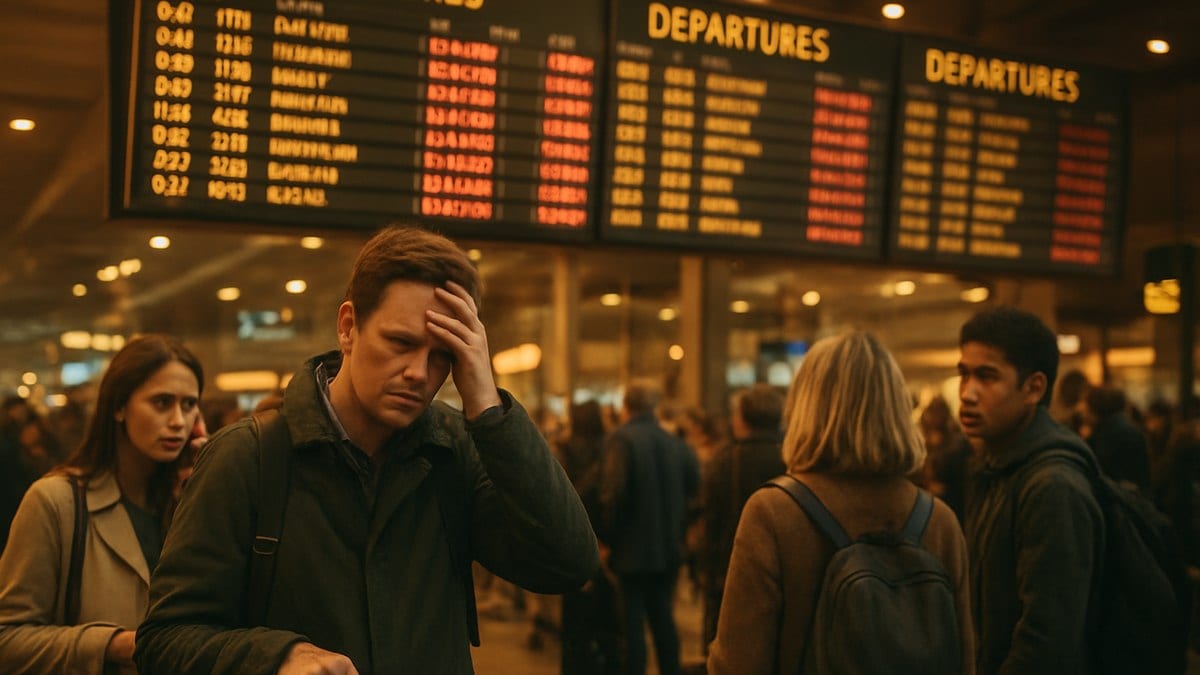
Storms, Holiday Crowds and a Fragile Network Collide
Publicly available flight tracking data and travel-industry coverage indicate that the disruption wave began building at the end of March and intensified over the Easter weekend, when severe thunderstorms, strong winds and pockets of late-season snow reduced capacity at already busy hubs. Reports from aviation data providers show that on peak days between April 2 and April 5, more than 15,000 flights were delayed across North America, with several thousand cancellations added to the tally over the same period.
Published coverage highlights Chicago O’Hare, Dallas Fort Worth, Atlanta, New York area airports and Houston among the hardest-hit U.S. hubs, with ground stops, lightning alerts and low-visibility conditions forcing airlines to slow or suspend operations for hours at a time. When the weather briefly improved, returning aircraft and crews were often out of position, limiting the ability of airlines to quickly restore normal schedules.
Travel outlets report that the timing has compounded the impact. The Easter holiday rush in 2026 brought one of the heaviest spring travel surges in recent years, as leisure travelers, students and family visitors converged on the system just as storms swept across the Midwest, Northeast and parts of the South. With load factors already high, even modest schedule cuts left few empty seats available for rebooking, stranding thousands in terminals overnight.
Analysts note that the turbulence comes after a winter marked by multiple major storms and an already tight operational environment. Airlines entered the Easter period with limited spare capacity, and some carriers were still repositioning aircraft and staff after earlier weather and geopolitical disruptions, increasing the risk that local problems would cascade into nationwide chaos.
By the Numbers: Thousands Stranded in Successive Wave
Daily disruption snapshots published by travel news outlets and flight data aggregators paint a picture of sustained stress across the network. On March 31, national data cited by industry-focused coverage showed more than 3,100 delays and over 100 cancellations across the United States, a level that already left many passengers struggling to make connections as storms moved through the central states.
The pressure escalated into April. On April 1, Chicago O’Hare emerged as a flashpoint, with more than 1,200 delays and over 100 cancellations tied to thunderstorms over the region, according to specialized travel reporting that draws on Federal Aviation Administration advisories and tracking sites. Those interruptions rippled along routes to and from Toronto, Detroit and a string of Midwestern and cross-border cities, stranding travelers well beyond Chicago itself.
Additional tallies compiled by travel trade publications show that April 5 brought a new crest in the disruption wave, with one national round-up attributing 398 cancellations and more than 3,200 delays in a single day to severe weather and congestion at major hubs including Dallas, Chicago, Detroit, Phoenix and El Paso. Separate coverage focusing on the same weekend reported at least 109 cancellations and more than 700 delays at key hubs in New York, Georgia, California and Texas, underscoring how multiple carriers and regions were affected simultaneously.
By April 7, fresh data cited by travel-industry outlets indicated that U.S. airports were still experiencing thousands of delays and hundreds of cancellations in a single day, with major cities such as Atlanta, New York, Boston, Chicago, Los Angeles, Seattle, Houston and Orlando all appearing prominently in disruption summaries. The cumulative effect across a week of rolling problems has been to leave large numbers of passengers stranded far from their intended destinations, with some facing multiple days of rebookings and missed onward connections.
Major Hubs Under Strain From Cascading Disruptions
The pattern of disruption across early April 2026 highlights the central role of a handful of hubs in the U.S. aviation network and how quickly problems at one airport can spread. Reporting from aviation and travel outlets emphasizes that airports such as Chicago O’Hare, Dallas Fort Worth, Hartsfield Jackson Atlanta and the New York metro fields act as critical junctions for nationwide traffic, making them particularly vulnerable during holiday surges and severe weather.
At O’Hare, thunderstorms and associated ground delays in the first days of April affected regional carriers and major network airlines alike. Travel reports indicate that carriers such as Envoy, SkyWest, United Airlines, Republic and others faced large numbers of delayed and canceled flights, which in turn disrupted smaller markets connected through Chicago. Passengers on routes to secondary cities in the Midwest and Ontario found themselves stuck in long lines at customer service desks as the knock-on effects spread.
In the South and Southwest, publicly available disruption summaries point to Dallas Fort Worth and Phoenix as key pressure points. Heavy rain, low clouds and a high volume of connecting traffic contributed to extended delays and waves of cancellations, constraining flights on major domestic corridors as well as some cross-border services. The result has been crowded gate areas and departure halls not only in those hubs but also in downstream cities that depend on them for feed and onward connections.
The East Coast has also not been spared. Air travel tracking and media coverage describe sizable disruption at New York’s LaGuardia and Newark, as well as at Boston and Washington-area airports over the same period, with storms and congestion affecting both short-haul shuttles and longer domestic legs. As flights backed up, aircraft and crews became increasingly misaligned with scheduled rotations, diminishing the capacity of airlines to absorb additional shocks.
Systemic Vulnerabilities and a Worrying Start to Spring
Beyond the immediate inconvenience for travelers, early analyses from transport observers and industry commentators suggest that the April 2026 chaos is symptomatic of deeper vulnerabilities in the U.S. air travel system. Recent government and academic reviews have described a network that behaves like a tightly coupled system, in which aircraft, crews, gates and airspace capacity are used very close to their limits under normal conditions.
When severe weather or airspace restrictions appear at a major hub during a peak demand period, that tight coupling can trigger cascading delays across large parts of the network. Research on hub-and-spoke air traffic structures has highlighted how even localized disruptions can scale rapidly when there is little slack, creating long, unpredictable tails of operational problems that persist for days rather than hours.
Travel-industry coverage of the Easter period notes that several factors have compounded the challenge in 2026, including continuing staffing constraints in some operational roles, high aircraft utilization rates and complex banked schedules at competitive hubs. While airlines have added capacity to meet strong demand, many have done so by stretching existing fleets and crews, limiting their ability to recover quickly once large disruption events begin.
Observers also point to the broader context of an increasingly volatile climate, with recent winters and springs bringing repeated extreme-weather episodes that repeatedly test the resilience of airline operations. The early April storm wave followed on the heels of major blizzards and severe weather systems earlier in the year, meaning carriers and airports were already operating in a heightened state of alert with fewer easy fixes available.
What Travelers Are Facing on the Ground
For passengers, the systemic story translates into long waits, crowded concourses and uncertain itineraries. Reports from consumer travel outlets and social media monitoring describe departure halls packed with travelers sleeping in chairs or on improvised bedding, while food outlets and restrooms struggle to keep up with demand during extended overnight disruptions.
Published advice from airlines and airport operators emphasizes the importance of real-time monitoring and flexibility. Travelers are being urged in public communications to track their flights through carrier apps, to check airport departure boards frequently and to consider accepting earlier rebooking options, even on inconvenient routings, rather than waiting for ideal nonstop alternatives that may not materialize.
Travel and insurance commentators note that the early April disruptions are likely to generate a wave of compensation and claim inquiries, particularly for passengers who incurred significant out-of-pocket costs for accommodation and alternative transport. Policies and airline conditions of carriage vary, but observers recommend that travelers retain receipts and documentation in case they are eligible for reimbursement under contract terms or trip protection coverage.
With storms still active in parts of the country and schedules heavily loaded by spring demand, aviation analysts caution that U.S. hubs could remain vulnerable to further disruption through the rest of April. For now, publicly available information suggests that thousands of passengers are still in the process of being re-accommodated, as airlines and airports work to unwind one of the most challenging early-spring travel periods in recent memory.