

More news on this day
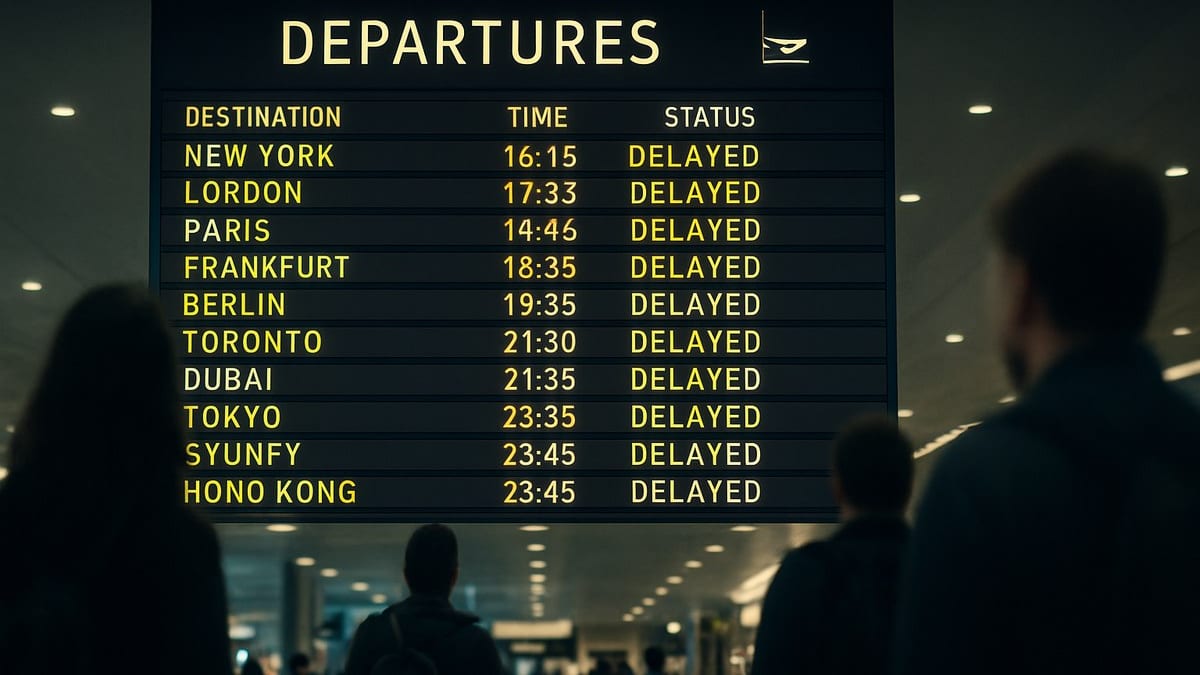
Air travel across seven countries faced fresh turbulence this April as 311 flight delays and 29 cancellations were recorded in a single day, highlighting how weather, operational bottlenecks, and geopolitical tension are converging to strain already fragile aviation networks.
Get the latest news straight to your inbox!
Seven Countries, One Day of Widespread Disruption
Recent tracking data and industry reporting indicate that the latest wave of disruption centered on Canada, the United States, China, Germany, Bahrain, Qatar, and Russia, where airports collectively logged 311 delayed flights alongside 29 cancellations. The figures, compiled from airport operations updates and aviation analytics platforms, point to a sharp spike in irregular operations concentrated in a single April day.
Canada’s busiest hubs, including Toronto and Vancouver, were among the first to see schedules unravel as delays accumulated through the morning and into the evening. Publicly available information shows that congestion at departure gates, long wait times at security, and aircraft held on taxiways combined to push many services outside their scheduled departure windows.
In the United States, ripple effects were felt on transborder and transcontinental routes linking Canadian cities with major American hubs. Data from flight-tracking dashboards show multiple rotations between Canada and the U.S. operating behind schedule, compounding congestion at already busy terminals.
Conditions in Asia and Europe proved no less challenging. Reports indicate that large airports in China and Germany dealt with knock-on delays tied to earlier weather issues, air traffic control constraints, and network congestion. In the Gulf region, operations in Bahrain and Qatar, already sensitive to evolving security dynamics and regional airspace changes, added further pressure to long-haul connections between Europe and Asia.
Weather, Staffing and Airspace Constraints Combine
While no single cause fully explains the 311 delays across the seven nations, aviation data and published coverage point to a familiar combination of triggers. Fast-changing spring weather continues to disrupt takeoff and landing slots in North America and Europe, with thunderstorms, low visibility, and high winds forcing air traffic managers to slow arrival and departure rates.
At the same time, airlines and airports in several of the affected countries are still working through the lingering effects of crew shortages and tight staffing in ground operations. Industry analysis published in recent months has highlighted how even modest schedule expansions can overwhelm baggage handling, check-in, and aircraft turnaround capacity when staffing levels remain below pre-pandemic norms.
Airspace structure and geopolitical tension are also shaping delay patterns. In the Gulf and parts of Eastern Europe, route adjustments and diversions around sensitive or restricted airspace are increasing flight times and tightening aircraft rotations. According to recent travel and aviation coverage, these extended routings can leave little margin for recovery when earlier flights run late or when weather disrupts a critical hub.
The result is a complex web of dependencies in which a handful of early disruptions can quickly propagate across continents. In this latest April episode, that dynamic translated into delayed departures and arrivals that stretched across multiple time zones and operational days, with aircraft and crews ending up out of position for subsequent services.
Passenger Experience: Longer Queues and Limited Options
For travelers caught in the middle of the April disruptions, the operational statistics translated into long queues, missed connections, and limited rebooking options. Reports from passenger rights organizations and travel advisories describe crowded terminals in Canadian and U.S. hubs, where some travelers faced multi-hour waits for updated itineraries or hotel arrangements.
In China and Germany, publicly available information indicates that passengers navigating complex long-haul journeys were particularly exposed. Tight connection windows through major transfer airports left little buffer once delays mounted, forcing some travelers to be rebooked onto next-day departures or alternate routings through different regions.
In the Gulf states of Bahrain and Qatar, where airports function as critical links between Europe, Asia, and Africa, even relatively small timing shifts created a cascade of missed onward flights. Travel-industry reporting notes that rerouting options were constrained by already high April load factors, leaving limited spare capacity to absorb displaced passengers.
Russia’s inclusion in the disruption pattern further complicated itinerary planning. With some international carriers already operating modified or reduced schedules involving Russian airspace or airports, additional delays and cancellations reduced flexibility for travelers attempting to navigate multi-leg journeys across Eurasia.
April Fits a Broader 2026 Pattern of Volatility
The latest incident of 311 delays is not an isolated aberration but part of a broader pattern of aviation volatility observed since the start of 2026. Industry dashboards and travel media have tracked multiple days this year in which thousands of flights worldwide were delayed or canceled, often concentrated around severe weather systems, regional conflicts, or infrastructure outages.
Recent analysis has drawn a connection between rising global passenger volumes and the limited resilience of current aviation infrastructure. Reports from airline and airport groups highlight how runway capacity, air traffic control systems, and terminal facilities have struggled to scale in step with recovering demand, especially during holiday peaks and seasonal surges.
Events in early April have reinforced these concerns. Separate disruptions in the Asia Pacific region and the Middle East earlier in the month demonstrated how problems in one geographic corridor can rapidly spread, with delayed aircraft and diverted routes leading to congested skies and backlogged ground operations on other continents.
For the seven nations affected in this latest episode, the timing of the disruption within a busy spring travel window magnified its visibility. Carriers are attempting to rebuild schedules and restore confidence ahead of the Northern Hemisphere summer, a period that traditionally brings some of the heaviest global traffic and highest expectations for reliability.
Calls for Greater Resilience and Clearer Communication
The recurring nature of these disruptions is prompting fresh scrutiny of how airlines, airports, and regulators manage capacity and communicate with passengers. Consumer advocacy groups and travel analysts have been emphasizing the importance of timely, transparent updates when large numbers of flights are delayed or canceled.
According to recent public guidance from passenger rights organizations, travelers are encouraged to monitor multiple information channels, including airline apps and airport departure boards, as schedules can change rapidly during cascading disruption events. Guidance also stresses the value of understanding refund and rebooking policies in advance, particularly for journeys involving several carriers or interline connections.
Industry commentary suggests that investments in digital tools, real-time data sharing, and contingency planning will be central to reducing the impact of future events of this scale. Some major hubs are experimenting with collaborative decision-making platforms that allow airlines, air traffic control, and ground handlers to align their responses more quickly when bad weather or airspace constraints emerge.
For now, the 311 delays and 29 cancellations recorded across Canada, the United States, China, Germany, Bahrain, Qatar, and Russia offer another case study in how tightly coupled the global aviation system has become. As April continues and the summer season approaches, the capacity of that system to absorb shocks without leaving passengers stranded will remain a central test for the industry.