

More news on this day
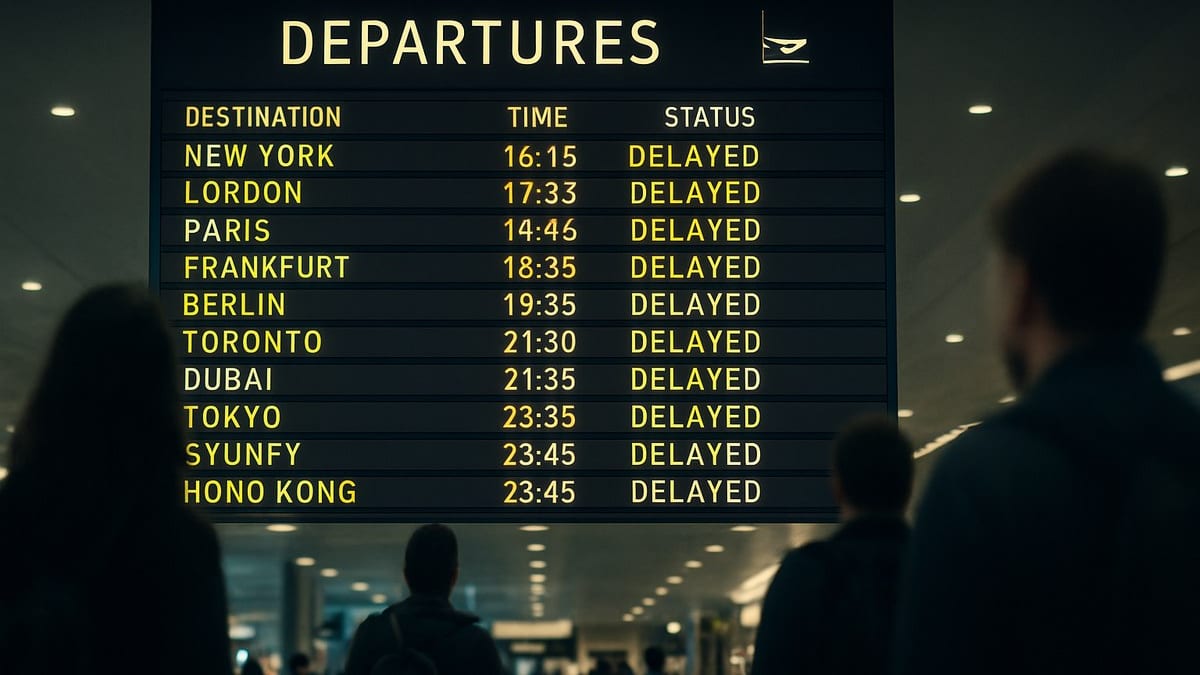
Air travelers across seven countries faced another difficult weekend on April 12, 2026, as a fresh wave of disruptions triggered 311 flight delays and nearly 30 cancellations, underscoring how weather, fuel costs and geopolitical tensions continue to collide in the global aviation system.
Get the latest news straight to your inbox!
Seven-Nation Disruptions Highlight a Sprawling Network Shock
Published coverage and flight tracking data indicate that the latest disruption was most visible in Canada, the United States, China, Germany, Bahrain, Qatar and Russia, where delays and cancellations rippled across major hubs on April 12. Airports in these markets collectively recorded 311 delayed departures and 29 cancellations within a compressed time frame, affecting thousands of travelers on both domestic and long haul routes.
Reports describe crowded terminals, extended waits at rebooking counters and rolling gate changes as airlines worked to resequence aircraft and crew. Passengers in several of the affected countries experienced missed connections and overnight stays, particularly at large transfer hubs that feed transcontinental and transpacific networks.
The pattern builds on elevated disruption earlier in the month, rather than a single isolated event. Analysts tracking operations note that these seven countries form key segments of the transatlantic, transpacific and Eurasian corridors, so simultaneous delays in each market quickly compound into wider schedule instability.
Operational data shared in recent travel-industry coverage suggest that while cancellations remained relatively limited compared with total scheduled flights, the volume of delayed services was large enough to distort aircraft rotations and crew rosters that were already under pressure.
Weather, Fuel Costs and Airspace Limits Combine
The April 12 wave of disruption did not stem from a single storm or technical failure. Instead, multiple strands that have been building since late February converged. Meteorological reports point to late-season winter systems over parts of North America, with snow and low visibility contributing to ground stops and deicing delays at some Canadian and U.S. airports.
At the same time, a global jet fuel crunch that intensified in March has pushed airlines to trim marginal frequencies and adjust schedules. Industry analysis shows that carriers have already cancelled more than a thousand flights in April in response to higher fuel prices, while introducing surcharges and fare increases on many long haul routes. These structural cuts reduce the flexibility airlines normally use to recover from day-of-operations shocks.
Geopolitical tensions and related airspace restrictions have further complicated long haul planning. Continued closures and advisories over parts of the Middle East have lengthened Europe to Asia and Asia to North America flight times, tying up aircraft and crews for longer rotations. Some services that previously operated on tight turnarounds now require additional buffers or technical stops, leaving less slack in daily schedules when disruptions occur elsewhere.
Risk briefings circulated to corporate travel managers in recent weeks describe a “multi-factor disruption environment” in which weather, fuel availability and airspace constraints interact, rather than acting as independent, short-lived events.
North American and European Hubs Under Sustained Pressure
Within North America, the April 12 disruptions followed a series of difficult days at major hubs. Coverage from earlier in the month detailed widespread delays at airports such as Chicago Midway, LaGuardia, Los Angeles and Detroit, driven by a mix of thunderstorms, congestion and late inbound aircraft. The latest wave extended that pattern into Canada, where large international gateways handled a disproportionate share of the 311 recorded delays.
Operational reports suggest that when several U.S. and Canadian hubs experience challenging conditions at the same time, cascading effects can quickly appear across secondary airports. Late evening departures are especially vulnerable, as incoming aircraft arrive behind schedule and duty-time limits constrain crew availability for subsequent legs.
In Europe, recent days have brought their own stressors. Aviation and travel outlets have highlighted elevated disruption at key airports including London Heathrow, Amsterdam and Oslo during the first full week of April, with hundreds of delays and dozens of cancellations reported in a single day across the continent. Industrial action affecting air traffic management in parts of southern Europe has added another layer of uncertainty for transatlantic passengers connecting onward within the region.
Although the April 12 numbers for Europe are lower than earlier in the week, the interconnected nature of airline networks means that late departures in Germany and neighboring countries still added to the global tally of delayed operations, particularly on routes feeding North America and Asia.
Middle East and Asia Connections Amplify Global Impact
The presence of Bahrain and Qatar on the list of seven affected countries reflects how disruptions in the Gulf region continue to reverberate across global itineraries. Both markets serve as critical connectors between Asia, Europe and Africa, and published data show that airports there have already been managing elevated delay levels in recent weeks as airlines reroute around sensitive airspace and contend with fuel logistics.
Travel industry briefings note that Gulf hubs have been operating under sustained pressure since late February, with some long haul services suspended, others detoured and many operating with extended block times. Even modest additional delays in this context can lead to missed onward connections for passengers traveling between Asia, Europe and North America.
China’s inclusion among the seven disrupted nations also carries outsized implications, as its major coastal airports anchor dense regional and intercontinental networks. Storm systems, air traffic flow measures or minor technical incidents at these facilities can quickly affect departure banks for flights to North America and Europe, particularly when aircraft are already operating on longer routes that avoid restricted corridors.
Publicly available operational analyses emphasize that the April pattern is less about isolated hotspots and more about overlapping constraints in multiple time zones. When Gulf, Chinese, European and North American hubs all face some form of disruption, recovery rooms in airline schedules shrink dramatically.
What Travelers Can Expect Through the Remainder of April
While the April 12 figures of 311 delays and 29 cancellations capture only a single day, aviation analysts caution that the underlying drivers are unlikely to resolve quickly. Energy market forecasts suggest that jet fuel prices will remain elevated in the near term, and airspace advisories tied to regional tensions show little sign of being fully lifted in the coming weeks.
Network planners interviewed in recent industry reports describe a focus on preserving core routes while trimming less profitable frequencies and introducing longer scheduled block times on affected long haul services. That approach may reduce the risk of outright cancellations but can still translate into chronically late arrivals and tighter connection windows, particularly during peak travel periods.
For individual travelers, recent guidance from airlines and travel advisers centers on building additional time into itineraries, favoring morning departures where possible and monitoring flight status closely in the 24 hours before departure. Multi-stop journeys that rely on Gulf or European hubs may require extra caution, given the combination of fuel constraints, airspace detours and localized weather or staffing issues.
As April progresses, the picture that emerges is of an aviation system adapting to a more volatile operating environment. The disruptions recorded across seven nations on April 12 illustrate how quickly localized challenges in one part of the world can echo across continents when aircraft, crews and critical airspace are all in high demand and short supply.