

More news on this day
Early April 2026 is emerging as one of the most turbulent stretches of the year for U.S. air travel, as a combination of severe weather, new operational constraints, and already stretched airline networks triggers widespread delays and cancellations centered on Boston Logan International Airport and several major hubs.
Get the latest news straight to your inbox!
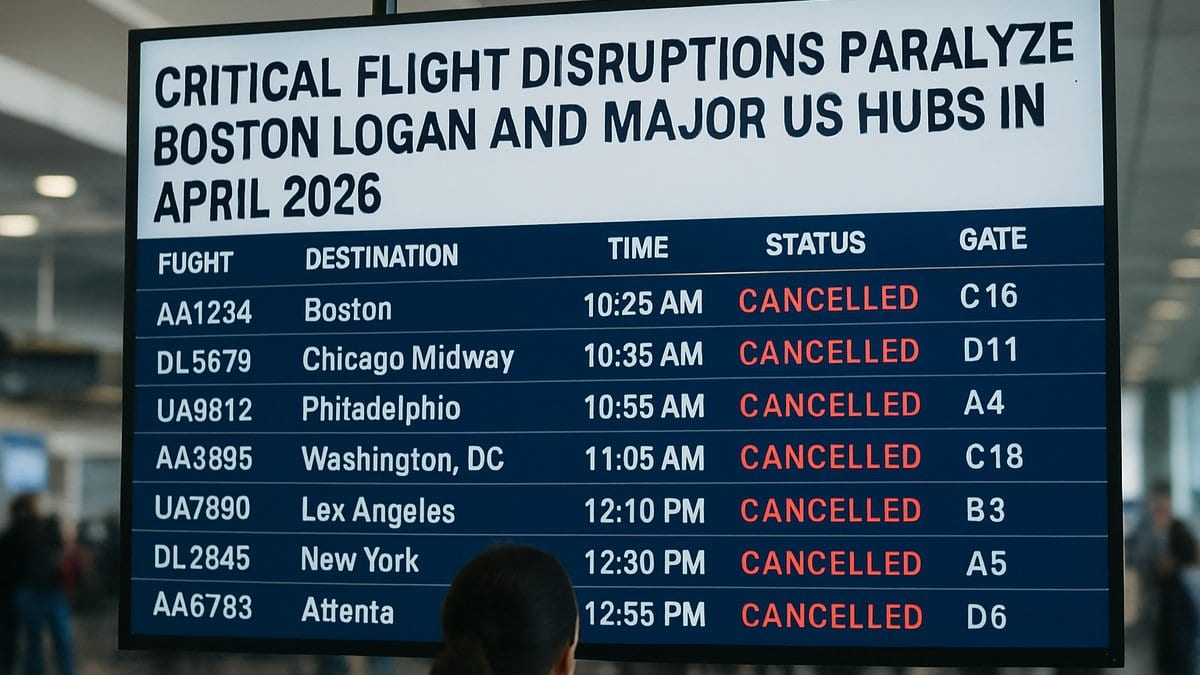
Boston Logan Confronts Another Round of Severe Disruptions
Boston Logan has entered April with passengers still reeling from a punishing winter in New England and a series of recent systemwide disruptions across the national aviation grid. Publicly available data from flight tracking and weather services indicates that stormy conditions along the Northeast corridor, coupled with ongoing congestion in the national airspace system, have produced a new wave of schedule instability for departures and arrivals in Boston.
The airport has already endured multiple weather shocks in 2026, including January and March winter storms that produced heavy snow, high winds, and power outages across Massachusetts. Earlier events forced dozens to hundreds of cancellations in Boston on peak days, setting a difficult backdrop for an early spring schedule ramp-up and leaving airlines with little room to absorb further disruption.
As airlines add back seats from Boston for the spring and summer travel seasons, even modest ground delay programs or temporary flow restrictions can translate into visible queues at gates and on taxiways. Reports from traveler forums and aviation tracking platforms suggest that some departures in early April have faced rolling delays as carriers try to reposition aircraft and crews that were displaced by weather earlier in the week.
Ground transport links that funnel travelers into Logan, including transit connections and highway corridors, have also felt the secondary effects of the disruption. Traffic congestion, shifting departure times, and rebooked itineraries have contributed to crowded terminals and unpredictable peak periods throughout the day.
Storm Systems and FAA Flow Controls Ripple Across Major Hubs
The challenges in Boston are unfolding alongside a broader pattern of early April instability across major U.S. hubs. Published coverage of national operations shows that severe thunderstorms, strong winds, and heavy rain have repeatedly slowed traffic through Chicago O’Hare, New York LaGuardia, Atlanta, and other key connecting airports in the days leading into April.
On some days, aggregated delay statistics show several thousand flights running late across the United States, with hundreds more canceled outright as airlines trim schedules to cope with adverse conditions. These clusters of disruption have been closely tied to weather outbreaks in the Midwest and along the East Coast, where convective storms and low visibility force the Federal Aviation Administration to meter departures and arrivals through ground delay programs and occasional ground stops.
Because Boston is tightly linked to these hubs through dense networks of connecting flights, problems that start in Chicago, New York, or Atlanta can quickly cascade into New England. Aircraft scheduled to operate Boston routes may be held at origin airports, crews can reach federal duty-time limits, and inbound congestion can force short-notice schedule adjustments even when local weather in Massachusetts appears relatively benign.
Operational data points to a familiar pattern: when one or two large hubs fall behind schedule, airlines struggle to reset the system before the end of the operating day. That leaves Boston-bound passengers vulnerable to rolling cancellations, last-minute gate changes, and missed connections that spill over into the next morning’s departures.
New Constraints at San Francisco Highlight Network Fragility
While Boston grapples with its own pressures, new operating constraints at San Francisco International Airport are amplifying concerns about nationwide reliability. Recent coverage of FAA actions and local infrastructure projects indicates that arrivals into San Francisco are being curtailed due to runway construction and a change in federal rules governing closely spaced parallel landings.
San Francisco is a major hub for transcontinental travel, including multiple daily flights to and from Boston and other East Coast cities. With arrivals per hour reduced and one runway dedicated primarily to taxi operations during construction, schedule planners expect a higher share of flights to experience delays, particularly during peak bank times when long-haul and short-haul operations intersect.
Industry analyses suggest that these constraints may increase the likelihood that flights into San Francisco depart late from origin airports in the East and Midwest, including Logan. If departures from Boston are held to avoid excessive airborne holding over California, that can create further congestion on Boston’s own ramp and push back subsequent flights using the same aircraft.
Travel experts note that this type of structural bottleneck illustrates how fragile the U.S. hub-and-spoke system can be. A localized capacity reduction on the West Coast can reverberate through the network, contributing to the kind of multi-hub disruption pattern that early April travelers are now encountering.
Airlines, Passengers, and Regulators Adjust to a Volatile Spring
For airlines, the early April disruption wave is unfolding just as carriers attempt to capitalize on strong spring demand from Boston and other large markets. Some airline schedule updates had planned increased capacity from Logan this month, including added frequencies and seasonal routes, anticipating robust leisure and business travel. The latest operational headaches are forcing network planners to weigh the benefits of aggressive scheduling against the growing risk of systemic delays.
Industry commentary points to several contributing factors beyond weather and infrastructure. These include tight staffing at some regional carriers, a limited pool of spare aircraft to recover from mechanical issues, and the persistent complexity of coordinating ground handling, security, and air traffic control resources across dozens of busy airports on the same day.
Passengers, meanwhile, are being urged by consumer advocates and travel publications to build more buffer time into connections, monitor flight status closely, and brace for same-day changes when moving through known pinch points. Early April stories from major hubs describe travelers sleeping in terminals, scrambling to rebook onto later departures, and shifting itineraries away from the most heavily affected airports when possible.
Regulators and airport operators are also in the spotlight as the disruption pattern evolves. Federal modernization programs aimed at improving airspace efficiency and weather integration remain in progress, and recent rulemaking activity highlights an effort to refine how ground delay programs and other traffic management tools are deployed. At the same time, airports such as Boston Logan are pursuing infrastructure and ground access projects intended to ease congestion, although those improvements may take several years to fully materialize.
What April Travelers Through Boston Logan Should Expect Next
With the month only just underway, April travelers passing through Boston Logan and other major hubs should prepare for conditions that can change rapidly from one day to the next. Forecast models suggest that additional rounds of unsettled weather are possible across both the Northeast and key Midwestern hubs, any of which could trigger new waves of disruption if they coincide with peak travel periods.
Publicly available historical data on delay causes indicates that Boston is particularly susceptible to weather-related disruptions in transitional seasons, when strong frontal systems and coastal storms intersect with already busy schedules. That pattern appears to be repeating in 2026, but with the added complication of infrastructure constraints at distant hubs and a tightly stretched airline workforce.
For travelers who must connect through multiple hubs, early morning departures from Boston may offer slightly better odds of leaving on time, before the cumulative effects of national delays build throughout the day. Same-day changes, schedule thinning by airlines, and proactive use of travel waivers are likely to remain common tools for managing the impact of storms and traffic-management initiatives.
As April progresses, aviation observers will be watching Boston Logan and its partner hubs for signs that carriers are successfully stabilizing operations, or whether further severe-weather outbreaks and capacity constraints deepen the disruption. For now, the message to travelers is clear: build in extra time, stay flexible, and expect that conditions in Boston may be shaped as much by events in distant cities as by the skies over Logan itself.