

More news on this day
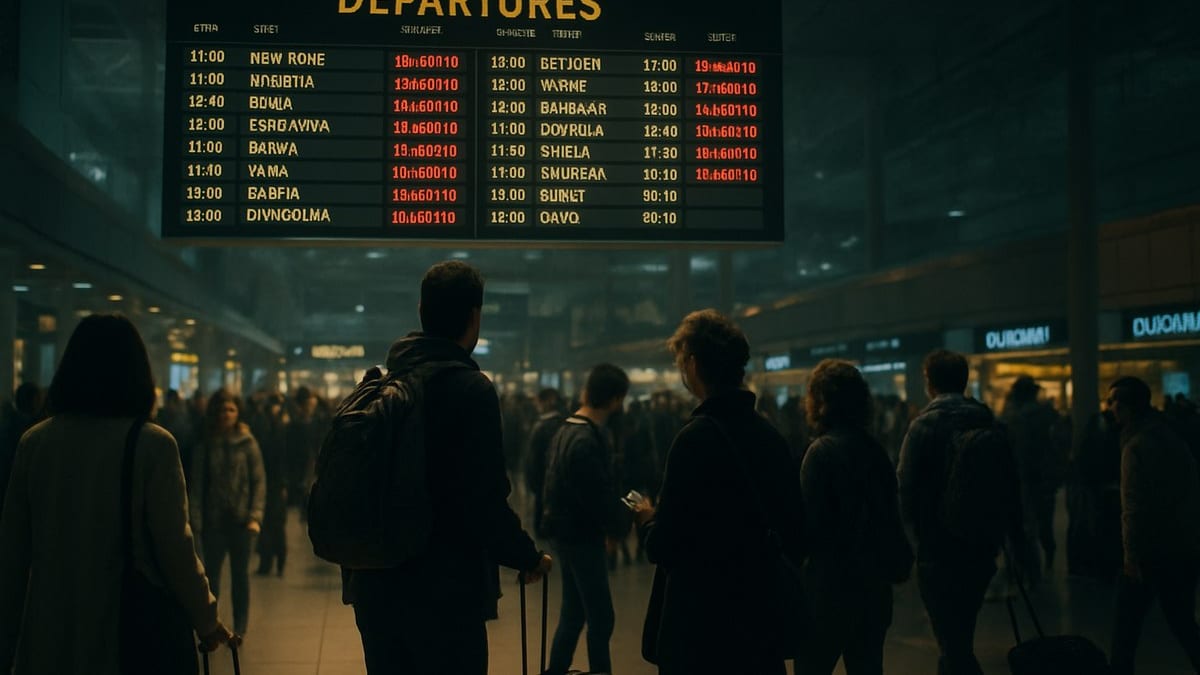
Early April has brought a new wave of air travel disruption across Asia Pacific, with publicly available flight tracking data indicating more than 3,000 delays and at least 150 cancellations concentrated at key regional hubs within just a few days.
Get the latest news straight to your inbox!
Storm Systems and Technical Failures Converge on Major Gateways
A series of intense storm systems across East and Southeast Asia has collided with local technical issues to produce widespread irregular operations. Coverage from regional travel outlets on April 5 describes thunderstorms, fog and low visibility slowing movements at major airports in China, Japan, South Korea, India and Singapore, triggering thousands of delays across the network as aircraft and crew rotations fell out of sequence.
Shanghai Pudong has emerged as one of the flashpoints. Recent reports focusing on activity there indicate that a line of thunderstorms combined with an air traffic control outage forced departures to halt for more than six hours on April 5. The backlog rippled onto later banks of flights, with carriers facing the choice between rolling delays deep into the night or canceling departures that could no longer be staffed within duty-time limits.
Further south, congestion at hubs in Bangkok, Kuala Lumpur and Jakarta has been compounded by localized incidents and infrastructure strain. Industry-focused coverage has highlighted how even small-scale events, such as facilities issues at terminals or temporary runway constraints, can sharply reduce handling capacity when traffic is already near peak levels for the season.
Across the region, operational data published this week point to a pattern in which weather disruptions and system failures at a handful of primary gateways quickly propagate across secondary airports. Connections through Manila, Delhi and key Gulf and Middle Eastern nodes have all been affected as Asia Pacific carriers attempt to realign long-haul and regional schedules.
Changi, Hong Kong, Seoul and Tokyo Feel the Knock-on Effects
Singapore Changi, Hong Kong International, Seoul Incheon and the Tokyo airports have all recorded elevated disruption in the opening days of April, according to publicly available flight-status boards and aviation tracking services. While these hubs have generally avoided prolonged closures, they sit at the center of dense route networks that magnify any upstream disturbance.
Published analyses of April 5 to 7 traffic patterns show that Changi handled a high volume of delayed arrivals from China and South Asia, resulting in tighter turnarounds and pushback holds, even as same-day cancellations remained relatively modest compared with some Chinese gateways. Hong Kong and Incheon, by contrast, experienced sharper spikes in both delays and cancellations, reflecting their role as interchange points for routes skirting restricted Middle Eastern airspace.
Tokyo’s Haneda and Narita airports have not seen the same headline-grabbing shutdowns, but they have absorbed disruption through late-running services from Southeast Asia and Australia. Industry coverage notes that when long-haul aircraft arrive hours behind schedule, departure waves for transpacific and regional flights must be resequenced, straining gate availability and crew rosters.
The result is a patchwork of irregular operations in which a traveler departing from a seemingly unaffected airport can still encounter rolling delays because the incoming aircraft operated a previous leg from a storm-affected hub. That dynamic has been especially visible on routes linking Japan and South Korea with Southeast Asian leisure destinations.
Australian Hubs Add to Regional Pressure
In the southern arc of the Asia Pacific system, Australian gateways are contributing to the overall turbulence. Coverage from regional broadcasters on April 6 points to nearly 30 cancellations and close to 200 delays in a single day across Sydney, Melbourne and Brisbane, affecting both domestic and international sectors.
Data referenced in those reports show that national and regional carriers have been forced to adjust schedules repeatedly as they contend with earlier delays feeding into already busy holiday-period operations. Aircraft that arrived late from Asia or the Pacific islands left crews close to duty limits, prompting further cancellations when recovery flights could not be staffed within regulatory constraints.
These Australian disruptions have had a measurable impact on Asia-bound traffic because many itineraries from North America and the South Pacific connect through Sydney or Melbourne before continuing to Singapore, Bangkok, Hong Kong or Tokyo. When flights out of Australia depart late or are consolidated, misconnected passengers and missed slots cascade into the northern hubs, adding to the more than 3,000 delays already recorded across the wider region.
Industry commentators cited in recent coverage argue that the pattern illustrates how tightly coupled the Asia Pacific aviation network has become. A string of moderate operational issues in Australia can now contribute to schedule instability thousands of kilometers away within a matter of hours.
Structural Fragility: Tight Schedules and Geopolitical Rerouting
Beyond immediate weather and technical problems, analysts tracking April’s disruptions point to structural weaknesses in the current operating environment. Airline schedules across Asia Pacific have been rebuilt aggressively to capture resurgent demand, leaving limited slack in aircraft rotations or crew planning. Publicly available commentary from aviation specialists notes that this approach maximizes revenue but reduces resilience when multiple disruptions hit at once.
Ongoing geopolitical tensions in the Middle East are further complicating matters. Since February, airspace restrictions and security concerns have forced many airlines to route around affected zones, extending flight times between Asia and Europe or Africa. Travel advisories and operational summaries indicate that these longer routings reduce daily utilization of long-haul aircraft, leaving fewer spare frames available when weather or technical issues arise back in Asia.
As carriers attempt to maintain planned frequencies under these constraints, they have little choice but to compress ground times and depend on tight turnarounds. April’s tally of more than 3,000 delays and 150 cancellations across Asia Pacific hubs underscores how quickly that model can unravel once a major airport experiences a multi-hour closure or a significant systems failure.
The situation is exacerbated by capacity limits at several flagship airports. Expansion projects at hubs across Thailand, Indonesia and the Philippines have progressed unevenly, and passenger volumes are now approaching or exceeding pre-pandemic levels. When terminals and runways are near saturation, every weather hold or technical stoppage displaces a larger number of flights.
What Travelers Can Expect for the Rest of April
With storm seasons active in parts of East and Southeast Asia and airspace restrictions continuing along some long-haul corridors, aviation forecasters quoted in recent trade coverage suggest that irregular operations are likely to persist through the remainder of April. The combination of weather volatility, infrastructure strain and rerouted traffic leaves little margin for a quick normalization of schedules.
Publicly accessible flight-tracking dashboards already show elevated delay rates for services touching Shanghai, Hong Kong, Seoul, Singapore, Bangkok and Sydney, and booking platforms indicate that some carriers have begun trimming frequencies on select routes to regain control of rotations. These pre-emptive cancellations are intended to prevent more chaotic last-minute changes, but they contribute to the headline count of more than 150 flights scrubbed across the region in the opening stretch of the month.
Travel industry advisories encourage passengers with April itineraries through Asia Pacific hubs to build in longer connection times and monitor schedules closely in the 24 to 48 hours before departure. Historical data from the first third of the month show that early-morning disruptions can take the entire operating day to unwind, particularly on multi-leg routings that rely on precise sequencing of aircraft and crew.
For now, the emerging picture across Asia Pacific is of a system running at near full capacity, where any shock can trigger a disproportionate level of disruption. The first weeks of April, with more than 3,000 delays and 150 cancellations spread across key hubs, illustrate how exposed the region’s air travel network remains to a mix of weather, technical and geopolitical stress.