

More news on this day
Travelers moving through Washington Dulles International Airport this April are facing a choppy start to the spring travel season, as thunderstorms and regional air traffic control constraints drive repeated waves of delays and cancellations across the Washington region.
Get the latest news straight to your inbox!
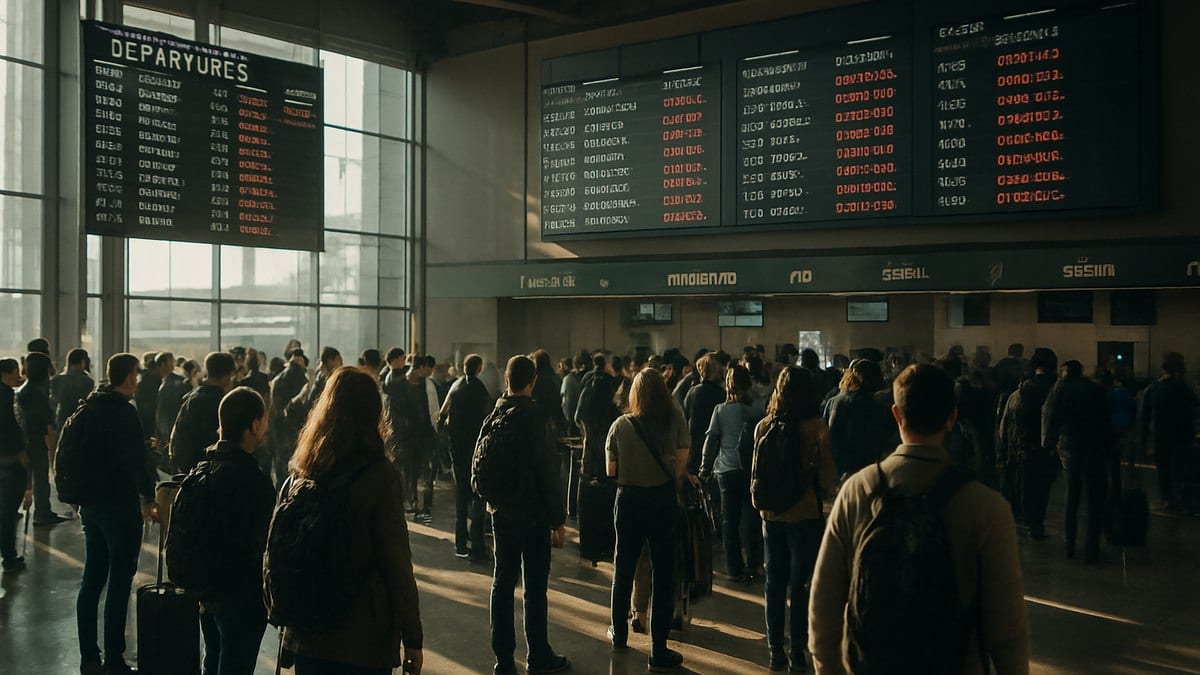
Thunderstorms Trigger Ground Stops Across Washington Airports
Strong thunderstorms sweeping across the Mid Atlantic on April 1 and April 2 have been a central driver of the latest disruption pattern at Washington Dulles International Airport, with regional reports describing late day ground stops and sharply reduced arrival rates across the Washington airspace. Publicly available flight tracking data shows that Dulles, Ronald Reagan Washington National and Baltimore Washington International all experienced spikes in delays as storm cells moved through during the busy afternoon and evening period.
Accounts of the April storms indicate that the Federal Aviation Administration responded by slowing or briefly halting inbound traffic, while also limiting departures from airports feeding into the Washington area. When those restrictions are imposed during peak travel hours, schedules can unwind quickly, leaving aircraft out of position and passengers stranded far from their intended connections. At Dulles, that translated into longer taxi times, aircraft waiting on ramps for release slots and a pattern of rolling delays that extended into subsequent days as airlines worked to reposition fleets and crews.
Consumer rights services focused on air travel report that many of the most affected flights linked Dulles with other major hubs, including in the Northeast and Midwest, where storm activity and congested airspace compounded local weather impacts. Because the immediate trigger was convective weather, analysts note that compensation under many regulatory frameworks is limited, even when individual delays run well past three hours and some departures are ultimately canceled.
The early April storms arrive on the heels of an already volatile late winter for U.S. aviation, marked by a significant March blizzard, multiple severe weather outbreaks and renewed strain on key coastal corridors. That broader backdrop has left limited slack in the system for Dulles and other Washington area airports, increasing the likelihood that even short-lived ground holds this month can ripple outward and affect flights days later.
Potomac TRACON Disruption Adds to April Headaches
Complicating the weather story is a separate disruption tied to the Potomac Terminal Radar Approach Control facility, the Federal Aviation Administration center in Warrenton, Virginia, that manages much of the approach and departure traffic for Washington Dulles and neighboring airports. Public notices and local accounts from late March describe an incident at the facility that prompted a temporary reduction in traffic volumes, with departures held at gates and arriving aircraft placed into extended ground or airborne delays.
Reductions in capacity at Potomac TRACON have an outsized impact on Dulles because the airport depends heavily on precise management of a complex arrival and departure flow that includes long haul international flights, domestic hub connections and regional jet traffic. When the facility cannot operate at normal levels, traffic managers restrict the number of flights that can enter the airspace at any given time, leading to departure metering at origin airports and extended waits on taxiways at Dulles.
Information shared by airlines with passengers during the late March event pointed to a temporary air traffic control facility issue in the Washington area that required limiting both arrivals and departures to maintain safety margins. While the specific cause of the interruption has not been fully detailed in public documents, the operational effect was clear in delay statistics and passenger experiences, with some flights held for several hours and knock on impacts stretching into the following morning.
Because the TRACON disruption occurred close in time to the early April thunderstorm pattern, travelers heading through Dulles this month have in some cases experienced a one two effect, where lingering schedule imbalances from the air traffic control issue collided with fresh weather driven constraints. Industry observers note that such combinations tend to magnify disruption, as airlines have fewer ready reserves of aircraft and crew to deploy when new problems arise.
National Delay Picture Shows Dulles as Part of a Wider Spring Squeeze
Aggregated tracking of cancellations and delays across the United States in early April places the Dulles disruptions within a broader national pattern. A recent analysis published by TheTraveler.org highlighted roughly 460 cancellations and about 5,500 delays over just a few days as storms and staffing gaps converged on major hubs. Washington area airports were among a cluster of large gateways reporting elevated disruption during this period, alongside cities such as Chicago, Boston, Atlanta and San Francisco.
Weather related slowdowns in one region can quickly cascade through the U.S. network, and Dulles is particularly sensitive to such ripple effects because of its role as an international and transcontinental hub. When storms in other parts of the country force airlines to alter routes or hold departures, flights headed into or out of Dulles can be delayed even in the absence of local weather problems. The April pattern has featured both local thunderstorms and upstream disruptions, multiplying the challenge for itinerary planning.
Travel industry coverage also points to lingering side effects from the intense March winter weather systems that battered portions of the Midwest and Northeast. Those storms prompted temporary airfield closures, large scale cancellations and a backlog of maintenance and crew repositioning that spilled into April schedules. For a hub like Dulles, which relies on coordinated timing across dozens of inbound and outbound banks, those residual effects can result in uneven daily performance, with relatively smooth mornings followed by increasingly delayed afternoon and evening operations.
Analysts following system wide performance suggest that spring 2026 may again test the resilience of U.S. aviation, with climate driven volatility in storm patterns intersecting with continuing operational constraints at both airlines and federal facilities. In that context, the recent difficulties at Dulles are seen less as an isolated episode and more as an early indicator of another challenging warm weather season for travelers.
Construction and Capacity Constraints Shape the Passenger Experience
Beyond acute weather and air traffic control issues, underlying capacity factors at Washington Dulles are influencing how severely disruptions are felt on the ground. A first quarter 2026 airport construction outlook from the Federal Aviation Administration identifies Dulles among the large U.S. airports with ongoing infrastructure projects, underscoring that gate availability, taxiway work and terminal upgrades can constrain flexibility during peak traffic windows.
When a storm system or regional facility problem forces flights to arrive in compressed waves instead of smoothly over time, limited gate space can translate into aircraft waiting on aprons for parking positions to open. Passengers on those flights may perceive the delay as occurring after landing, but in practice the constraint is linked to longer term capacity planning and construction phasing. April’s disruption pattern at Dulles has featured multiple reports of aircraft spending extended periods waiting for gates or for ramp congestion to clear.
At the same time, the airport is positioning for expanded long haul service later in the spring, with the Metropolitan Washington Airports Authority promoting new and restored nonstop routes that are scheduled to ramp up after the current wave of weather and operational issues. That growth trajectory underscores the tension between near term inconvenience and long term connectivity gains, a tradeoff that has become common across growing North American hubs.
For travelers, the combination of construction, expansion and irregular operations can translate into crowded hold rooms, shuffled gate assignments and tight turnaround times when flights do depart on schedule. Industry guidance for navigating Dulles during this period emphasizes early arrival, active monitoring of gate and time changes and a willingness to adjust plans when cascading delays make original connections unrealistic.
What April Travelers Through Dulles Can Expect Now
With the month still unfolding, publicly available forecasts and operational advisories suggest that passengers using Washington Dulles in the coming days should be prepared for continued pockets of disruption, especially during late afternoon and evening periods when convective storms are most likely and traffic volumes peak. The risk is not uniform across all days, but recent patterns indicate that even short weather events can cause outsized scheduling challenges when layered onto an already strained network.
Travel coverage focused on spring 2026 delays advises passengers connecting through major hubs like Dulles to build additional buffer into itineraries, favor longer connection times when booking and consider earlier departures where possible to reduce exposure to late day knock on effects. Using airline mobile applications alongside independent flight tracking tools is recommended to keep up with shifting departure times, gate changes and aircraft swaps as airlines attempt to recover from irregular operations.
Passenger accounts from the first week of April at Dulles describe a mix of experiences, from near normal flows in the early morning to multi hour disruptions later in the day as thunderstorms and residual air traffic control constraints took hold. That variability means that some travelers may pass through the airport with minimal disruption while others, often on the same day, encounter significant delays. For those with critical connections or long haul onward flights, conservative planning remains the safest approach.
As airlines and federal agencies work through the immediate aftermath of the recent storms and facility issues, observers will be watching closely to see whether operational reliability improves heading into late April and early summer. For now, Washington Dulles stands as a case study in how intersecting weather, infrastructure and airspace management challenges can converge to create a difficult environment for both carriers and passengers at one of the country’s key international gateways.