

More news on this day
Spring travel across the United States is colliding with stressed aviation, rail and telecom systems this April, creating a fresh test for travelers trying to predict where the next disruption will appear.
Get the latest news straight to your inbox!
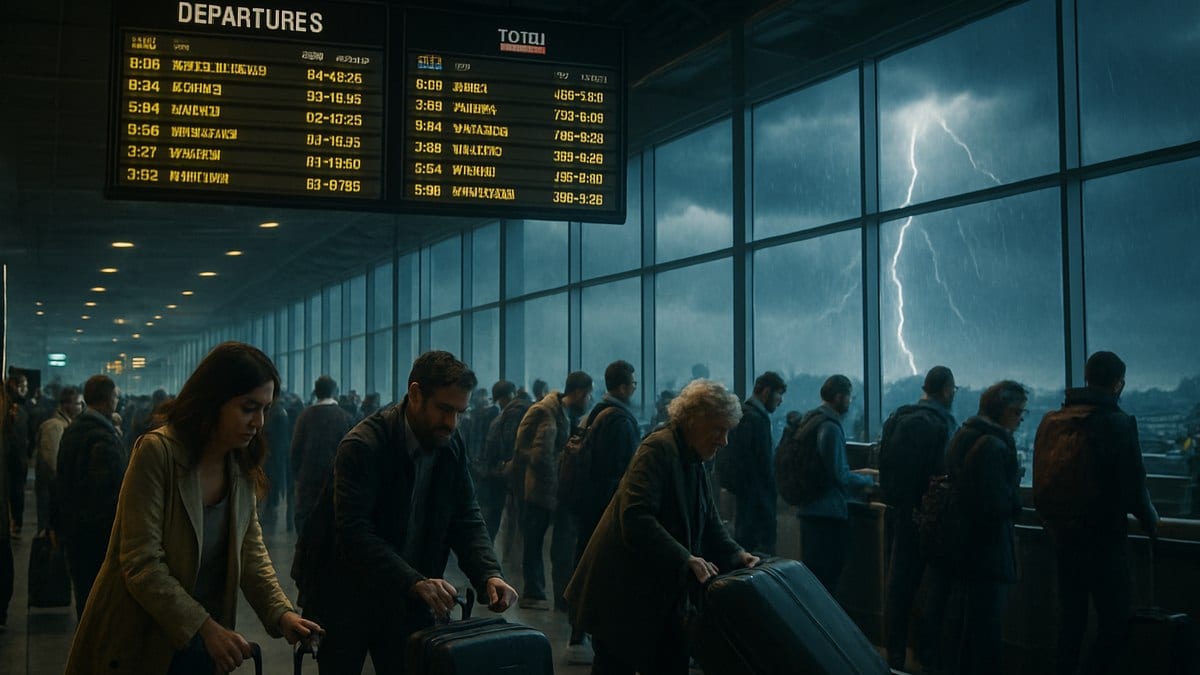
Storm Season Keeps U.S. Skies on Edge
After a turbulent March marked by a powerful blizzard and severe weather across large parts of the country, April is opening with more unsettled conditions that continue to strain airline networks. Publicly available weather and aviation data show a mix of low clouds, thunderstorms and late-season snow affecting major hubs from the Northeast to the Rockies, triggering ground delay programs and route restrictions that can ripple through airline schedules.
Recent coverage of Federal Aviation Administration traffic reports indicates that airports in New York, Boston, Philadelphia, Washington, Orlando, Tampa and several interior cities have all appeared on April weather delay summaries. When multiple regions experience adverse conditions on the same day, even modest storms can quickly translate into holding patterns, diverted flights and missed connections far from the original weather system.
Early April has also seen individual carriers struggle to recover once operations fall out of rhythm. One widely discussed breakdown at a major U.S. airline in the first week of April involved hundreds of delayed flights and dozens of cancellations centered on its hub network, as crews and aircraft slipped out of position. Analysts note that a combination of spring storms, tight schedules and limited spare capacity has left airlines with less margin to absorb even short-lived weather events.
For travelers, the quiz this month is less about whether weather will create problems and more about where and when. Patterns so far suggest particular vulnerability on complex connecting itineraries through crowded hubs on days when storms are forecast across multiple regions.
Rail Corridors Trade Capacity for Construction
On the ground, April is also emerging as a transition month for rail passengers, as long-planned construction projects collide with rising seasonal demand. Along the busy Northeast Corridor and its feeder lines, Amtrak and state transportation agencies are advancing infrastructure upgrades intended to boost reliability and capacity in the coming years, but the near-term effect is a patchwork of schedule changes and substitute buses.
In Connecticut, transportation notices outline temporary service adjustments on the Hartford Line beginning in late April and extending through late October, including periods of bus replacement to allow track and station work. Similarly, recent advisories for other regional services in southern New England and the New York area reference ongoing Amtrak capital projects that require taking tracks out of service, with knock-on effects for commuter and intercity trains sharing the corridor.
The changeover to new infrastructure is also in focus around the recently opened Portal North Bridge on the main line between New Jersey and New York. Information released by project partners ahead of the cutover described temporary schedule reductions for some Northeast Corridor services while the new bridge entered operation and safety testing was completed. Riders have reported adjusted departure times and renumbered trains as operators recalibrate timetables to the updated layout.
Even outside the Northeast, published updates show Amtrak rebalancing its national network, adding capacity on some West Coast routes while relying more heavily on buses to cover gaps during construction or connection-sensitive segments in the East. That mix of enhancement and disruption makes April a particularly tricky month for passengers trying to read between the lines of timetable revisions.
Airports Feel the Strain Beyond the Runways
Air travel disruption this spring is not limited to storms and schedules. Structural stresses elsewhere in the system are adding friction at the margins and raising the chance that relatively small shocks can turn into big headaches for travelers.
An ongoing funding lapse affecting the U.S. Department of Homeland Security since mid-February has drawn attention to staffing at airport security checkpoints. Public reporting on the situation describes longer lines and intermittent delays at some terminals as agencies work to manage resources under constrained budgets, especially during peak travel periods. While the impact varies by airport and time of day, the added uncertainty feeds into a broader picture of tight capacity across the travel ecosystem.
Technology and telecom reliability are also part of this season’s disruption quiz. A high-profile nationwide mobile network outage in January raised questions about backup communications for airlines, airports and transit agencies, as well as for passengers who rely on mobile boarding passes and real-time status updates. Although April has not seen a repeat on that scale so far, transportation analysts point to the episode as a reminder that digital networks have become another potential point of failure for travel.
Together, these pressures mean that even routine issues, such as a local power interruption at a terminal or a brief outage in a reservation system, can have outsized effects when layered on top of already stretched operations.
Weather, Work Zones and Wireless: Where the Next Snag May Appear
Looking ahead through the rest of April, several overlapping themes stand out as likely sources of new disruption. Meteorologists highlight the continuing clash between lingering cold air and strengthening warmth and humidity, a classic setup for strong spring storms across the Plains, Midwest and South. Any renewed round of severe weather in those regions often echoes through major airline hubs that link domestic and international networks.
In rail, public construction calendars for the Northeast and selected regional lines show an uptick in track work and station upgrades scheduled for late April and May. While operators attempt to cluster the most intrusive work in overnight or off-peak windows, the density of traffic on key corridors leaves little slack, and minor delays can stack up quickly when a key segment is constrained.
Digital infrastructure remains a wild card. Carriers and travel providers frequently perform overnight technology upgrades during shoulder seasons, and recent experience suggests that even planned maintenance can create pockets of disruption if systems do not return as expected. Travelers who depend on mobile apps for boarding, seat assignments and rebooking may feel those impacts first.
As a result, the “quiz” for April travelers is to identify the combination of weather risk, construction hotspots and digital dependencies embedded in each journey. Trips that cross multiple vulnerable networks, especially on tight schedules, may be more exposed than simple, nonstop itineraries.
How Travelers Are Adapting to a Volatile Spring
In response to these overlapping risks, travel advisers and consumer advocates are emphasizing strategies that anticipate disruption rather than react to it. Recent guides and coverage encourage passengers to treat official airline and rail alerts, aviation weather outlooks and posted construction schedules as part of their pre-trip planning, much like checking a forecast before a road journey.
Many April travelers are also recalibrating their tolerance for tight timing. Reports from major hubs indicate growing interest in longer connection windows, earlier departures on days with severe weather risk and, where possible, routing choices that avoid multiple weather-prone or construction-affected nodes in a single day. For rail users in regions facing extended work programs, that can mean building in extra time to accommodate bus bridges or adjusted local services.
The broader pattern this April suggests that disruptions are less about any single catastrophic event and more about cumulative strain on intertwined networks. For those trying to stay one step ahead, the winning move in this month’s travel quiz may be to assume the system is fragile, watch the signals closely and design itineraries with room for the unexpected.