

More news on this day
April travelers watching departure boards across the United States are finding that the next disruption is increasingly predictable in pattern, if not in exact location or timing.
Get the latest news straight to your inbox!
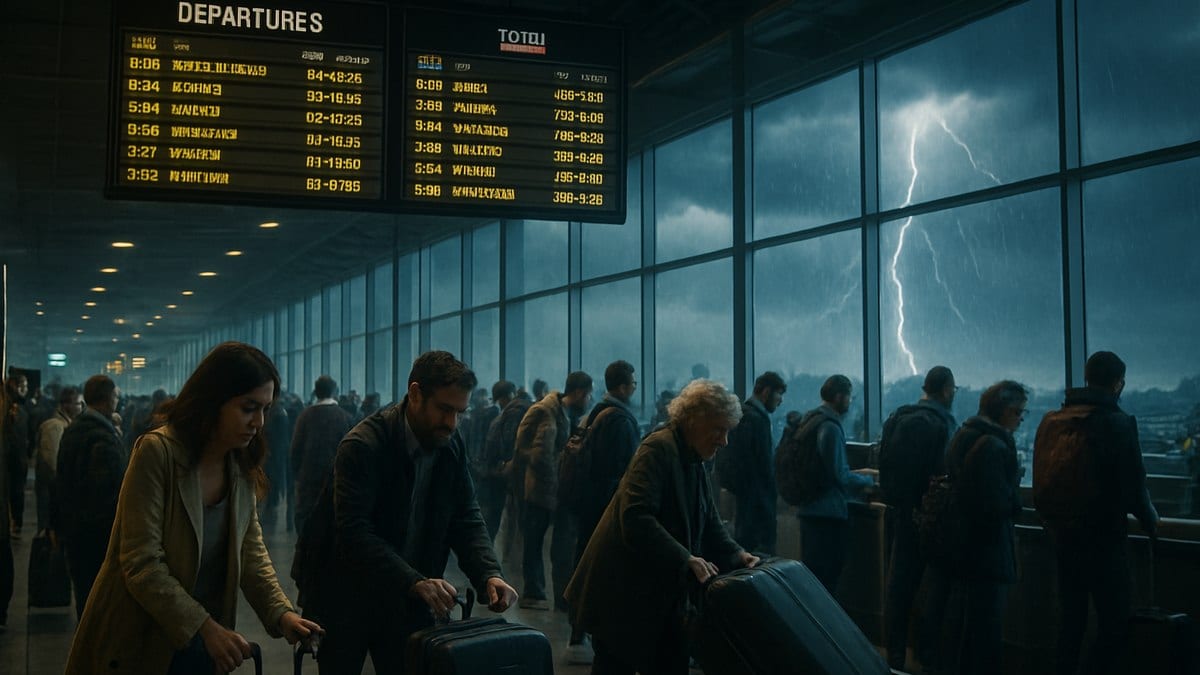
Airlines Juggle Weather Whiplash and Staffing Gaps
Early April has underscored how vulnerable U.S. aviation remains to a combination of spring storms and thin staffing at key facilities. Industry-focused coverage of the Easter weekend described a patchwork of Federal Aviation Administration ground stops and delay programs on April 5, with low visibility and storm systems affecting hubs from New York to San Francisco and triggering rolling delays across the national grid.
Separate reporting in late March highlighted how ongoing controller shortages continue to ripple through the system. An analysis of delays at major airports, including Chicago O’Hare, pointed to staffing constraints at en route centers and towers as a driver of repeated ground delay programs and capacity caps, particularly during peak morning and evening waves. The result has been clusters of multi-hour holdups even on days without severe weather.
Travel data aggregators tracking the first days of April recorded thousands of delayed flights and hundreds of cancellations tied to thunderstorms and frontal systems sweeping across multiple time zones. For passengers, the practical takeaway is that disruption risk is highest where weather and staffing issues intersect, especially at already congested hubs such as New York, Chicago and the San Francisco Bay Area.
Observers note that airlines have responded by padding schedules, trimming frequencies on marginal routes and building larger buffers into crew rotations. Those moves may improve reliability over time, but in the short term they are also translating into fewer spare seats and less flexibility when irregular operations hit during busy April school holiday periods.
IT Outages and Equipment Issues Add a Digital Wild Card
Alongside weather and staffing, technology has emerged as a recurring wild card. In March, a high-profile systems outage at JetBlue triggered a temporary nationwide ground stop for the carrier, according to U.S. media accounts. The disruption was linked in public reporting to issues with aircraft maintenance communications, prompting the airline to halt departures while systems were restored.
The episode followed a series of technology-related slowdowns and ground delays over the past two years, ranging from airline-specific reservation glitches to problems inside federal air traffic systems. While none have matched the scale of the nationwide outage that briefly halted all U.S. departures in early 2023, analysts say the pattern demonstrates how tightly coupled airline operations now are to complex IT architectures.
Travel risk specialists caution that for April and beyond, digital vulnerabilities should be treated as a standing disruption category alongside weather and labor. When booking, they recommend building in longer connection times at busy hubs and keeping critical trip information, such as boarding passes and hotel details, accessible offline in case of app outages or network failures.
For business travel planners, publicly available airline and government dashboards that track system status and delay programs are becoming daily-reading tools, allowing teams to spot early signs of trouble before large-scale ground stops are formally announced.
Rail Passengers Face Long-Term Construction Timetables
On the rails, April travelers are encountering a different sort of disruption: planned but prolonged. Amtrak and state transportation departments have outlined a series of schedule changes through spring and summer to accommodate infrastructure work across multiple corridors.
In the Northeast, service reductions tied to the cutover to the new Portal North Bridge in New Jersey have already been affecting Amtrak and NJ Transit riders, with reports indicating that a multiweek program of track activations and related repairs has cut frequencies by more than half for some peak-period services. Additional urgent repair work has been added to the project window to prevent future unplanned outages, increasing the likelihood of short-notice timetable adjustments.
Further south, construction on the Long Bridge across the Potomac River near Washington, D.C., is expected to constrain some Amtrak and Virginia Railway Express operations for years, according to industry and construction reports. Early phases of the project, which began impacting schedules in January, have already introduced recurring delays as work crews share limited track capacity with passenger and freight trains.
Regional announcements this month have also flagged changes on the Hartford Line in New England, where the Connecticut Department of Transportation has set an April 21 start for modified schedules that will run through October to support drainage work, interlocking upgrades and grade-crossing safety improvements. While many of these projects promise faster, more reliable service in the long run, spring travelers should be prepared for bus substitutions, longer journey times and occasional cancellations on affected routes.
Capacity Squeeze from Aircraft Delivery Delays
Behind the scenes, another April storyline is shaping disruption risk for the summer: aircraft that have yet to arrive. Aviation trade coverage indicates that Boeing and key suppliers are still working through quality and production issues on the 737 MAX program. Spirit AeroSystems, a major fuselage supplier, reported slower fuselage deliveries in March, while Boeing has acknowledged wiring rework on certain undelivered jets and shifting of planned first-quarter deliveries into later in the year.
Broader industry analyses suggest that delivery backlogs on both the 737 MAX and 787 families have already forced major U.S. carriers to cut or defer route expansions, particularly on domestic and near-international networks. Some airlines have turned to leasing older aircraft or extending the life of existing fleets, but those moves only partially offset the missing capacity.
The capacity squeeze has two practical implications for April travelers. First, with thinner fleet reserves, airlines have less ability to substitute spare aircraft when mechanical issues occur, increasing the risk that a single technical problem cascades into cancellations. Second, tighter seat supply has contributed to firmer fares on many popular routes, leaving fewer options to rebook at short notice when flights are disrupted.
For travelers trying to “spot the next disruption,” that means paying closer attention not only to weather forecasts but also to which carriers operate older or heavily utilized fleets on specific routes, where minor maintenance issues are more likely to trigger longer downtimes.
April’s Travel Quiz: Where Trouble May Hit Next
Looking across air and rail networks, April’s emerging pattern points to a few hotspots for potential disruption. Meteorologists are tracking additional storm systems capable of producing severe thunderstorms across the central and eastern United States, conditions that have repeatedly forced the FAA to impose en route flow restrictions and ground delays at major hubs.
At the same time, ongoing controller hiring and training efforts mean staffing improvements will be gradual, not immediate. Until more fully certified controllers are in place, bottlenecks at key facilities are likely to resurface on busy days, particularly when combined with low ceilings or convective weather.
On the rail side, infrastructure projects that entered new phases in late winter are now intersecting with rising leisure demand. Passengers on the Northeast Corridor, in Virginia and across parts of New England face a spring defined less by surprise cancellations than by timetable revisions, reduced frequencies and near-term reliability challenges.
For travelers, the April quiz is less about guessing whether there will be disruptions and more about identifying where they are most likely to appear on a given day. The answer, for now, lies at the intersection of aging infrastructure, constrained staffing and volatile spring weather, with digital systems and supply chains adding their own unpredictable variables.