

More news on this day
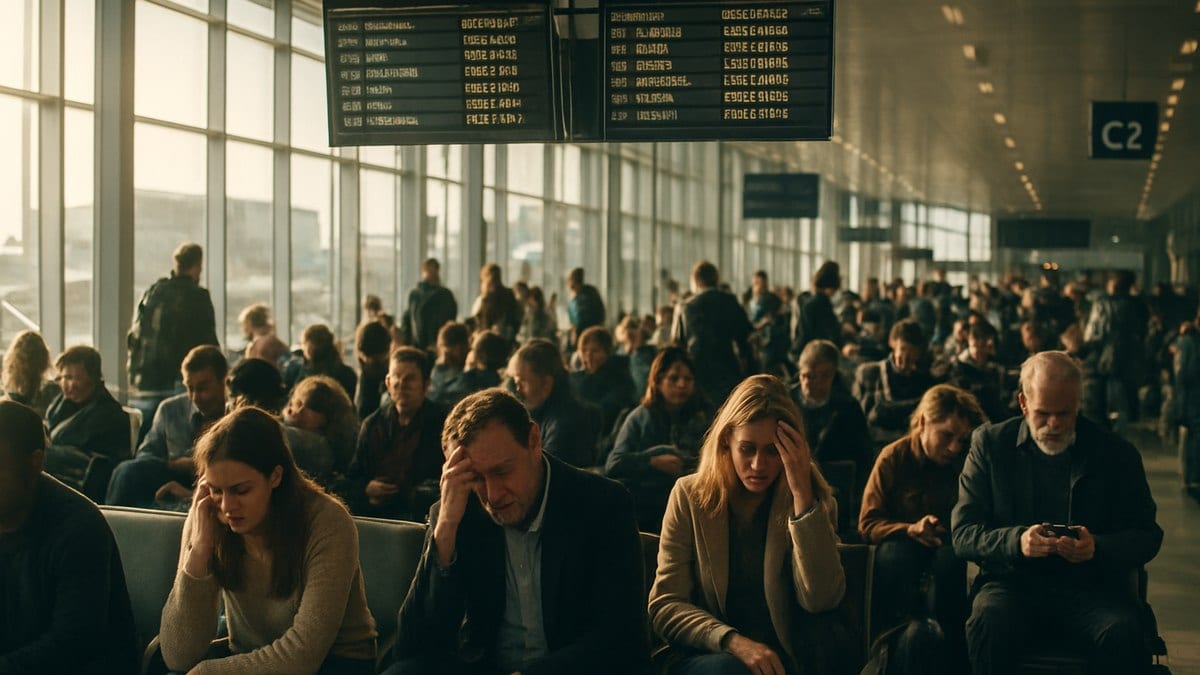
Thousands of air travelers across the United States have been stranded in early April 2026 as a mix of severe weather, holiday crowds and wider geopolitical disruptions triggered cascading delays and cancellations at some of the nation’s busiest hubs.
Get the latest news straight to your inbox!
Stormy Skies and Holiday Crowds Collide
Early April brought a difficult combination for US aviation, with strong spring storm systems tracking across key regions just as Easter holiday traffic pushed flight loads near capacity. Publicly available flight-status data for the first weekend of April show more than 5,600 delays and close to 500 cancellations nationwide on Saturday, April 4 alone, with Hartsfield-Jackson Atlanta, Dallas/Fort Worth, Chicago O’Hare and Houston George Bush among the hardest-hit hubs.
Separate tallies compiled by travel-industry outlets for April 5 highlight how quickly those problems compounded. One widely cited snapshot reported 398 cancellations and more than 3,200 delays centered on Dallas, Chicago, Detroit, Phoenix and El Paso. Another Easter-focused analysis the same day pointed to at least 339 cancellations and over 3,500 delays across US airports including Chicago, Dallas, Atlanta and Orlando, indicating that thousands of travelers were likely stranded or forced into extended overnight waits as aircraft and crews fell out of position.
In Atlanta, data aggregated by aviation analysts and travel publications for April 7 underline the strain on that pivotal hub. Dozens of cancellations there rippled through domestic corridors linking the Southeast with New York, Chicago and Florida, as well as transatlantic services to Europe. With many flights fully booked for the holiday period, reports indicate that rebooking options were often limited to next-day or even later departures.
Meteorological summaries for the same period show clusters of severe thunderstorms and at least a handful of confirmed tornadoes across parts of the central and eastern United States in early April. Those conditions can force ground stops, reduce runway capacity and trigger longer routing to avoid convective weather, amplifying disruption at hubs that already handle some of the world’s highest daily aircraft movements.
Major Hubs Bear the Brunt
The disruption has been most visible at the country’s big connecting hubs, where a single storm cell or operational pause can disrupt dozens of onward connections. In Atlanta and Dallas/Fort Worth, airlines rely on tightly banked waves of arrivals and departures to feed cross-country and international links. When storms move through at peak periods, aircraft may be held on the ground, diverted or slowed en route, which quickly erodes connection windows.
In Chicago, both O’Hare and Midway have contended with shifting wind patterns and low clouds that can cut usable runway capacity. Dallas and Houston have faced rounds of heavy rain and thunderstorms that reduce visibility and require increased separation between aircraft. Phoenix, Detroit and El Paso, while smaller than the largest coastal hubs, act as important connectors for regional and transcontinental traffic, so cancellations there reverberate across the network.
Operational data from early April show that regional carriers flying under the brands of larger airlines have been particularly exposed. Reports from travel industry trackers emphasize that when flights operated by regional partners are canceled, passengers may have fewer alternative departures to choose from, especially on thinner routes to smaller cities. With planes in many markets already close to full, those lost seats are not easily replaced.
Compounding these factors, some hubs are still working through residual issues from earlier in the year, including temporary airspace restrictions and infrastructure constraints in parts of Texas and New Mexico that altered normal traffic flows. As airlines adjust schedules and routings to reflect these changes, networks can be more vulnerable to sudden spikes in demand or weather-related shocks.
Global Turmoil Adds Pressure to US Networks
The early April crunch at US airports is also playing out against a volatile international backdrop. Since late February, conflict in the Middle East has led to significant airspace closures and schedule cuts affecting hubs from Dubai to Tel Aviv. Industry analyses published in March and early April estimate that tens of thousands of flights have been canceled globally since the escalation, with hundreds of thousands of passengers facing disrupted itineraries.
Some of that pressure is now reaching US gateways. Reduced frequencies and rerouted services to and from the Gulf region and parts of the eastern Mediterranean have forced airlines to reshuffle long-haul fleets, sometimes at short notice. According to public data collated by aviation and business news outlets, major European and Gulf carriers have trimmed schedules on routes connecting the Middle East with North America, which can funnel more demand through remaining flights and limit recovery options when irregular operations arise.
Travel-focused publications note that related disruptions continue in other regions as well. Asia-Pacific networks endured a wave of cancellations and delays in March linked to a mix of weather, technical issues and knock-on effects from shifting airspace patterns. These stresses on international connectivity feed back into US hubs, where aircraft rotations and crew pairings are planned many days in advance and depend on predictable arrivals from overseas.
For passengers within the United States, the connection between a thunderstorm over Georgia and a conflict thousands of miles away is not always obvious. However, schedule data and industry commentary suggest that airlines now have less slack in their global systems. When a domestic disruption coincides with international turbulence, spare aircraft and crews that might once have been redeployed to relieve pressure are already tied up elsewhere.
Travelers Face Long Lines and Limited Options
For stranded travelers at major US hubs, the operational story translates into long lines at customer-service counters, crowded gate areas and uncertainty about when they will reach their destinations. Reports from passenger-tracking tools and social media monitoring by travel outlets over the Easter period describe queues stretching across concourses as travelers sought rebooking, hotel vouchers or information about their rights.
Analysts highlight that high load factors leave little room to absorb disrupted passengers. When nearly every seat is sold, even a modest wave of cancellations creates a large pool of displaced travelers competing for a small number of spare seats. This is particularly acute on popular holiday routes from northern cities to Florida, Texas and the Southwest, as well as transcontinental services linking the East and West coasts.
Public guidance from consumer advocates and airline advisories points to a familiar set of tactics for minimizing disruption: monitoring flight status frequently, enabling airline app alerts, and considering earlier departures when severe weather is forecast along a route. Travelers are also encouraged to check whether itineraries involve regional partners, since those flights may have fewer backup options and can be more vulnerable when irregular operations begin.
Some carriers have issued flexible-travel policies for specific dates and regions, allowing passengers to change flights without additional fees when forecasts indicate severe storms or airspace constraints. However, these waivers do not create additional capacity, and rebooked passengers often find themselves competing for similar departure windows, especially on peak travel days.
Outlook for the Remainder of April
Looking ahead, operational planners expect further pockets of turbulence across the US network as spring storm season intensifies. Climatological records and ongoing National Weather Service monitoring for April indicate an elevated risk of severe thunderstorms and isolated tornado outbreaks across parts of the Plains, Midwest and Southeast, all regions that host critical aviation hubs.
Aviation data providers tracking on-time performance caution that recent days may offer a preview of a choppy month, particularly on afternoon and evening departures that are more sensitive to building storm complexes. Carriers have already begun trimming some frequencies in vulnerable time windows and adding scheduled padding on routes frequently affected by convective weather in order to reduce the risk of missed connections.
At the same time, the global picture remains uncertain. Airspace constraints related to Middle East tensions, along with lingering schedule adjustments across Europe and Asia, continue to affect aircraft availability and crew rotations. Any new shock in those regions could again intersect with domestic weather patterns in the United States, producing fresh waves of disruption at major hubs.
For now, travelers planning April journeys through airports such as Atlanta, Dallas/Fort Worth, Chicago O’Hare, Houston, Orlando and Phoenix are being urged through public advisories and media coverage to build extra time into itineraries, stay flexible about routing, and prepare for the possibility that even routine trips may involve extended waits on the ground.