

More news on this day
Regional airspace disruptions and constrained capacity at Tel Aviv are redirecting growing flows of passengers through Aqaba in Jordan and Taba in Egypt, as Israeli carrier Arkia adjusts its operations and taps Red Sea gateways to keep travelers moving.
Get the latest news straight to your inbox!
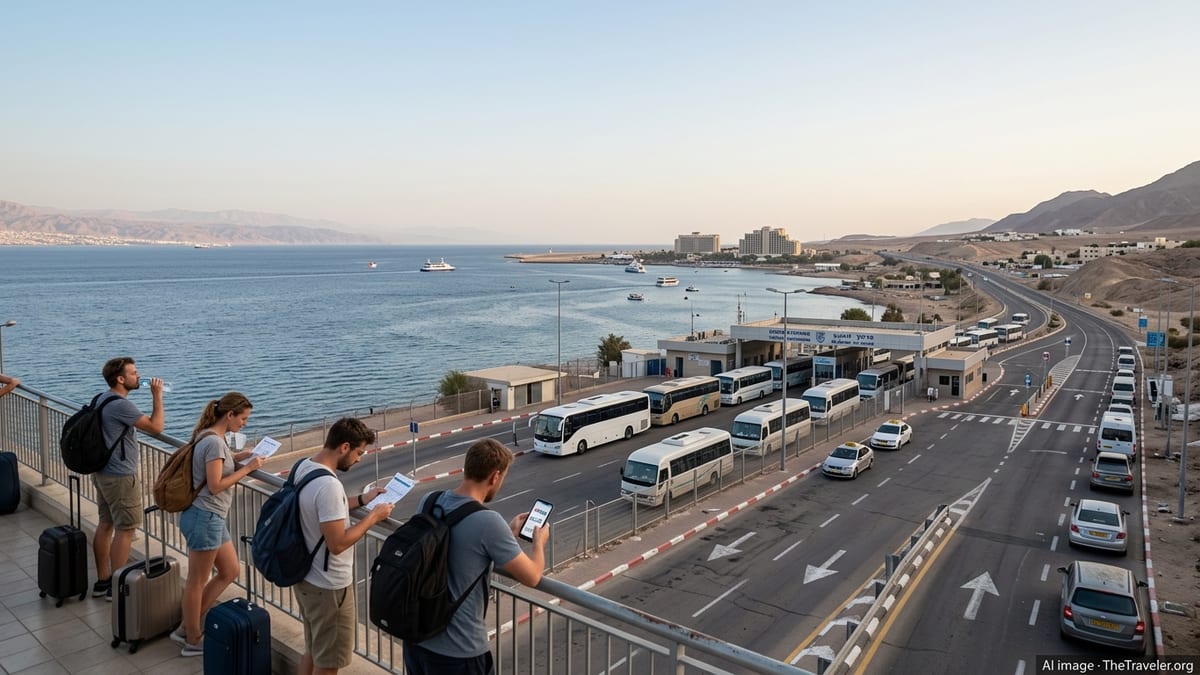
Red Sea Crossings Grow as Tel Aviv Capacity Stays Tight
Publicly available flight and logistics data for March 2026 indicate that Arkia and other Israeli airlines are increasingly relying on routes that connect European cities to Taba and Aqaba, with onward movement by land to and from Israel. Industry coverage of recent schedules highlights daily repatriation services into both Red Sea gateways, positioned as pressure valves for Ben Gurion Airport’s limited commercial activity.
Reports focused on Israeli aviation show that while Arkia has restarted a number of Tel Aviv routes, including selective European and long-haul services, overall capacity remains below pre-crisis norms. With airspace over parts of the Middle East still subject to advisories and intermittent closures, carriers are using coastal hubs on the Gulf of Aqaba to maintain an essential passenger lifeline.
This shifting pattern is especially visible in short-haul leisure traffic. Travelers originating in Europe are being ticketed to Taba or Aqaba, then transferring by road through the Eilat area to reach Israeli destinations. The arrangement is framed as a temporary workaround, but the sustained volume of movements through these crossings suggests they have become a central element of the regional travel network.
For passengers, the rerouting often means longer journeys and additional border formalities, yet it has also opened up more flexible itineraries combining Red Sea resort stays with Israel or Jordan touring. Travel operators active in the region are updating packages to incorporate these overland legs as standard components rather than emergency measures.
Arkia Tweaks Network Strategy Around Tel Aviv Constraints
According to airline announcements and schedule filings, Arkia has spent the past year recalibrating its network in response to shifting operational conditions at Tel Aviv’s Ben Gurion Airport. The carrier, historically focused on domestic links to Eilat and short-haul Mediterranean routes, has layered in selective long-haul services while simultaneously leaning on nearby gateways to offset domestic bottlenecks.
Earlier efforts to restore full-scale links between Tel Aviv and Eilat were complicated by infrastructure and security constraints, leaving airlines with fewer direct options into Israel’s southern tip. The combination of reduced domestic frequencies and intermittent disruptions around Ben Gurion has made Red Sea alternatives more attractive when continuity of service is the main priority.
In parallel, Arkia has expanded its international portfolio for the upcoming spring and summer seasons, signaling confidence in medium-term demand even as it preserves flexibility around Tel Aviv. Published seasonal plans point to roughly 40 international destinations, with a concentration in Europe and the Mediterranean and a handful of longer routes using widebody aircraft leased from partner airlines.
The strategic message is that Arkia intends to remain visible in Israel’s outbound market while hedging against local constraints by spreading risk across nearby transit points. Aqaba and Taba fit neatly into this approach, providing redundancy and an additional layer of operational resilience when Ben Gurion traffic must be throttled or rerouted.
Aqaba and Taba Position Themselves as Alternative Hubs
The rising profile of Aqaba and Taba is reshaping how both destinations are marketed. Tourism authorities and airport operators on the Jordanian and Egyptian sides of the Gulf have long promoted the Red Sea coastline as a leisure destination linked to Petra, Wadi Rum, and Sinai. With Israeli carriers and tour companies pushing more passengers through these gateways, the focus is gradually broadening from resort access to regional connectivity.
Aqaba, already served by a network of European charter and low-cost flights, has seen its role reinforced as a practical entry point for travelers heading into both Jordan and southern Israel. Meeting-industry guides and airline timetables list steady weekly frequencies into the city, positioning it as a compact alternative to Amman for vacations and combined itineraries that include overland segments to Eilat.
Taba, primarily known for its land border with Israel and nearby Red Sea hotels, is experiencing a similar shift. Coverage of current transport arrangements describes shuttle services moving passengers between Israeli cities and the Taba crossing, timed to connect with flights out of Egyptian airports on the Sinai and beyond. For many travelers, this structure transforms Taba from a peripheral resort checkpoint into a critical transit node.
As these patterns consolidate, both Aqaba and Taba are gaining visibility among travelers who previously might have flown nonstop to Tel Aviv. That visibility, combined with competitive fares on indirect routings, is beginning to influence booking behavior, particularly for cost-conscious passengers willing to trade simplicity for price and flexibility.
Traveler Experience: Longer Journeys, New Itinerary Options
For individual travelers, the operational realignment has tangible day-to-day effects. Instead of a single international flight into Tel Aviv, many now face multi-stage itineraries involving a Red Sea arrival, a land transfer around Eilat, and border formalities en route to Israeli destinations. Online traveler accounts describe a mix of relief at having workable exit and entry options and frustration at added complexity.
Journey times can lengthen significantly compared with direct Tel Aviv services, especially when border queues or road congestion build up around peak shuttle departures. However, some passengers are taking advantage of the new patterns to add beach time in Aqaba, Taba, or Eilat itself, effectively turning logistical detours into mini stopovers that soften the inconvenience.
Travel companies and information platforms are responding by publishing more detailed guidance on border crossing procedures, ground transport links, and schedule buffers needed to make tight connections. Industry observers note that as travelers become more familiar with these routes, they are likely to view Red Sea gateways as viable alternatives rather than purely emergency measures.
In the medium term, if Arkia and competing carriers retain a portion of their Taba and Aqaba capacity even after Tel Aviv operations normalize, the result could be a more diversified regional air map. That would leave travelers with a broader range of price points and routing choices, albeit at the cost of added planning for those prioritizing speed and simplicity.
Outlook: Temporary Fix or Lasting Shift in Regional Flows?
The key question for the next travel seasons is whether Aqaba and Taba will remain central to Arkia’s operating model once airspace conditions stabilize and Ben Gurion’s capacity recovers. Airline planning documents for summer 2026 still emphasize Tel Aviv as the primary hub, but the continued use of Red Sea gateways suggests that their role will not vanish overnight.
Analysts following Middle Eastern aviation trends point to several factors that could embed these patterns more deeply: ongoing security sensitivities, the appeal of multi-country itineraries combining Jordan, Egypt, and Israel, and the availability of competitively priced charter and low-cost capacity into Aqaba and nearby Egyptian airports. Each of these reduces the likelihood that pre-crisis norms will simply snap back.
For now, Arkia’s approach appears to balance caution with opportunity, using Taba and Aqaba to maintain connectivity while Tel Aviv’s operations evolve. Travelers eyeing the region in 2026 are being advised by travel planners and online resources to remain flexible, monitor schedules closely, and consider Red Sea routings as part of their planning toolkit rather than as a last resort.
Whether the current surge in traffic through Aqaba and Taba ultimately proves temporary or enduring, it has already reshaped perceptions of the Red Sea corridor. What began as an operational workaround is rapidly turning into a defining feature of how passengers move in and out of Israel during a period of heightened uncertainty, with Arkia at the center of that transformation.