

More news on this day
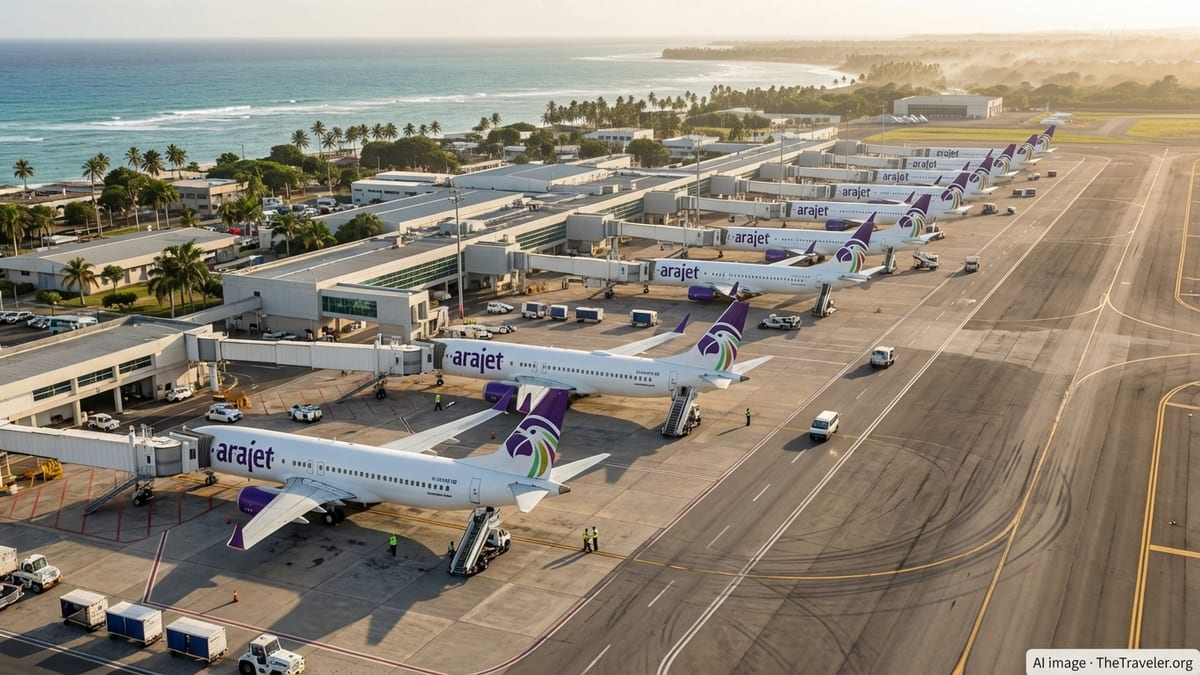
Arajet’s latest performance figures for January, building on a record 2025 and unprecedented milestones in 2024, are redefining the Dominican Republic’s role in regional aviation and signaling the emergence of a new air connectivity hub in the Americas.
Historic Momentum After a Record-Breaking 2025
Arajet enters this January on the back of a transformative year that has reshaped the Dominican Republic’s aviation landscape. In 2025 the low-cost carrier transported more than 1.48 million passengers, a 37 percent increase on the previous year, according to data presented by the airline and the country’s Civil Aviation Board. More than 1.2 million of those travelers flew to or from Dominican airports, underscoring Arajet’s role as a direct driver of inbound tourism and outbound mobility.
This surge builds on a historic 2024, when Arajet became the first Dominican airline to carry over one million passengers in a single year. Civil Aviation Board figures show the carrier moved 934,293 passengers excluding connections and surpassed 1.2 million when connecting travelers were counted, an unprecedented volume for a locally based airline. That performance secured Arajet more than four-fifths of all passengers transported by Dominican carriers and marked the best year on record for the country’s local aviation sector.
Combined, these milestones mean Arajet enters the new year with the scale, network depth, and brand recognition that many regional airlines spend a decade trying to achieve. For aviation planners and tourism officials in Santo Domingo, the airline’s historic January trajectory is less a surprise than the logical next step in a rapid growth curve that has positioned the Dominican Republic as one of Latin America’s most dynamic emerging markets for air travel.
Industry analysts note that this level of consolidation gives Arajet unusual leverage for a homegrown carrier. It is now central to how the Dominican Republic connects with its core source markets and increasingly how those markets connect with each other, a role that becomes even more visible as fresh January data confirms rising international traffic into the country’s main airports.
January Traffic Surges as Dominican Aviation Hits New Highs
The wider context for Arajet’s strong January is a Dominican aviation market that continues to set records. Regional airline association figures show the country reached its highest volume of international passengers in history in January of the latest reporting year, with around 1.8 million travelers passing through its airports and year-on-year growth of roughly 3 percent. That performance places the Dominican Republic among Latin America’s standout markets for traffic growth at the start of the year.
Arajet’s contribution to that surge is significant. The airline closed the second half of 2025 as the third-largest carrier in passenger traffic to and from the country, behind only JetBlue and American Airlines and ahead of established global brands including Delta, United, and Copa. During the third quarter alone it transported more than 354,000 passengers on itineraries touching Dominican airports, and when connecting passengers are included the figure surpassed 400,000, equivalent to more than 9 percent of all travelers moving through the national airport system.
Those volumes provide a solid base for a historically strong January, when tourist flows traditionally spike and the country’s winter peak season is in full swing. With Arajet already accounting for the vast majority of passengers transported by Dominican airlines and controlling a growing share of connecting traffic, each additional flight operated in January magnifies its influence on national statistics and the country’s visibility in international markets.
Airport operators in Santo Domingo and Punta Cana report that the airline’s growth has helped push up overall movement counts, particularly on mid-haul routes that tie the Caribbean to major cities in North, Central, and South America. As Arajet layers in more frequencies and uses its Boeing 737 Max fleet more intensively at the start of the year, its January schedule effectively acts as a barometer for how aggressively the Dominican Republic is leaning into its role as a regional gateway.
Santo Domingo and Punta Cana Evolve into Dual Connectivity Anchors
Central to Arajet’s January performance is the evolution of the Dominican Republic’s major airports from point-to-point tourist gateways into true connectivity platforms. Las Américas International Airport in Santo Domingo remains the airline’s primary base, but Punta Cana International Airport has rapidly become a second strategic pillar. Arajet now operates at three airports across the country and has steadily increased the number of routes touching Dominican soil, expanding from 20 to nearly 30 in less than two years.
This twin-airport strategy is increasingly visible in January traffic flows. Santo Domingo serves as the main connecting hub, funnelling passengers from across the Americas through a centrally located Caribbean gateway. Punta Cana, long known for its resort-focused arrivals, is acquiring a second identity as a connection point for southbound and northbound travelers who might never leave the airport area but still contribute to local aviation and service revenues.
The impact can be seen in Civil Aviation Board data showing that by mid-2025 Arajet accounted for more than 85 percent of passengers transported by Dominican airlines, and had become the fifth-largest airline globally by tourist arrivals to the country. As the new year gets underway, those rankings translate directly into aircraft rotations, overnight stays, and incremental spend in and around both airports, reinforcing their status as a combined connectivity platform rather than isolated gateways.
For travelers moving between secondary cities in the Americas, this network design turns the Dominican Republic into an attractive alternative to traditional hubs such as Panama City, Bogotá, or Miami. A Colombian tourist heading to Mexico or an Argentine traveler bound for the U.S. East Coast can routings via Santo Domingo or Punta Cana on a single low-cost ticket, making the country a crossroads rather than simply an end destination.
Network Expansion and New U.S. Routes Drive Hub Status
Arajet’s accelerating expansion into the U.S. market is one of the clearest reasons its January results carry outsized strategic weight. The airline completed its first flight to the United States with the launch of service between Santo Domingo and Miami, a route that has since scaled up to daily frequencies. Additional plans call for nonstop services connecting Santo Domingo and Punta Cana with major U.S. gateways including Newark, Orlando, Boston, and Chicago, rolled out in phases through 2025 and into 2026.
These new links sit atop an already dense network across Latin America. Arajet connects Santo Domingo with cities such as Mexico City, Bogotá, Medellín, Lima, São Paulo, Buenos Aires, and key Central American capitals. Many of these routes are among the airline’s busiest, with some individual city pairs carrying close to or above 100,000 passengers annually. As new U.S. flights come online, they plug directly into this grid, enabling same-day connections between North America and multiple points in South America and the Caribbean via Dominican airports.
The bilateral Open Skies agreement between the Dominican Republic and the United States has been instrumental in unlocking this growth, giving Arajet the regulatory freedom to expand frequencies and add destinations. January schedules are already reflecting that liberalization, with more options for travelers combining beach vacations in the Caribbean with business trips in North or South America, or visiting friends and relatives on multi-leg itineraries that would have required separate bookings in the past.
For policymakers, every new U.S. route reinforces the image of the Dominican Republic as a country whose air connectivity reach extends far beyond traditional sun-and-sand tourism. Each additional connection from Miami, Newark, or other U.S. hubs represents another spoke in a growing wheel that positions Santo Domingo and Punta Cana as serious competitors in the contest to capture transfer traffic.
Low-Cost Model and Fleet Strategy Underpin Growth
Behind Arajet’s headline January numbers is a business model specifically designed to turn the Dominican Republic into a price-competitive hub. The airline operates an all-Boeing 737 Max fleet, which management highlights for its fuel efficiency and lower per-seat operating costs. With 13 aircraft currently in service and plans to grow that number to 17 by the end of 2026, Arajet can add capacity quickly on high-demand routes while maintaining a relatively simple, standardized operation.
The low-cost structure allows the airline to stimulate demand in price-sensitive markets, particularly in Latin America where average incomes remain below those of North America and Europe. Introductory fares on new routes, especially in January when travelers take advantage of holidays and school breaks, can be significantly lower than those offered by legacy competitors. Ancillary revenues from baggage, seat assignments, and other optional services help keep base fares low while supporting profitability.
This strategy has already proven effective. In early 2024 Arajet flew more than half a million passengers in just six months, matching its entire 2023 volume and securing close to four-fifths of all passenger traffic flown by Dominican-based airlines at the time. That ability to double volumes at relatively low cost, paired with its expanding route map, gives the airline a strong platform for sustained growth through each successive January peak.
Fleet planning also supports the Dominican Republic’s broader hub ambitions. Concentrating on a single aircraft type simplifies maintenance and crew training and allows for quick swaps between routes as demand patterns evolve. When a new connection between, for example, Miami and Punta Cana or Buenos Aires and Santo Domingo proves stronger than expected, capacity can be shifted rapidly without complex fleet reassignments, keeping the network responsive during the busiest months of the year.
Tourism, Trade, and the Wider Economic Ripple Effect
Arajet’s performance is not just an aviation story; it is increasingly a barometer for the Dominican Republic’s wider economy. Tourism remains one of the country’s most important industries, and easier, cheaper air access is directly linked to hotel occupancy, restaurant revenues, and employment across a range of service sectors. With Arajet moving hundreds of thousands of visitors and connecting passengers in a single quarter, the airline has become a critical channel for the flow of travelers and spending.
Record passenger volumes mean more visitors discovering destinations beyond the classic resort corridors. Cities such as Santo Domingo and Santiago are seeing increased interest from travelers who arrive on Arajet flights and choose to explore urban culture, gastronomy, and heritage sites before or after heading to the beach. Domestic tourism also benefits as residents tap low fares to travel abroad, strengthening diaspora ties and cross-border commerce.
The economic impact extends to trade as Arajet prepares to launch cargo operations in the coming year. With a growing fleet and a network linking major commercial centers in the Americas, the airline is positioned to carry high-value, time-sensitive goods in the belly holds of its passenger aircraft. For exporters of perishables, fashion, and light manufacturing, more regular flights to hubs such as Miami, Mexico City, and São Paulo translate into shorter transit times and more reliable supply chains.
Government officials have been keen to highlight this connectivity dividend, pointing to the airline’s rapid ascent as a case study in how targeted aviation policy, including support for Open Skies and incentives for fleet investment, can translate into broader economic gains. As January results reinforce Arajet’s trajectory, those arguments are likely to gain even more traction in policy debates about infrastructure and tourism promotion.
Competitive Pressures and the Road Ahead
While Arajet’s historic January performance solidifies the Dominican Republic’s standing as an emerging hub, it also raises questions about competition and sustainability. Regional rivals, particularly in Panama, Colombia, and Mexico, are unlikely to cede transfer traffic without a fight. Established low-cost groups and legacy carriers have deep pockets, loyalty ecosystems, and partnerships that can be deployed to defend market share and open new routes of their own.
To maintain momentum, Arajet will need to balance rapid growth with operational reliability. High load factors and tight turnarounds can strain resources, especially during peak January periods when weather disruptions and air traffic congestion are more likely. The airline’s admission to the International Air Transport Association and adherence to its safety and operational standards provide reassurance, but consistent performance will be essential to keep passengers returning and to persuade partners to deepen cooperation.
There is also the question of how far the Dominican Republic can stretch its airport infrastructure. While recent investments at both Las Américas and Punta Cana have increased capacity, sustained double-digit growth in international traffic would eventually require additional gates, apron space, and air traffic management upgrades. Planning for that expansion is already underway, but the pace of Arajet’s rise and the strength of January seasons will test how quickly those projects can move from drawing board to reality.
For now, industry observers say the airline’s trajectory is unmistakably upward. Each new set of January figures adds another data point to a story of an ambitious carrier turning a tourism powerhouse into a full-fledged aviation hub. If Arajet can continue translating growth into reliable, affordable connectivity, the Dominican Republic’s place on the map for global travelers and airlines alike is set to become even more prominent in the years ahead.