

More news on this day
Archer Aviation’s path to launching electric air taxi services in the United States took a decisive step forward on March 9 as its partners in Florida, New York and Texas were selected for a new White House eVTOL Integration Pilot Program, positioning the three states as early testbeds for commercial urban air mobility.
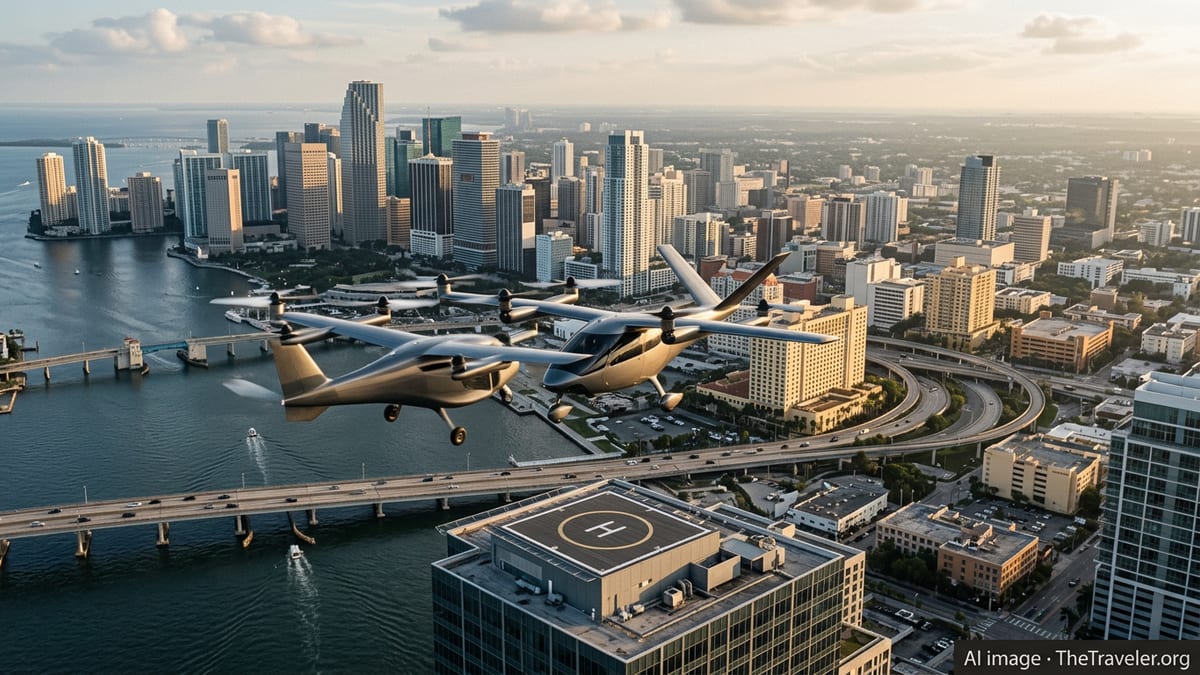
White House Pilot Program Targets Early Air Taxi Operations
The US Department of Transportation and the Federal Aviation Administration confirmed that partners working with Archer in Texas, Florida and New York will participate in the federal eVTOL Integration Pilot Program, an initiative crafted to pave the way for commercial air taxi operations as soon as the second half of 2026. The selection marks one of the clearest signals yet that Washington is moving from research and demonstrations toward real-world deployment of advanced air mobility services.
The pilot framework is designed to allow a limited number of early operations in carefully controlled environments, giving regulators, industry and local authorities a chance to test procedures for scheduling, routing, noise management and emergency response. Officials describe it as a first-of-its-kind pathway to integrate a new powered-lift aircraft category alongside conventional airplanes and helicopters in busy US airspace.
Archer’s inclusion reflects growing confidence in the maturity of its Midnight electric vertical takeoff and landing aircraft and in the company’s readiness to work hand in hand with aviation regulators. The program will also serve as a bellwether for how quickly public agencies can adapt rules, infrastructure and oversight for a technology that aims to transform short-haul urban and regional travel.
Florida, New York and Texas Emerge as Early eVTOL Hubs
By anchoring the pilot program in three of the country’s largest and most dynamic travel markets, federal officials are effectively mapping where US passengers are likely to first encounter air taxis in day-to-day life. Archer is coordinating with the Texas Department of Transportation, the Florida Department of Transportation and the Port Authority of New York and New Jersey as it prepares for initial Midnight operations in those regions.
In Florida, where tourism and cruise traffic drive heavy demand for airport and seaport transfers, early air taxi routes are expected to focus on cutting long surface commutes between major airports, downtown districts and coastal resorts. State leaders have already signaled strong interest in advanced air mobility as a tool to relieve highway congestion and support the state’s role as an international gateway.
New York, one of the world’s most challenging airspace and infrastructure environments, offers a high-profile proving ground. Existing heliports around Manhattan, along with connections to major airports, provide natural launch points for eVTOL services aiming to replace lengthy car journeys with quiet, all-electric hops measured in minutes. For the Port Authority and city officials, the pilot program will test how electric air taxis can be integrated into dense urban neighborhoods with close attention to safety and community impact.
In Texas, early operations are expected to center on rapidly growing metropolitan regions where commuting distances are long and highway congestion is worsening. Working with state transportation officials, Archer and its partners will explore vertiport locations and operating concepts that can support both daily commuters and business travelers moving between airports, downtowns and emerging commercial districts.
Midnight Aircraft Positioned at the Center of Federal Effort
At the heart of the pilot program is Archer’s Midnight, a piloted electric air taxi designed to carry four passengers plus a pilot on short urban and regional missions. The aircraft uses multiple small electric propellers and a distributed propulsion architecture to reduce noise and emissions compared with traditional helicopters while targeting commercial airline levels of safety through system redundancy.
Archer’s goal is to enable passengers to replace 60 to 90 minute trips by car with quiet, all-electric flights lasting around 10 to 20 minutes. That premise is particularly compelling in the three pilot states, where clogged highways and complex airport access routes routinely add uncertainty and stress to travel plans for residents and visitors alike.
The federal initiative builds on a series of regulatory milestones for the eVTOL sector, including FAA rules that bring powered-lift operations into the same regulatory framework as commercial airlines and charter providers. For Archer, the new program is expected to generate detailed operational data on everything from ground handling and passenger boarding to flight procedures and maintenance cycles, information that will feed into future scaling of its network.
Building a Playbook for Safe, Scalable Urban Air Mobility
Beyond the immediate commercial implications for Archer, the eVTOL Integration Pilot Program is intended to create a national playbook for how advanced air mobility can be safely introduced and expanded. Officials say the three-state effort will inform future rulemaking on route design, noise standards, community engagement, pilot training and coordination with existing airport and air traffic control systems.
Much like early self-driving car and robotaxi trials, these first air taxi services will be closely watched for their ability to gain public trust. Community outreach in Florida beach cities, New York boroughs and fast-growing Texas suburbs will be central to the program, as residents weigh the benefits of shorter travel times against concerns over low-altitude flight paths and neighborhood noise.
For the travel sector, the pilot routes will offer a preview of how itineraries may shift once fast, predictable air taxi connections are available between airports, hotels, business districts and attractions. If the program succeeds in demonstrating safe, reliable operations, it could accelerate the development of dedicated vertiports and integrated booking platforms that treat eVTOL flights as a standard leg in a multi-modal journey.
US Stakes Claim in Global Air Taxi Race
The White House’s decision to back a structured eVTOL pilot program underscores a broader ambition to keep the United States at the forefront of a rapidly emerging aviation market. Governments in Europe, the Middle East and Asia are also supporting demonstration flights and early commercial services, often tied to major sporting events or new urban districts.
By prioritizing real-world operations across Florida, New York and Texas, US transportation officials are signaling that they intend not only to regulate the technology but to help shape global standards for safety and integration. For Archer, success in the pilot program would strengthen its position against a growing field of competitors while providing a template for future launches in cities such as Los Angeles, where the company is already aligned with organizers of the 2028 Olympic and Paralympic Games.
As the pilot projects move from planning into flight testing over the next two years, travelers and residents in the three participating states are likely to be among the first in the world to experience air taxis as a practical, booked-in-advance transportation option rather than a futuristic concept. Their response will help determine how quickly the vision of short, quiet hops above gridlocked traffic becomes a mainstream feature of the American travel landscape.