

More news on this day
Sarasota–Bradenton International Airport has ridden a wave of record passenger growth, but a series of heavily disrupted travel periods is testing whether this compact Gulf Coast hub is becoming one of Florida’s most challenging airports for flyers.
Get the latest news straight to your inbox!
Record Growth Meets Limited Capacity
In less than a decade, Sarasota–Bradenton International Airport, known by its code SRQ, has transformed from a modest regional facility into one of Florida’s fastest-growing commercial airports. Published figures from airport and state documents indicate passenger numbers have more than tripled from pre-pandemic levels, with several recent years setting new traffic records. That surge has brought more nonstop routes and carriers to the region, but it has also pushed a relatively small terminal and runway system close to its operational limits.
Publicly available planning documents describe an airport designed for roughly 1 to 2 million annual passengers now contending with volumes well above that range. Expansion projects, including a new ground-level concourse, baggage system upgrades and additional parking, are underway to accommodate as many as 6.5 to 7 million passengers in coming years. Until those projects are fully realized, however, the gap between demand and infrastructure is contributing to congestion at peak times, particularly during winter tourist season.
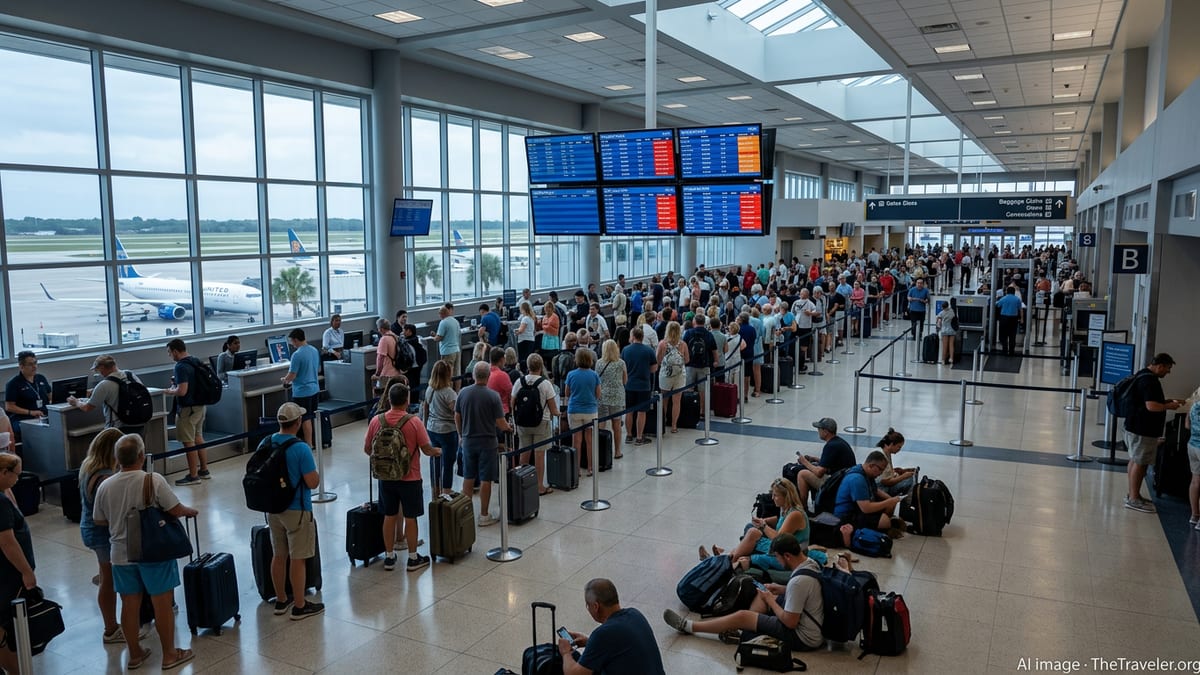
The result is an environment where even routine schedule pressures can quickly cascade. With limited gate space and fewer alternative routings than a major hub, SRQ has less margin for absorbing late-arriving aircraft, extended turn times or minor mechanical issues. When disruptions strike, passengers can experience long lines, crowded gate areas and difficulty rebooking, as the number of daily flights and seats remains relatively constrained compared to Florida’s largest airports.
Local sentiment, reflected across regional coverage and community forums, points to a perception that SRQ has gone from “sleepy” to “bursting at the seams.” While that growth underscores the region’s popularity with visitors and new residents, it sets the stage for high-impact delays when operations do not go to plan.
Weather Systems and Seasonal Shockwaves
Like every airport in Florida, Sarasota–Bradenton is highly exposed to weather. Reports from recent storm systems affecting the southern half of the state show SRQ appearing alongside Miami, Fort Lauderdale, Orlando and Tampa on lists of airports coping with waves of cancellations and delays. Intense thunderstorms, low ceilings, and the lingering effects of tropical systems regularly force ground stops, reduce runway capacity and trigger holding patterns across the region’s congested airspace.
Because SRQ serves a schedule heavily concentrated in daytime departure banks, especially during winter and early spring, a single severe weather system can knock out a significant portion of the day’s operations. Flights originating in northern hubs may arrive late due to earlier weather or air traffic control restrictions, which then compresses turnaround times and complicates scheduling for the remainder of the day. Short operating windows leave less time for crews and aircraft to “catch up” before mandatory duty limits or nighttime noise restrictions come into play.
These seasonal shockwaves are amplified by SRQ’s role as a leisure gateway. Many passengers are connecting to cruises, vacation rentals or time-sensitive stays along the Gulf Coast. When storms disrupt operations, travelers may have fewer alternative flights within a given 24-hour window compared with major hubs, which can turn a delay into an overnight or multi-day setback. Publicly available guidance from airlines and travel trackers consistently advises winter and early spring travelers to Florida to monitor flight status closely and build buffer time into itineraries.
Although Sarasota does not face the same volume of afternoon thunderstorms and tropical impacts as South Florida’s largest airports every day of the year, even periodic severe events are enough to expose the operational tightness of a fast-growing mid-sized facility. The question for travelers is not whether SRQ experiences weather-related disruptions, but how resilient it is when those disruptions arrive.
How SRQ’s Disruption Record Compares in Florida
On-time performance data from aviation analytics firms and federal statistics place Sarasota–Bradenton in a middle band of reliability when compared with Florida’s largest airports. Recent snapshots show SRQ posting on-time rates in the mid-70 percent range over selected periods, which is weaker than top-performing U.S. airports but not the worst in the state. Some major Florida gateways, particularly Fort Lauderdale–Hollywood International, have appeared near the top of national rankings for delay-prone airports, with significantly higher overall disruption rates.
Those comparisons matter for travelers trying to determine whether SRQ can be considered the “worst airport experience” in Florida. Large hubs such as Orlando, Miami and Fort Lauderdale handle many times the traffic of Sarasota, with complex international operations, crowded airspace and heavy reliance on ultra-low-cost carriers that historically report higher cancellation and delay rates. Published analyses of 2024 operational data frequently highlight those mega-airports, rather than SRQ, as the state’s most consistently challenged performers.
However, disruption rates tell only part of the story. For an individual passenger, the experience of a delay at SRQ can feel more acute precisely because alternatives are limited. At a major hub, a missed flight may be rebooked on another departure within hours. At Sarasota–Bradenton, especially outside peak season or on less-frequent routes, the next available option might not depart until the following day. In that sense, even a statistically average delay profile can translate into above-average frustration for those caught in the middle of an operational crunch.
Viewed through this lens, Sarasota–Bradenton is not clearly the worst airport in Florida in objective performance terms, but it does occupy a uniquely sensitive position. It combines popular leisure demand, constrained infrastructure and fewer backup options, which can make any given disruption feel more consequential than a similar delay at a larger field.
Passenger Experience: Crowding, Access and Expectations
Beyond statistics, the lived experience at SRQ is shaped by crowding and access. The compact terminal, designed for smaller volumes, can feel stretched during peak travel days. Travelers report busy yet navigable security checkpoints most of the year, but during holiday periods or major weather events, the space at gates, concessions and baggage claim can quickly become saturated. Seating shortages and long lines for food and restrooms are common complaints when multiple flights are delayed at once.
Ground access presents another pressure point. Recent local discussions note that county budget decisions have affected bus routes linking the airport with downtown Sarasota and key beaches, reducing public transit options just as passenger numbers remain elevated. For visitors arriving without a rental car, this can compound frustration after a delayed or canceled flight, particularly when rideshare pricing surges or wait times spike during peak hours.
Expectations also play a significant role in how disruptions are perceived. Many travelers choose SRQ precisely to avoid the crowds and complexity of Tampa or Orlando. When they encounter cancellations, congested gate areas or lengthy rebooking lines at a smaller airport, the sense of disappointment can be sharper. Social media and community forums reflect this disconnect, with some residents and repeat visitors describing the airport as a victim of its own success.
At the same time, the airport continues to invest in upgrades aimed at easing those pain points, including expanded concourse space, additional gates and improved baggage systems. As those projects come online, the traveler experience may begin to align more closely with the convenience many expected when they booked a flight into a smaller coastal airport.
What Travelers Can Realistically Expect Next
Looking ahead to upcoming peak periods, publicly available timetables and construction schedules suggest that Sarasota–Bradenton will remain in a transitional phase. New infrastructure is arriving in stages rather than all at once, while airlines are still adjusting schedules in response to evolving demand, pilot availability and broader industry disruptions. For passengers, that points to an environment where occasional bouts of severe disruption are likely to continue, even if overall on-time performance edges upward.
Travel advisors and consumer advocates commonly recommend a few basic strategies for navigating Florida’s more delay-prone airports, and those apply to SRQ as well. Early-morning departures tend to face fewer knock-on delays, nonstop flights reduce the risk of missed connections, and choosing carriers with stronger national reliability records can help mitigate some of the unpredictability. Building flexible arrival and departure plans, especially in winter and early spring, remains prudent for anyone flying into or out of the Gulf Coast.
Ultimately, Sarasota–Bradenton’s story is less about being the single worst airport in Florida and more about the growing pains of a small hub absorbing big-city demand. Travelers weighing SRQ against Tampa, Fort Myers or Orlando face a trade-off between proximity and resilience. For some, the shorter drive and smaller footprint will outweigh the risk of a more disruptive delay. For others, especially those on tight international connections or cruise schedules, the redundancy of a larger airport may still offer greater peace of mind.
As airlines, regulators and the airport itself respond to continued demand along Florida’s Gulf Coast, Sarasota–Bradenton’s performance in the next few busy seasons will determine whether its reputation among travelers shifts from “conveniently close” toward “reliably smooth,” or remains defined by memorable bouts of disruption at a much-loved but stretched facility.