

I went to Pastéis de Belém with that specific mix of excitement and skepticism that only a world-famous food stop can inspire. This is not some hidden Lisbon gem. It is an institution that produces tens of thousands of custard tarts a day and fills entire tramloads of tourists.
I had eaten pastéis de nata all over Lisbon before going, so I arrived wondering if these originals would genuinely stand out or whether I was just signing up for an overhyped queue. What I found was a mix of excellent pastry, logistical headaches, smart tactics that can save you time, and a few realities that most glossy travel reels gloss over.
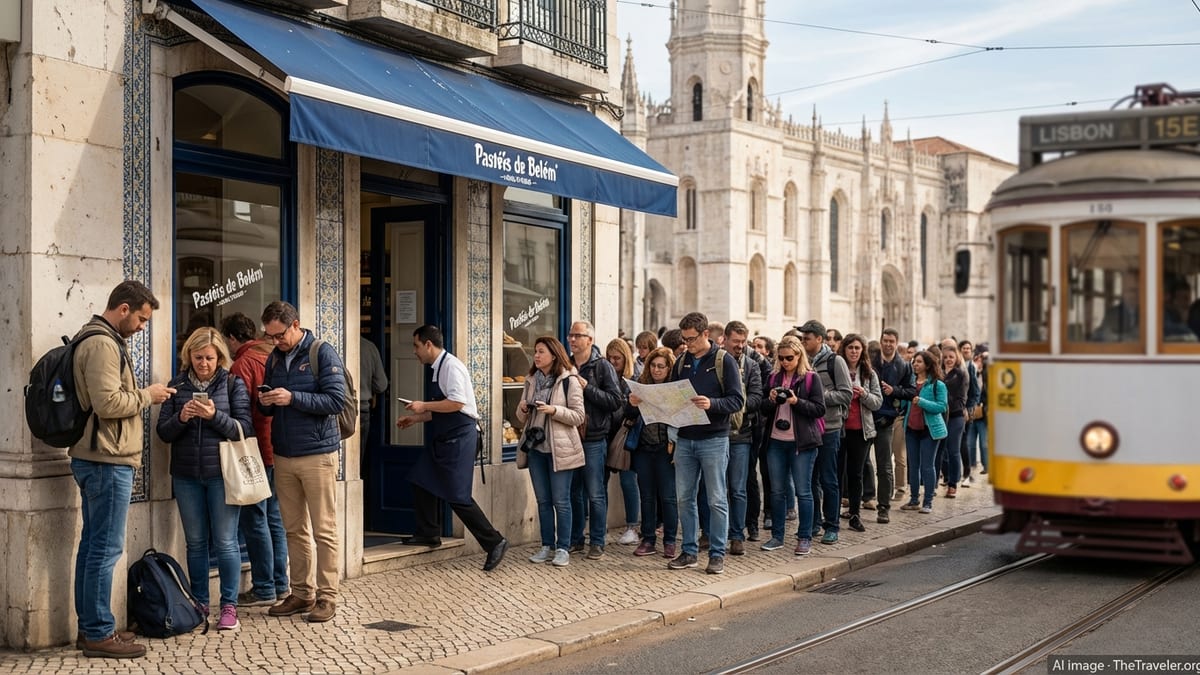
Getting There and First Impressions
I chose to go late morning on a weekday, coming from central Lisbon on tram 15E toward Belém. The ride itself took roughly 25 to 30 minutes in modest traffic, with crowds thickening as we approached the riverfront monuments. The tram dropped me almost at the bakery’s door on Rua de Belém, which is incredibly convenient. Buses 714 and 728 also stop nearby, and the Belém train station is a short walk away, so access is easy even if you are not staying in the neighborhood.
From the tram window I could already see the telltale sign that I had arrived: a snaking line of people along the blue awning, phones out, everyone inching forward. Inside, I knew, was a huge, old-school tiled café that could seat hundreds, but from the street what you see is a compact facade, the takeout counters, and the iconic script name. There is that immediate feeling of “Yes, this is the place from the photos” mixed with “Oh, this is actually smaller and more chaotic than I imagined.”
By the time I stepped off, around 11 am, the takeaway queue already stretched down the block. This was shoulder season, not the peak of summer, and still the crowd felt dense. If you are imagining a relaxed neighborhood pastry stop, reset that expectation. Pastéis de Belém feels more like a small tourist attraction that happens to serve pastries, and the energy outside reflects that. People are figuring out which line to stand in, tour guides are gathering groups, and there is an almost constant shuffle of people arriving from the monastery across the street.
Understanding the Lines and How Not to Waste Your Time
One surprise that worked in my favor was learning that there are essentially two different experiences here: takeaway at the front counter and table service inside the café. The long line that you typically see in photos is almost always the takeaway line. It looks terrible, and at busy hours it is. On my visit, the takeaway queue would easily have meant a 25 to 40 minute wait. What many people do not realize is that you can usually get a table inside faster than you can get a box to go.
I walked straight past the outdoor crowd and into the interior corridors. Staff were moving briskly, guiding people through to the back rooms, and within 5 minutes I was being shown to a small table in one of the tiled dining areas. There was no dramatic wait, no need to hover. For a place that serves thousands of people a day, the turnover is fast. If your goal is to actually sit and eat a couple of tarts with a coffee, I would strongly recommend ignoring the outdoor takeaway line and heading inside to be seated.
That said, “quick” is relative. The atmosphere inside is busy, bordering on hectic. Servers are efficient but not especially warm, and you can tell they are working at high speed. If you are hoping for a cozy café experience where you linger for ages, you might be disappointed. You are not pressured to leave, but there is a clear rhythm of order, eat, go, with staff constantly weaving between tables carrying trays of tarts. I did not feel rushed, but I always felt aware of how many people were waiting for their turn.
The Pastries Themselves: How Good Are They Really?
Once I was seated, I ordered the classic combination: a couple of pastéis de Belém and a coffee. The tarts arrived within minutes, still warm from the oven, with shaker tins of cinnamon and powdered sugar on the table. They looked almost exactly like the photos that have been circulating for years: blistered tops in shades of deep amber and golden yellow, set in flaky pastry shells that looked delicate but sturdy enough to hold the custard.
Biting into the first one, I understood immediately why these tarts became famous. The pastry was crisp, light, and distinctly layered, shattering delicately without feeling greasy. The custard was smooth and creamy but not too runny, with a rich eggy flavor and just enough sweetness. The caramelized top added a faintly bitter note that balanced the sugar. With a dusting of cinnamon, it was one of those bites where you do not talk for a moment because you want to register all the textures and flavors properly.
Was it better than every other pastel de nata I had tried in Lisbon? Not automatically. In a blind taste test, I suspect I would put it near the top, but not always in first place. There are excellent tarts at other bakeries in the city that rival these in flavor and texture. What Pastéis de Belém does offer, though, is remarkable consistency at incredible scale and a distinctive style: a slightly thicker, more substantial custard and a pastry that manages to stay crisp despite the volume they push out each day.
I have read some complaints that quality varies depending on how long the tarts have been sitting. That did not match my personal experience, but I can believe it. When production is this high and turnover is constant, some trays will inevitably shine more than others. My advice is simple: eat them on the spot, while they are still warm. Do not buy a big box here with plans to eat them cold that evening or the next day. The texture suffers. A pastel that is divine straight from the oven is merely decent a few hours later, and that can color your impression unfairly.
Prices, Portions, and the Cost of the Hype
On the practical side, the prices are surprisingly reasonable for a world-famous spot. At the time of my visit, a pastel cost roughly what it does at most quality bakeries around Lisbon, and a box of six was only slightly more per unit than buying a single tart. You pay in euros, card is widely accepted, and the bill for my coffee and a couple of tarts felt modest compared with what I might have expected for such a high-demand location.
Where the cost creeps in is less about money and more about time and mental energy. If you hit Pastéis de Belém at a peak hour and insist on takeaway, you may spend a significant chunk of your day in line for something you can find, in a very similar form, at multiple other places across the city. That does not mean the experience is not worth it, but the “cost” is not purely financial. It is also the stress of crowds, the jostling on the sidewalk, and the sense that you are ticking a box rather than stumbling onto a relaxed local secret.
I also noticed that while the main tarts are well priced, some of the other pastries and drinks are less of a value proposition. They are fine, but they are not the star of the show. If you come here, it makes sense to focus on the namesake pastéis de Belém rather than treating it as a full-blown brunch destination. You are here for the classic custard tart, not for a nuanced exploration of the entire pastry case.
Inside the Café: Atmosphere, Service, and Comfort
The interior of Pastéis de Belém is a maze of tiled rooms, arched doorways, and corridors that seem to stretch further back than you expect. It feels larger than it looks from the street, with seating scattered across several distinct spaces. The blue and white azulejos on the walls give it a traditional Portuguese character, and for a moment you can almost forget the crowds and imagine what this place must have felt like decades ago.
Then the modern reality hits: this is a high-capacity, high-throughput operation. Tables are close together, conversations overlap, and there is a constant clatter of plates, cups, and cutlery. Families wrangle kids, tour groups compare tasting notes, and servers navigate the organized chaos with impressive efficiency. It is not a tranquil café; it is a machine for delivering custard tarts to an endless stream of customers. If you are sensitive to noise and crowds, this might feel more exhausting than charming.
Service is professional but unsentimental. My server was quick, direct, and accurate, but there was no small talk or sense of personal connection. I did not expect any in a place this busy, and I did not feel mistreated, but if your idea of a memorable food experience depends on warm hospitality, you may come away a little underwhelmed. This is industrial-scale tradition, not a family-run corner café where the owner chats with regulars at the door.
Comparing Pastéis de Belém to Other Lisbon Nata Spots
By the time I visited Pastéis de Belém, I had already tried pastéis de nata at several bakeries around Lisbon, including some of the city’s well-known chains and small neighborhood pastelarias. That context matters because it shaped how I evaluated the original. If you eat your first ever pastel de nata here, it will probably be a revelation. If you have spent days doing your own unofficial tart tour, it lands as one strong contender among many.
The main difference I noticed is that Pastéis de Belém has a slightly richer, denser custard than many competitors. Some bakeries offer a lighter, more delicate filling with more pronounced vanilla or citrus notes. Here, the flavor skews a little more toward caramelized sugar and egg, with a silky texture that borders on indulgent. The pastry shell, while impressively crisp, is not radically better than what some of the best pastel shops in central Lisbon manage on a good day.
I left with the sense that the legends about these tarts are not wildly exaggerated, but the gulf between Pastéis de Belém and other top spots has narrowed over the years. Lisbon is full of excellent pastéis de nata now, and some smaller bakeries produce tarts that I personally enjoyed just as much. What Belém offers is the combination of history, consistency, and the ritual of going to the source rather than an objectively unbeatable pastry that no one else can match.
Timing Your Visit and Avoiding the Worst Crowds
If there is one aspect of the experience I would handle differently next time, it is timing. I went late morning, which was manageable but still crowded. Speaking with staff and watching the flow of people, it was clear that the sweet spot for avoiding the longest lines is either very early or later in the evening. They typically open at 8 am and stay open until around 10 or 11 pm depending on the season, every day of the week. Official hours can shift slightly, especially around late December and early January, so it is worth double-checking before you go, but in general you have a long daily window to work with.
Arriving shortly after opening gives you a good chance of a shorter queue and a calmer interior. Night visits can also be pleasant, especially outside of peak summer, though you may find fewer nearby attractions open if you plan to combine it with other sights. What I would not do is show up around midday on a sunny weekend and expect to breeze in. That is when the shop feels most like a conveyor belt, and you will likely spend more time in line than you do actually eating.
Another thing to know is that you do not need to book ahead for a standard visit. Despite producing tens of thousands of tarts a day, Pastéis de Belém runs on a walk-in basis for both takeaway and table service. Some specialized tours include a stop here, and there are occasional workshops run by external companies where you can try your hand at making a version of the pastries, but the core experience does not require a reservation. You simply need patience and realistic expectations about the crowds.
Is It Worth Going All the Way to Belém Just for This?
Belém is home to several of Lisbon’s major attractions, including the Jerónimos Monastery and the Belém Tower, so in practice most visitors do not come all the way out here solely for the pastry. They combine Pastéis de Belém with sightseeing in the neighborhood, and that is exactly how I would recommend doing it. The bakery sits almost directly across from the monastery, and it makes sense to either start or end your Belém visit with a stop here rather than making a dedicated trip from central Lisbon just for a box of tarts.
If you are extremely short on time in the city and you only care about tasting a pastel de nata, you do not need to come here specifically. There are excellent alternatives in the city center that will give you a very similar culinary experience without the commute or the tourist crush. But if you are already planning to spend a half day in Belém, skipping this place starts to feel a bit like visiting Naples and ignoring pizza. You might not strictly need to go, but you will probably be curious enough that you regret missing it.
For me, the visit felt worthwhile as part of a broader day in Belém. The pastry itself was truly good, the interior offered a glimpse of a long-running institution in action, and the minor frustrations were manageable because I had aligned my expectations with reality. It did not change my life, but I was genuinely glad I went, and I would go again with a better plan for timing.
The Takeaway
So, are Pastéis de Belém “worth it”? My answer is a careful yes, with conditions. The tarts are excellent, in some moments outstanding. Eating them warm at the source, in a room lined with azulejos, carries a certain thrill if you care about food history and iconic dishes. You are not just grabbing a random pastry; you are participating in a long, ongoing story that has shaped how the world thinks about Portuguese sweets.
At the same time, the experience is not magical on its own. The lines can be long, the atmosphere is busy rather than intimate, and the gap in quality between these tarts and the best of Lisbon’s other pastel de nata shops is not as dramatic as the hype suggests. If you arrive expecting the single greatest pastry of your life, you may walk away thinking “That was very good, but not life changing.” If you treat it as one excellent stop among many in a city overflowing with pastry, you are far more likely to enjoy it.
I would say Pastéis de Belém is absolutely worth it if you are already heading to Belém, if you are willing to sit inside rather than joining the endless takeaway line, and if you plan your visit for early morning or later in the day to avoid the worst of the crowds. It is less worth it if you only have a day or two in Lisbon, dislike busy places, or are expecting an intimate, slow-paced café experience. Under the right conditions, though, it is a memorable, tasty, and very Lisbon moment that I am glad I made time for.
FAQ
Q1. Do I need a reservation to visit Pastéis de Belém?
Reservations are not required for a normal visit. You simply walk in and either join the takeaway line at the front or head inside to wait for a table. Even when it is busy, the turnover is fast, and table seating usually moves more quickly than the takeaway queue.
Q2. What are the current opening hours?
At the time of my visit, Pastéis de Belém opened daily at 8 am and closed around 10 or 11 pm depending on the season. They are open every day of the week, though closing times can be earlier on certain holidays. Because hours can change, I recommend confirming the latest schedule shortly before you go.
Q3. Is it faster to sit inside or get takeaway?
In my experience, sitting inside was faster. The outdoor takeaway line is what most people see and join, and it can be very long at peak times. By walking inside and asking for a table, I was seated within a few minutes and had tarts on the table shortly after that.
Q4. How many pastéis should I order per person?
If you are trying them for the first time, plan on at least two per person. They are not huge, and they are easy to eat quickly, especially when warm. If you are sharing a box, a group of two or three people will easily get through six without feeling overstuffed.
Q5. Are the pastéis at Belém really better than everywhere else in Lisbon?
They are excellent, but not untouchable. I found them to be among the best I tried, with a slightly richer custard and very crisp pastry. However, several other bakeries in Lisbon produce tarts that are just as enjoyable. The difference is noticeable but not dramatic enough to justify unrealistic expectations.
Q6. When is the best time of day to go?
Early morning, shortly after opening, tends to be the calmest time, with shorter lines and a more relaxed atmosphere. Late evening can also be quieter. Midday, especially on weekends and during peak tourist seasons, is when queues are longest and the café feels most crowded.
Q7. Can I take a box of pastéis home or back to my hotel?
You can, and they do sell boxes specifically for takeaway, but the tarts are at their best when eaten warm and fresh. After a few hours the pastry softens and the custard loses some of its texture. I would treat takeaway boxes as a short-term treat rather than something to save for the next day.
Q8. Is Pastéis de Belém suitable for people with dietary restrictions?
The classic pastéis contain gluten, dairy, and eggs, so they are not suitable for vegans, people with egg allergies, or those with celiac disease. The bakery focuses on its traditional recipe and does not specialize in alternative versions. If you have strict dietary needs, you may need to look elsewhere in Lisbon for adapted recipes.
Q9. Is it worth going to Belém just for the bakery?
If you only care about tasting a pastel de nata, you can find excellent options in central Lisbon and near popular neighborhoods without making the trip to Belém. The bakery becomes truly worthwhile when combined with the area’s other attractions, like the Jerónimos Monastery and the riverside monuments. As part of a half day in Belém, it fits naturally and feels much more justified.
Q10. Would I go back to Pastéis de Belém on a future trip?
Yes, but with a plan. I would aim for an early morning visit, skip the takeaway line, sit inside, and focus on enjoying a few fresh, warm tarts rather than treating it like a major outing on its own. Framed that way, it is a satisfying, low-stress way to reconnect with a classic Lisbon experience.