

More news on this day
A Boeing 737-400 operated by Ariana Afghan Airlines skidded off the runway during landing at Kabul International Airport, triggering an emergency evacuation, temporary disruption to flight operations and renewed scrutiny of aviation safety standards in Afghanistan, according to early local reports and aviation tracking data shared online.
Get the latest news straight to your inbox!
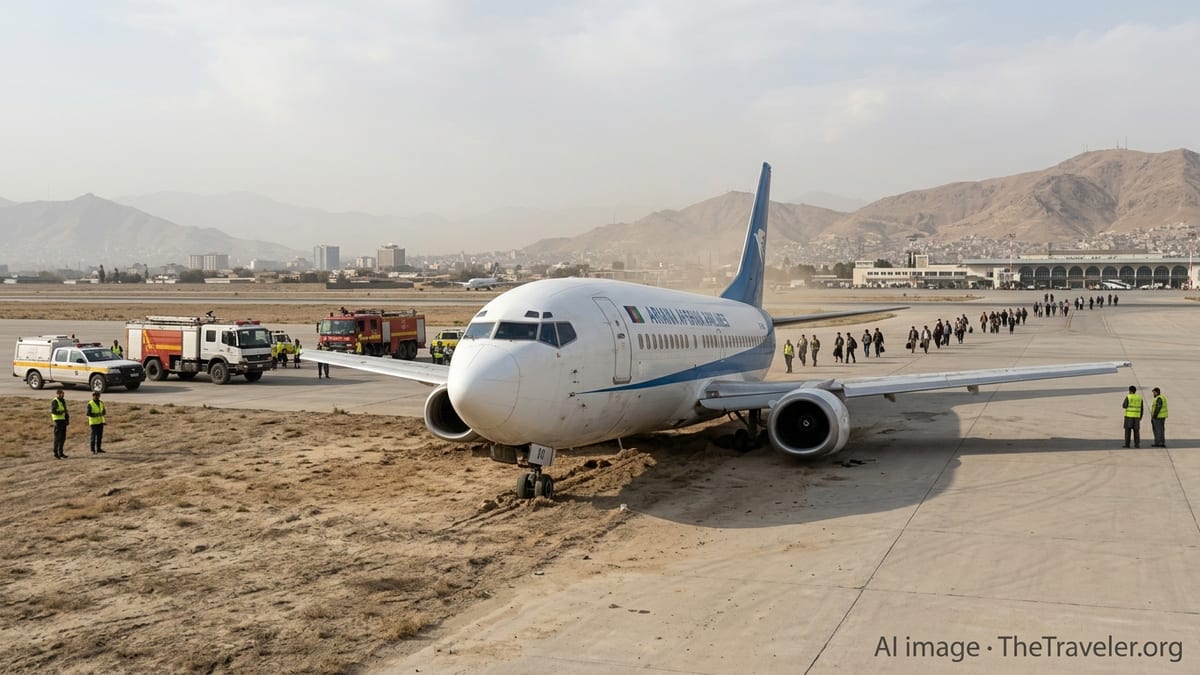
Runway Excursion Sparks Emergency Response in Kabul
Initial reports and imagery circulating on aviation forums and social media indicate that the Ariana Afghan Airlines jet veered off the paved surface after landing at Kabul International Airport, coming to rest on soft ground beside the runway. The aircraft is described as a Boeing 737-400, one of the older narrowbody models in the carrier’s small fleet.
Footage posted online appears to show passengers evacuating via mobile stairs and moving across the tarmac while the aircraft sits askew with its nose off the centerline. Commentaries from aviation enthusiasts suggest that, despite visible damage to landing-gear and lower-fuselage areas, the airframe remained largely intact, helping to prevent more serious consequences.
Publicly available information so far does not indicate fatalities, and online accounts describe the evacuation as relatively orderly. However, the incident has added to growing concern about the operational environment at Kabul’s main airport, where resources, training and equipment have been under pressure since the wider international withdrawal and the shift in political control.
The excursion is understood to have occurred during landing rather than takeoff, distinguishing it from an earlier Ariana Afghan runway overrun involving another Boeing 737-400 at Khost Airport in August 2024, which also caused substantial damage and prompted questions about the airline’s safety practices.
Flight Operations Halted Amid Runway Inspection and Aircraft Recovery
The runway excursion prompted an immediate halt to regular movements at Kabul International Airport while ground teams assessed potential damage and stability risks. Available aviation tracking data suggests that several arrivals destined for Kabul were delayed, diverted or held, while scheduled departures remained on the ground as airport staff and emergency vehicles surrounded the stranded aircraft.
Clearing a disabled jet from a runway is typically a complex process that can require specialized lifting equipment, towing vehicles and extensive coordination between airport management and the airline. In Kabul, where ground-handling infrastructure is more limited than at large regional hubs, the task is expected to be more challenging and time-consuming, increasing the duration of disruption for passengers and carriers.
Airlines serving Kabul generally operate on tight schedules, with relatively few daily frequencies to key regional destinations. Even a temporary closure of the main runway can create a cascading effect, with missed connections, crew duty-time complications and delayed freight deliveries, including humanitarian supplies. Aviation monitoring sites and local media reports indicate that these knock-on impacts were already visible within hours of the incident.
Once the aircraft is removed, airport staff are expected to carry out a close inspection of the runway surface and adjacent safety areas for debris, structural damage or contamination from fuel and hydraulic fluid. Only after such checks are completed and any necessary repairs made can full operations safely resume.
Probe Underway Into Causes and Contributing Factors
According to published coverage of previous Afghan aviation incidents, inquiries in the country typically involve the national civil aviation authorities, with technical support sometimes drawn from international organizations and aircraft manufacturers. In this latest case, observers expect a formal investigation into why the 737-400 was unable to remain on the runway and what factors may have contributed to the loss of directional control.
Key areas of focus are likely to include runway conditions at the time of landing, such as possible contamination by water, dust or debris, as well as wind, visibility and any mechanical or braking issues. Investigators are also expected to examine flight crew decision-making, including landing speed and configuration, touchdown point and the use of reverse thrust and braking systems.
Publicly available data on Ariana Afghan Airlines shows that the carrier operates aging aircraft with relatively complex maintenance demands. Aviation analysts often highlight that older airframes, while not inherently unsafe, require rigorous inspection regimes, a robust supply chain for spare parts and continuous pilot training to manage non-standard situations, all of which can be more difficult to maintain in challenging economic and political conditions.
The Kabul event follows the airline’s earlier Boeing 737-400 overrun in Khost in August 2024, where the aircraft departed the end of the runway during takeoff and struck obstacles before diverting to Kabul. That incident, widely discussed in industry roundups of commercial safety events, has been cited by commentators as a warning sign about operational margins in Afghanistan’s domestic and international air network.
Chaos and Confusion for Passengers at Kabul Airport
Travelers present at Kabul International Airport reported on social channels that the runway incident rapidly translated into confusion inside the terminal, with departure boards freezing, queues forming at check-in counters and limited public announcements about the evolving situation. Some passengers described being moved between gates or asked to wait in crowded holding areas while staff sought updated information on whether flights would operate.
For many travelers, particularly those without flexible visas or accommodation options, any prolonged disruption at Kabul can be especially stressful. Afghanistan’s limited connectivity means that missed flights can translate into days of delay, and same-day rebooking options are scarce compared with larger regional hubs in the Gulf or South Asia.
International humanitarian workers, business travelers and Afghan residents alike rely heavily on a small number of carriers serving Kabul, including the national airline and regional operators. As a result, capacity constraints can quickly emerge when even a single aircraft is taken out of service for repairs or inspection after an incident.
Reports indicate that some travelers sought alternative routes via neighboring countries, while others remained in limbo pending clearance of the runway and confirmation that their aircraft and crews remained available. For outbound passengers booked on Ariana Afghan Airlines itself, the sight of the damaged 737-400 on the field has raised immediate questions about future schedules and ticket changes.
Renewed Focus on Aviation Safety in Afghanistan
The Kabul runway excursion arrives at a time when Afghanistan’s aviation sector is already under close international scrutiny. Earlier coverage of the Khost overrun and a separate wrong-runway landing by an Ariana Afghan flight in Delhi in 2025 have drawn attention to issues ranging from pilot training and cockpit resource management to air traffic control procedures and navigational infrastructure.
Industry observers note that Afghanistan’s geography, climate and higher-elevation airports demand careful performance planning, particularly for older narrowbody jets operating near maximum takeoff or landing weights. Hot temperatures, short or uneven runways and surrounding terrain all reduce operational margins, making strict adherence to procedures critical.
International safety reviews frequently emphasize the need for continuous simulator training, updated approach and departure procedures and reliable instrument landing systems to support pilots in marginal conditions. However, constraints on funding, technical expertise and international engagement can slow the implementation of such improvements at Afghan airports.
For travelers, the latest incident may prompt closer scrutiny of carrier safety records and a renewed preference for routing through larger, better-resourced hubs whenever possible. Aviation analysts predict that, depending on the findings of the forthcoming investigation, Ariana Afghan Airlines may face fresh pressure to modernize its fleet, strengthen training programs and enhance oversight in order to maintain essential connectivity for the country.