

More news on this day
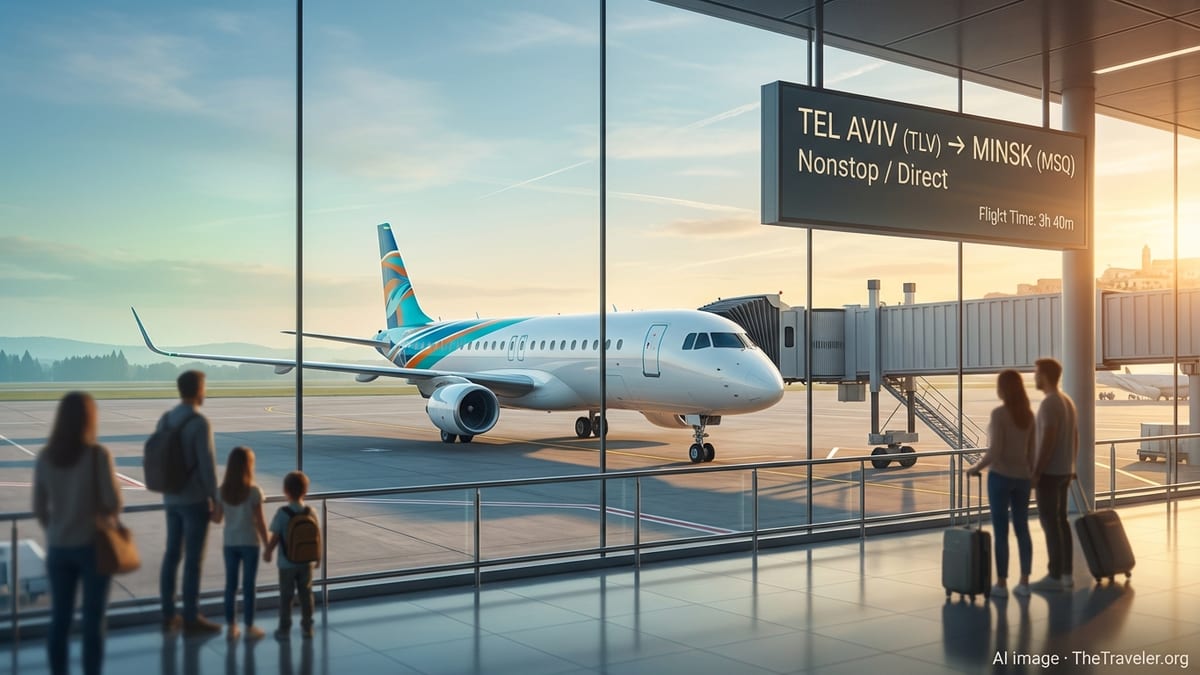
Travelers between Israel and Belarus are about to gain a powerful new shortcut. Arkia Israeli Airlines is rolling out direct Tel Aviv to Minsk flights that eliminate the time-consuming layovers that have long defined this corridor, positioning the route as a fast, modern bridge between the Mediterranean and Eastern Europe.
With convenient schedules, competitive fares, and a focus on a smooth passenger experience, Arkia is pitching the new service as a genuine upgrade to how Israelis, Belarusians, and connecting tourists plan their vacations.
More News
- TSA Rolls Out $45 ConfirmID Fee for Travelers Without REAL ID at Security
- Flying Blue Launches February 25% Promo Rewards on Transatlantic and Regional Routes
- United Fast-Tracks Starlink Wi‑Fi Across Fleet, Free for MileagePlus Members
A New Nonstop Corridor Between Tel Aviv and Minsk
After several years of disrupted connectivity, direct air links between Belarus and Israel are returning, with Arkia stepping in as a key player. The Israeli carrier has confirmed plans for nonstop Tel Aviv–Minsk services from early February 2026, operating out of Ben Gurion International Airport and landing at Minsk National Airport. The flights dramatically simplify a journey that, since 2022, often required tedious detours through third countries, extended transit times, and multiple security checks.
Arkia’s schedule is designed to be straightforward: two weekly flights, typically on Mondays and Fridays, creating an easy pattern for both weeklong vacations and long-weekend breaks. Flight time on the route is set at around 3 hours 30 to 3 hours 45 minutes, depending on direction, roughly cutting the total door-to-door journey time that many travelers previously faced when forced onto connecting itineraries.
The restoration of nonstop connectivity also marks a symbolic reopening of an important air corridor. Regular flights between the two countries were suspended in spring 2022 amid geopolitical tensions, leaving a significant gap for tourism, business ties, and family visits. With Arkia entering the market alongside Belarusian carrier Belavia, observers see the route’s return as a vote of confidence in renewed demand and in the long-term value of direct links between Minsk and Tel Aviv.
From Multi-Stop Hassle To Seamless City-Pair Travel
For several years, passengers traveling between Israel and Belarus have often had to route through hubs such as Istanbul, the Caucasus, or Central Europe, turning what should be a short hop into an all-day, sometimes overnight, journey. Arkia’s direct service aims to erase that complexity. By cutting out transfers, the airline is effectively handing back half a day to many passengers, a change that is particularly meaningful for short vacations and quick business trips.
Removing layovers does more than simply shorten itineraries. It also reduces the cumulative risk of delays and missed connections, a growing concern in a period of congested airports and stretched ground operations worldwide. A single, point-to-point flight means fewer queues, fewer passport control lines, and a dramatically lower chance that luggage will go astray somewhere between origin and destination.
In practical terms, that creates a more predictable travel experience. Families can plan arrivals in Minsk closely around hotel check‑in times, tour departures, or family gatherings. Business travelers can schedule meetings for the afternoon of arrival without worrying about a missed connection pushing them into the evening. For Arkia’s commercial team, this operational simplicity is a core selling point, allowing the airline to brand the route as a premium yet accessible upgrade over the patchwork of connecting options that dominated in recent years.
Arkia’s Schedule, Aircraft And Onboard Experience
Arkia is deploying its Embraer E‑Jet family aircraft, notably the E195, on the Tel Aviv–Minsk route. The type is well suited to medium-haul regional services, offering a cabin configuration that feels more personal than large single‑aisle jets while still providing modern amenities. The two-by-two seating layout across the cabin means there are no middle seats, an immediate comfort boost for travelers used to narrow-body layouts on busy regional routes.
Typical flight times of just under four hours give Arkia the opportunity to offer a service level tailored to leisure and visiting‑friends‑and‑relatives traffic. Hot meals, complimentary soft drinks on many fares, and buy-on-board enhancements where applicable are expected to feature, in line with the airline’s broader product on regional routes. For travelers choosing to upgrade, Arkia’s higher fare tiers typically add greater flexibility, additional baggage, and seat selection in preferred rows.
Arkia’s initial schedule is built around twice-weekly operations, fitting neatly into the airline’s broader network planning for 2026. Early‑morning or midday departures from Tel Aviv aim to get passengers into Minsk with plenty of daylight left, while return flights are timed for comfortable evening arrivals back in Israel. At Ben Gurion International Airport, flights are scheduled to operate through the main Terminal 3, offering familiar facilities and smoother connections to domestic ground transport for passengers arriving back home.
Pricing, Booking Trends And The Battle With Layovers
Arkia is pairing the new nonstop service with headline-grabbing fares aimed at quickly stimulating demand. One‑way tickets have been advertised starting in the mid‑200‑dollar range, with early booking windows focused on February and March 2026. For many travelers, particularly families or small groups, those prices are competitive with or even cheaper than multi‑segment itineraries that involve stops in third countries, especially once extra baggage fees and airport expenses during layovers are factored in.
Industry fare trackers and online travel agencies already show Arkia’s name appearing prominently in search results for Tel Aviv–Minsk, often undercutting or matching connecting options offered by carriers via the Caucasus or other hubs. That pricing strategy indicates an aggressive push to capture market share quickly as direct flights come back into the picture. Analysts say the airline is likely banking on strong early take‑up from the Belarusian diaspora in Israel, as well as tourists looking for new weekend‑break destinations beyond the traditional European capitals.
Advance sales patterns suggest interest is strongest around holiday periods, school vacations, and shoulder-season weekends, with Arkia emphasizing the route as an enabler of easy, three- or four‑night city stays. The message is clear: instead of burning an extra day each way in transit, travelers can maximize their time on the ground in Minsk’s historic center, its surrounding forests and lakes, or onward regional destinations, all on a schedule that fits around work and family commitments.
Tourism, Culture And The Jewish Heritage Draw
Belarus remains relatively underexplored for many Israeli and Western tourists, something Arkia’s marketing teams are eager to change. The airline is positioning Minsk not only as a capital city break destination, with its museums, theaters, and café culture, but also as a gateway to a wider countryside rich in castles, national parks, and small towns with deep Jewish historical roots.
Jewish heritage travel is expected to be a major component of initial demand. Many Israelis trace family origins to what is now Belarus, and the country holds numerous synagogues, cemeteries, and memorial sites tied to centuries of Jewish life and to the tragedies of the twentieth century. Direct air service makes it significantly easier for descendants to visit ancestral towns, research family histories, or join organized heritage tours that were harder to schedule reliably when the route depended on third‑country connections.
On the inbound side, Belarusian visitors to Israel can once again plan pilgrimages and vacations in and around Jerusalem, Tel Aviv, the Dead Sea, and the Galilee without worrying about prolonged travel or the uncertainties of changing planes. Tour operators in both countries are responding by building new itineraries specifically around the revived nonstop links, including twin‑center holidays that combine Minsk or regional Belarus with a few days on Israel’s Mediterranean coast.
Economic, Diaspora And Diplomatic Ripples
Direct flights do more than move tourists. Before 2022, the Minsk–Tel Aviv corridor was an important artery for business travelers, migrant workers, and members of a sizable Belarusian diaspora in Israel. The return of Arkia to this market is widely expected to restore many of those flows and open the door to new commercial and cultural collaborations.
Small and medium-sized businesses that straddle both countries, particularly in technology, agriculture, and services, stand to benefit from predictable, year‑round access. For entrepreneurs, the difference between a simple nonstop flight and a day of connecting travel can determine whether a face‑to‑face meeting or site visit is feasible. Trade fairs, conferences, and cultural festivals are likewise easier to plan when direct capacity is available on fixed days every week.
There are also softer diplomatic implications. While Arkia is a commercial airline, its decision to commit aircraft and slots to Minsk sends a signal about expectations for long‑term stability in the corridor. Together with Belavia’s resumed operations, the airline’s presence restores an air bridge that once played a visible role in people‑to‑people ties, student exchanges, and religious and cultural delegations. Industry observers note that, even in periods of political complexity, stable travel links can serve as a practical foundation for dialogue and everyday cooperation.
Competition, Capacity And The Future Of The Route
Arkia is not alone on the Tel Aviv–Minsk stage. Belavia, the Belarusian national carrier, is also resuming services on the route, operating its own twice‑weekly flights from January 2026. That means travelers will have a choice between two carriers offering point‑to‑point service, a sharp contrast with the previous few years when only indirect options were available.
This dual‑carrier setup introduces welcome competition in schedule timing, onboard product, and pricing. Belavia’s operation with larger Boeing 737 aircraft suggests a focus on capacity and a more traditional full‑service experience, including business class cabins, while Arkia’s Embraer jets emphasize a slightly more intimate regional feel. For passengers, the outcome is a wider range of departure days, cabin choices, and fare types, improving the odds of finding a flight that aligns with specific budgets and travel preferences.
Looking ahead, much will depend on how quickly demand returns and whether geopolitical conditions remain stable. If load factors are strong through late winter and into the spring, aviation analysts expect both Arkia and Belavia to consider extending seasonal schedules, adding frequencies, or attaching connecting services to feed traffic from other cities. The renewed route could also serve as a test case for further Arkia expansion into Eastern European markets that once relied on multi‑stop itineraries but may now support dedicated nonstops.
FAQ
Q1. When do Arkia’s direct Tel Aviv to Minsk flights start?
Arkia’s nonstop Tel Aviv–Minsk service is scheduled to begin in early February 2026, with the first flights opening a regular twice‑weekly pattern between Ben Gurion International Airport and Minsk National Airport.
Q2. How often will Arkia operate flights between Tel Aviv and Minsk?
Arkia plans to operate two flights per week on the route, typically on Mondays and Fridays, creating convenient options for long weekends, short business trips, and weeklong vacations.
Q3. How long is the flight from Tel Aviv to Minsk with Arkia?
The direct flight time is expected to be around 3 hours 30 minutes to 3 hours 45 minutes, depending on direction and operating conditions, making it a relatively short medium‑haul journey.
Q4. What aircraft will Arkia use on the Tel Aviv–Minsk route?
Arkia is deploying Embraer E‑Jet family aircraft, notably the E195, which offers a comfortable two‑by‑two seating layout, modern cabins, and no middle seats for passengers.
Q5. How do Arkia’s fares compare with connecting flights via third countries?
Early promotional fares for Arkia’s nonstop service are positioned to be competitive with, and in many cases cheaper than, itineraries that require layovers, especially once extra costs such as transit airport spending and additional baggage fees on multiple segments are considered.
Q6. What are the main advantages of choosing Arkia’s nonstop flight over a connecting itinerary?
Travelers benefit from shorter total journey times, fewer airport queues and security checks, reduced risk of missed connections, and a much lower chance of baggage delays, all of which contribute to a more predictable and less stressful trip.
Q7. Who is expected to use the new Tel Aviv–Minsk flights most?
The route is expected to draw strong demand from the Belarusian diaspora in Israel, leisure travelers exploring new destinations, Jewish heritage visitors tracing family roots in Belarus, and business travelers maintaining commercial links between the two countries.
Q8. Will other airlines also offer direct flights between Minsk and Tel Aviv?
Yes, Belarusian carrier Belavia has announced its own twice‑weekly Minsk–Tel Aviv flights, meaning passengers will be able to choose between Arkia and Belavia for nonstop travel on this corridor.
Q9. Can travelers connect onward from Minsk or Tel Aviv using Arkia’s new service?
While the Tel Aviv–Minsk flight itself is point‑to‑point, passengers can build their own itineraries by combining Arkia’s Tel Aviv network with separate tickets from Minsk on other carriers, effectively using the route as a bridge between Israel and the wider Eastern European region.
Q10. How does this new Arkia route change the overall vacation experience?
By eliminating layovers, providing predictable schedules, and offering competitive fares on modern regional aircraft, Arkia’s Tel Aviv–Minsk route turns what was often a complicated, multi‑stop trip into a simple city‑pair journey, giving travelers more time at their destination and less time in transit.