

More news on this day
Israeli carrier Arkia has announced special flights between Athens and the Egyptian resort of Taba, operated in partnership with Electra Airways, creating a vital overland route for thousands of passengers stranded by the sudden closure of Israel’s airspace.
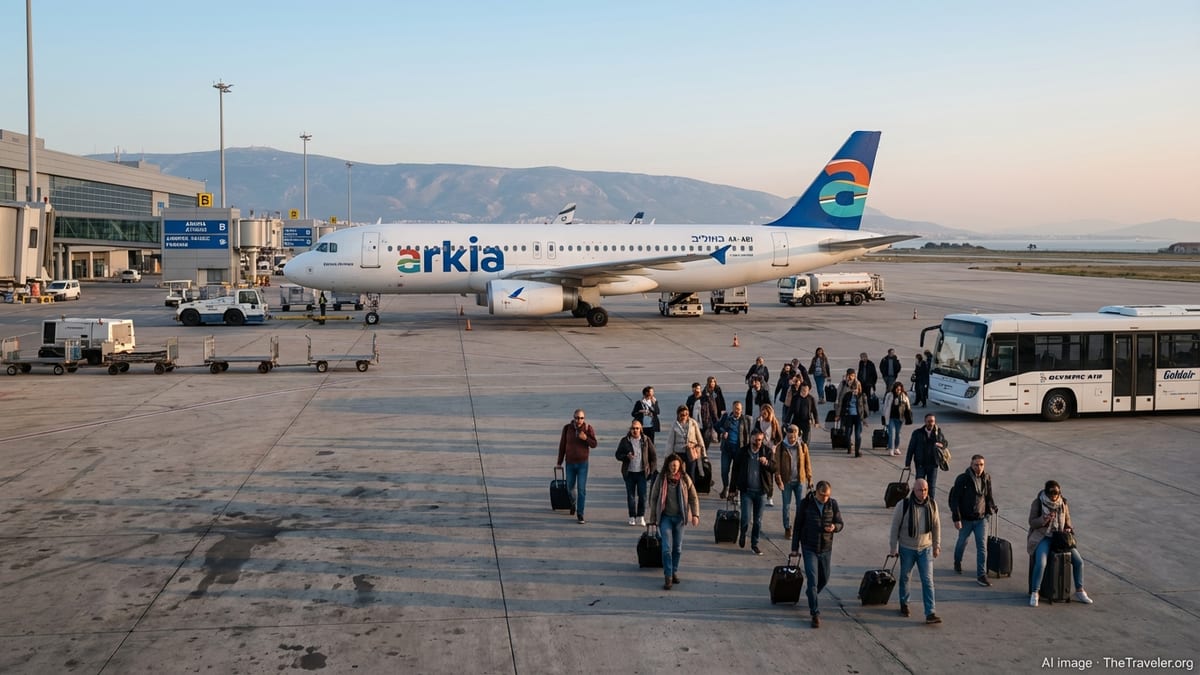
New Emergency Route Linking Athens and Taba
Arkia’s new operation establishes a temporary shuttle between Athens International Airport and Taba on Egypt’s Red Sea coast, offering travelers a way to skirt the shutdown of Israel’s skies. The flights, which began operating on March 1, are marketed and coordinated by Arkia but flown by Bulgaria-based Electra Airways using Airbus A320 aircraft.
The route is designed as a bridge rather than a traditional holiday connection. Passengers can fly into Athens from a range of European and international cities, then continue on to Taba and complete their journey by land, crossing into Israel via the Taba border terminal near Eilat. The service also works in reverse, allowing travelers who managed to reach southern Israel by road to exit via Taba and connect to onward flights from Athens.
Initial fares have been set from around 359 dollars one way, excluding baggage, with surcharges for cabin trolleys and checked suitcases. While higher than typical regional tickets, the pricing reflects both urgent demand and the operational constraints of running a short-notice shuttle during an ongoing regional security crisis.
Arkia has framed the move as an emergency measure aimed at maintaining a basic flow of passengers while Ben Gurion Airport remains off limits to commercial traffic. Seats on the first departures sold quickly as word spread among tour groups, independent travelers and Israelis who had been rerouted to Athens when their original flights to Tel Aviv were canceled.
Airspace Closure Triggers Wave of Cancellations
The Athens–Taba initiative comes against the backdrop of an unprecedented disruption to civil aviation across the Eastern Mediterranean and Gulf. Israel closed its airspace on Saturday following coordinated US and Israeli strikes on Iran and ongoing missile fire in the region, forcing airlines to divert or cancel flights into Tel Aviv at short notice.
Foreign carriers including Lufthansa Group, Wizz Air and regional operators have extended suspensions of Israel services at least through the first week of March. European aviation regulators have also issued conflict-zone bulletins advising airlines to avoid multiple national airspaces, complicating routing options for carriers trying to maintain long-haul schedules through the Middle East.
Elsewhere in the region, major Gulf airlines such as Etihad Airways and Qatar Airways have temporarily halted or sharply curtailed operations as they navigate a patchwork of closures and military no-fly zones. The result is a web of disrupted itineraries, with Athens, Cairo and other hubs absorbing diverted aircraft and unexpected layovers.
For passengers, the combination of national airspace closures, airline self-suspensions and rapidly changing security advisories has created a patchy, unpredictable map of possibilities. In this context, any stable corridor that allows people to move closer to their final destination has acquired outsized importance.
Overland Crossing Through Sinai as a Pressure Valve
By pairing Athens with Taba, Arkia and Electra Airways are tapping into an established but usually niche route into Israel: the land crossing at the southern tip of the Sinai Peninsula. Under normal circumstances, the Taba terminal is best known as an entry point for Israelis heading to Red Sea beach resorts, not as a primary gateway for international repatriation.
This week, however, the dusty crossing south of Eilat has become a pressure valve for a stressed system. Travelers landing in Taba can board buses or taxis to reach the border, then continue on Israeli roads to Eilat and further north. In the opposite direction, Israelis able to reach Eilat by domestic transport can exit at Taba and continue by air from Egypt to Greece and beyond.
Officials have cautioned that the route is not without its own complexities. Israel’s National Security Council has in the past warned of heightened security concerns in parts of Sinai, and travelers are being advised to stay updated on government guidance regarding overland travel. Crossing procedures, border queues and ground transport capacity may also fluctuate as more passengers funnel through the small terminal.
Despite these caveats, the Athens–Taba bridge is already being viewed as one of the few viable alternatives for those who cannot or do not wish to wait for a full reopening of Ben Gurion Airport or for large-scale rescue operations operated directly into Israel.
Thousands Stranded as Carriers Prioritize Repatriation
The launch of the special flights coincides with mounting pressure on Israeli and foreign airlines to bring home citizens and residents stranded abroad. Tens of thousands of people saw their flights to Tel Aviv abruptly canceled after operations were frozen, many only learning of the shutdown after reaching departure gates in Europe, North America and Asia.
Flag carrier El Al has temporarily closed new ticket sales until at least March 21 while it builds a repatriation schedule that will prioritize customers whose original flights were canceled. The airline earlier repositioned aircraft out of Tel Aviv to airports such as Athens, Bucharest and Paris to be ready for a rapid ramp-up of inbound services once regulators give the green light.
Israel’s other domestic airlines, along with charter operators, are also preparing ad hoc return flights from European and Mediterranean airports. However, uncertainty over when and how airspace restrictions will be eased means that firm timetables remain fluid, and passengers are being urged to stay in close contact with their airlines and travel agents.
In this environment, Arkia’s Athens–Taba option is serving not as a complete solution, but as one additional strand in a patchwork of routes that include land entries from Jordan and Egypt, limited sea passages from Cyprus and carefully controlled humanitarian flights.
What Travelers Should Expect in the Coming Days
Travel experts warn that demand for the Athens–Taba flights is likely to outstrip supply, at least in the short term. Seats are limited by aircraft size and crew availability, and operating in a region under heightened military alert leaves little room for schedule elasticity. Prospective passengers are being advised to monitor Arkia’s channels for added frequencies or schedule changes.
Costs could also fluctuate as airlines balance operational risk and demand. Passengers using the corridor need to factor in not only airfare but also ground transport between Taba and Israeli cities, as well as potential overnight stays in Athens or Eilat as they stitch together multi-leg journeys home.
For now, both airlines and regulators appear focused on maintaining essential connectivity rather than restoring full commercial networks. The Athens–Taba shuttle, pieced together quickly under crisis conditions, reflects that priority. It is a pragmatic workaround that depends on coordination between carriers, border authorities and security agencies on both sides of the Sinai frontier.
How long the special flights will operate remains unclear and will depend on both the security situation and the pace at which Israel’s main airports can safely resume normal traffic. Until then, Arkia’s partnership with Electra Airways provides a narrow but critical corridor for those still searching for a way home.