

More news on this day
Saudi Arabia’s Aroya Cruises has curtailed its inaugural Arabian Gulf season amid regional disruption, completing a controlled disembarkation of guests in Dubai and signaling plans to resume Gulf deployments by 2027 as cruise tourism in the region continues to expand.
Get the latest news straight to your inbox!
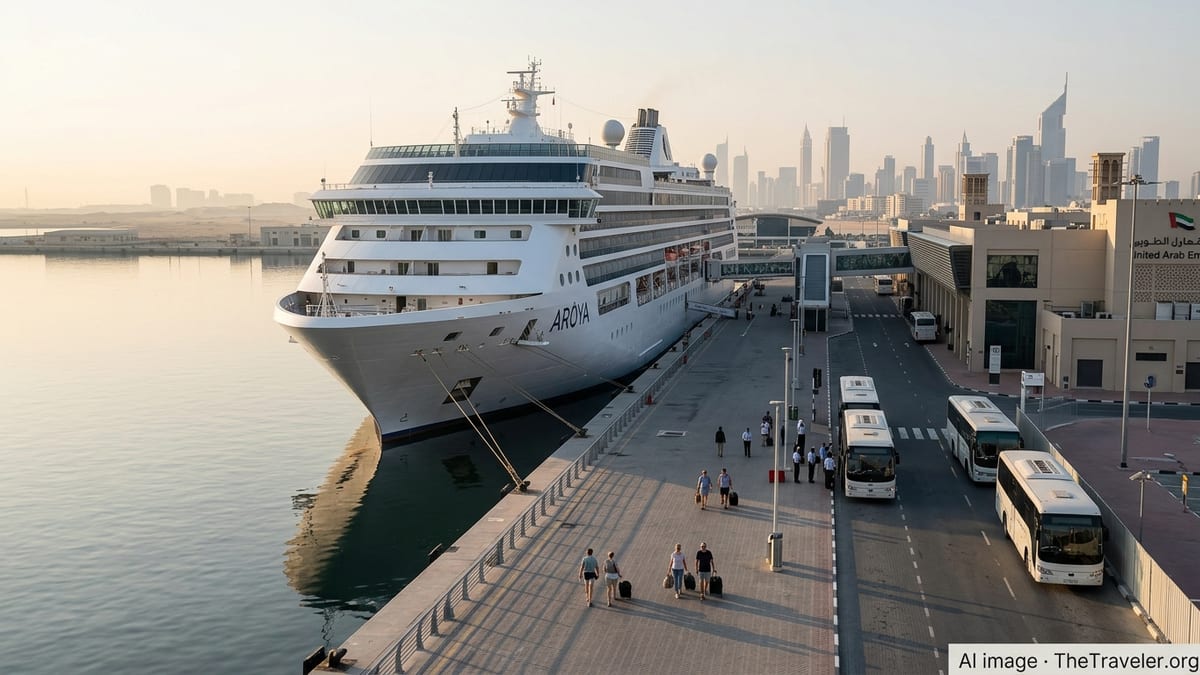
Orderly Disembarkation Marks Early End to Gulf Season
According to an operational update published on the Aroya Cruises website on 7 March 2026, the line has brought its Arabian Gulf season to an early close, citing regional operational considerations. Publicly available information indicates that all guests on board the company’s flagship vessel were safely disembarked in Dubai on 7 March, following several days of mounting travel disruption across Gulf ports.
Industry coverage notes that the ship had only recently launched its first Arabian Gulf itineraries, operating from Dubai with calls planned across the United Arab Emirates, Qatar, Oman and Saudi Arabia. The season was initially scheduled to run through early May, but escalating regional constraints on air and sea movements prompted cruise lines to shorten their winter deployments.
Aroya Cruises’ update emphasizes that affected guests were contacted directly and provided guidance in line with the company’s guest policies. Reports indicate that the line’s shoreside teams worked to assist passengers with onward travel arrangements from Dubai, reflecting the broader logistical challenge of repatriating thousands of cruise guests from the region.
The decision aligns with a series of itinerary changes by multiple cruise brands operating in the Arabian Gulf, where cruise ships have remained alongside in major ports while repatriation plans are completed and future sailings reassessed.
Regional Disruption Forces Widespread Cruise Cancellations
Travel and maritime bulletins describe a sharp reduction in commercial movements across key Gulf corridors in early March, as regional tensions affected both shipping and aviation. Cruise industry reports show that Aroya Cruises joined Celestyal Cruises, MSC Cruises and TUI Cruises in cancelling or curtailing winter Gulf programs for the remainder of the 2025–26 season.
Coverage in specialist cruise publications outlines how multiple ships, including Aroya’s flagship and several European-operated vessels, either advanced the end of their seasons or declared end-of-voyage in Gulf ports. This led to complex repatriation operations, with airlines and charter providers coordinating departures from hubs such as Dubai.
Analysts note that the Gulf’s cruise infrastructure remained largely intact, with major ports and terminals operational, but heightened risk assessments and airspace restrictions made it increasingly difficult to maintain regular passenger cruise schedules. Given the discretionary nature of leisure travel, cruise operators moved quickly to suspend itineraries rather than attempt modified sailings in a rapidly changing environment.
While the immediate impact has been the loss of late-season voyages and associated tourism revenue, observers point out that most operators, including Aroya Cruises, have framed the suspension as a temporary response to exceptional conditions rather than a long-term withdrawal from the region.
Plans for Red Sea and Mediterranean Keep Aroya Sailing
Even as the Arabian Gulf program pauses, Aroya Cruises is maintaining a broader deployment strategy across the Red Sea and Eastern Mediterranean. Prior announcements from the line and coverage in regional cruise media detail a schedule of three- to five-night Red Sea sailings from Jeddah, followed by a summer season homeporting in Istanbul from June 2026.
Published itineraries show the ship operating a mix of short and week-long cruises to ports in Saudi Arabia, Egypt and Jordan before repositioning to Turkey for Eastern Mediterranean routes. These voyages are expected to include popular destinations such as Sharm El Sheikh and ports along the Turkish coast, providing continuity of operations while Gulf sailings are on hold.
Industry commentary suggests that this dual focus on the Red Sea and Mediterranean allows Aroya Cruises to continue building brand recognition and operational experience while regional conditions in the Gulf stabilize. It also supports Saudi Arabia’s wider tourism diversification goals, which position cruising as a key growth pillar alongside aviation and resort development.
By sustaining its broader network, the line retains the flexibility to reintroduce Arabian Gulf itineraries once conditions support a full seasonal program, limiting the long-term impact of the current suspension on its overall growth trajectory.
Looking to 2027 for a Structured Gulf Return
While the line’s immediate public updates concentrate on guest safety and current-season changes, planning signals emerging from cruise industry coverage point to a medium-term return to the Arabian Gulf, with 2027 identified by analysts as a realistic horizon for a renewed, stable deployment.
Commentary in regional cruise trade publications notes that Aroya Cruises and other operators typically blueprint Gulf seasons one to two years in advance, aligning ship positioning with winter demand patterns and port development timelines. Given the disruption to the 2025–26 program, industry observers expect a cautious approach to 2026 in the Gulf, with full-scale growth efforts more likely to resume from the 2026–27 and 2027–28 winter windows.
A 2027 relaunch would allow time for maritime risk assessments, air connectivity and port operations to normalize, while enabling Aroya Cruises to refine its product based on feedback from its Red Sea and Mediterranean deployments. It would also dovetail with broader tourism initiatives in Saudi Arabia and neighboring states, where new terminals and waterfront developments are being positioned to handle rising cruise volumes.
For prospective guests and travel partners, this suggests that Arabian Gulf itineraries will remain part of Aroya Cruises’ long-term strategy, but with an emphasis on predictability and resilience after the challenges experienced in early 2026.
Cruise Tourism Growth Continues Despite Short-Term Setback
The early end to Aroya Cruises’ Gulf season comes at a time when cruise tourism in the region has been on a clear upward trajectory. Over the past several years, port investments in Jeddah, Dubai, Doha, Abu Dhabi and other Gulf cities have been designed to attract larger ships, streamline passenger handling and position the region as a winter alternative to traditional Caribbean and Mediterranean routes.
Pre-disruption forecasts from cruise market analysts highlighted steady increases in passenger volumes across the Arabian Gulf, driven by new homeports, simplified visa processes and marketing efforts targeting both regional travelers and international fly-cruise guests. Aroya Cruises, launched as a Saudi-focused brand, has been regarded as a cornerstone of these plans, aimed at cultivating a domestic and regional source market in addition to international visitors.
Although the current suspension has interrupted that momentum, industry observers widely view the situation as a short-term pause rather than a reversal. The underlying fundamentals driving cruise growth in the Middle East, including year-round sunshine, modern infrastructure and substantial tourism investment, remain in place.
As Aroya Cruises concentrates on safely concluding its current operations and redirecting capacity to the Red Sea and Mediterranean, the longer-term outlook for cruise tourism in the Arabian Gulf continues to be framed in terms of resilience and deferred growth. A structured return targeted around 2027 would align with this narrative, positioning the line to benefit when regional conditions once again support a full winter season of sailings.