

More news on this day
Saudi Arabia’s Aroya Cruises has suspended its Arabian Gulf sailings and is closely monitoring security conditions in the Strait of Hormuz region, underscoring both the vulnerability and resilience of a cruise sector that has grown rapidly in the Gulf despite surging geopolitical risks.
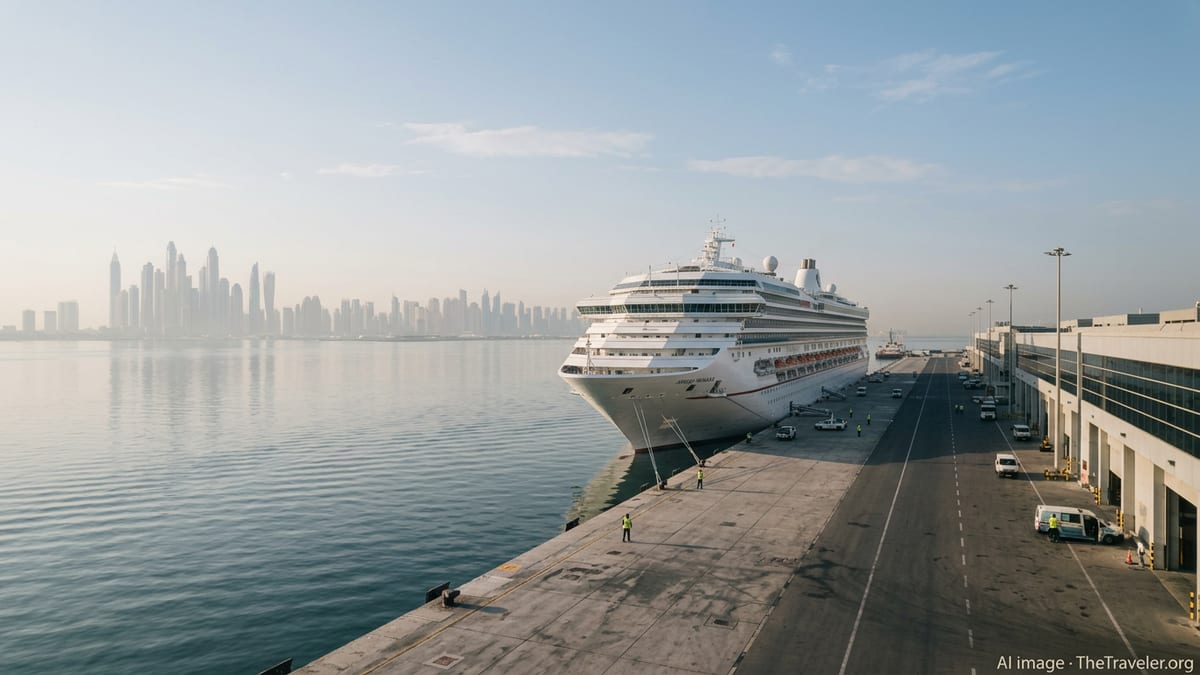
Aroya Manara Idle in Dubai as Sailings Put on Hold
Aroya Cruises, the Saudi-backed brand that only began its inaugural Arabian Gulf season in late February, has put upcoming itineraries on hold as tensions spike around the Strait of Hormuz. Its sole vessel, the Aroya Manara, remains alongside in Dubai with future departures suspended while the line evaluates safety, insurance and airspace constraints affecting the wider region.
The decision follows days of rapid escalation, including reported attacks on commercial vessels and the effective closure of the Strait of Hormuz to most cruise and cargo traffic. Industry outlets and regional travel trade reports indicate that Aroya has halted all scheduled Gulf cruises through at least May 2026, pending clearer guidance from maritime and government authorities on when routine operations can safely resume.
Aroya had positioned itself as a new regional champion for homegrown cruising, promoting short sailings linking the United Arab Emirates, Qatar and Saudi ports. The abrupt pause has left guests facing cancelled holidays, rebookings or complex repatriation journeys as airline schedules across multiple Gulf states are disrupted by airspace restrictions and flight suspensions.
While the line has emphasized that the safety of passengers and crew remains its primary concern, the grounding of Aroya Manara highlights how quickly a promising new tourism product in the Gulf can be upended by shifts in the regional security environment.
Wider Arabian Gulf Cruise Season Unravels
Aroya’s suspension comes amid a broader, near-total shutdown of cruise activity in the Arabian Gulf. Celestyal has cancelled all remaining departures in its 2025 to 2026 “Desert Days” program, ending its season weeks early after its ships were forced to remain in Dubai and Doha instead of continuing round trip voyages. MSC Cruises and TUI Cruises have similarly withdrawn or frozen Gulf sailings, citing elevated security risks, closed or restricted airspace and uncertainty over marine insurance coverage.
Travel trade reports describe thousands of cruise passengers temporarily stranded on vessels in Dubai, Abu Dhabi and Doha, as operators work with local authorities and embassies to organize departures on a reduced number of flights still operating into and out of the region. Port calls in Bahrain and several other Gulf destinations have largely ceased as itineraries are cancelled or rewritten around safer waters.
At sea, maritime advisories describe commercial traffic through the Strait of Hormuz as effectively halted or drastically curtailed. Major container carriers have paused transits, and some shipping giants have stopped bookings to and from several Gulf countries until further notice. For the cruise sector, which relies on reliable port calls, predictable fuel supply and stable insurance, the sudden spike in risk has made regular turnarounds all but impossible in the short term.
Even vessels that remain technically able to operate are finding that closed or constrained airspace makes it difficult to move passengers and crew. For Gulf-based cruise homeports that have invested heavily in fly-cruise models, the aviation squeeze is proving almost as disruptive as conditions at sea.
Growth Story Tested, Not Broken
The current crisis lands at a sensitive moment for Arabian Gulf cruise ambitions. Over the past decade, regional governments have poured investment into cruise terminals, destination infrastructure and marketing in a bid to position the Gulf as a winter alternative to the Caribbean and Mediterranean. New terminals in Dubai, Doha and Saudi ports, along with dedicated visa schemes and bundled city stays, have helped push regional passenger numbers steadily higher.
Aroya Cruises itself is emblematic of those long term plans. Backed by Cruise Saudi, the brand was created to serve both domestic and international guests, tailoring itineraries and onboard experiences to Gulf culture while linking into wider initiatives to diversify Saudi Arabia’s tourism economy. The pause in operations, while disruptive, is being framed more as an operational safety decision than a retreat from the market.
Industry analysts note that cruise lines have weathered similar geopolitical shocks before, from past tensions in the Gulf to disruptions in the Eastern Mediterranean and Red Sea. In many cases, itineraries were temporarily redeployed, with ships repositioned to alternative regions until conditions stabilized, only for lines to return once risk levels and insurance costs normalized.
As a result, observers expect that the long term growth trajectory for Gulf cruising remains intact, even as the current security situation forces operators to compress or cancel at least part of the 2025 to 2026 winter season. The speed at which ships can be redeployed to the Mediterranean or other warm weather markets reinforces the sector’s flexibility in responding to fast changing regional events.
Logistics, Insurance and Airspace Complicate Recovery
Behind the headlines about stranded cruise passengers lies a more complex web of logistical and financial challenges. Container carriers, tanker operators and logistics firms have reported near total suspensions of transits through the Strait of Hormuz, while war risk surcharges and tightened insurance conditions are sharply raising the cost of any remaining voyages into the Arabian Gulf.
For cruise lines, those pressures translate into higher operating costs, uncertainty over fuel deliveries and limited confidence that itineraries can be executed safely and consistently. Port operations across the region are patchy, with some facilities reporting intermittent closures or heightened security checks. Airspace closures and reduced frequencies at major Gulf hubs are limiting the availability of flights used for cruise turnarounds, crew rotations and emergency repatriations.
Even if the security situation begins to ease, insurers and flag states are likely to move more slowly in restoring coverage and approving routine transits, potentially delaying the full resumption of Gulf cruises. Operators will need credible assurances that corridors are secure, ports are functioning on a predictable basis and that guests can access embarkation ports without facing cascading last minute flight cancellations.
In the interim, many lines are expected to accelerate plans to reposition ships toward the Mediterranean, Northern Europe or other established markets for the upcoming summer. That process, while operationally feasible, requires delicate communication with guests who had booked Gulf itineraries months in advance, as well as close coordination with travel advisors and tour operators who built packages around Arabian Gulf calls.
Signals of Resilience in Global Cruise Demand
Despite the abrupt stop to sailings in one of the industry’s newest growth regions, global cruise demand indicators remain strong. Major brands report healthy bookings for Caribbean, Mediterranean and Northern European deployments, with many ships sailing near or at full capacity in early 2026. The redirection of vessels away from the Gulf is more a question of geography than appetite, as travelers shift to alternative itineraries rather than abandon cruising altogether.
In other regions, port authorities and tourism boards are already positioning themselves to capture displaced capacity. Asian, Mediterranean and Indian Ocean destinations are marketing themselves as stable alternatives that can quickly absorb additional calls from vessels reassigned from the Gulf. That redeployment flexibility is central to how the cruise industry manages regional crises while protecting overall revenues.
For the Arabian Gulf, the current pause may ultimately underscore the strategic importance of building resilient, diversified tourism offerings that can withstand short term geopolitical shocks. Once maritime risks recede and airspace normalizes, Gulf ports are likely to leverage their upgraded terminals, modern airports and growing destination portfolios to lure ships back, including Aroya Manara.
Until then, Aroya Cruises’ decision to suspend operations and monitor conditions serves as a vivid illustration of both the fragility of regional cruise plans and the underlying strength of global cruise tourism, which has learned to bend around conflict zones while continuing to grow.