

More news on this day
Artemis II is poised to launch as the first crewed trip toward the Moon in more than half a century, and nearly every figure attached to the 2026 mission underscores its scale: from the 11 million pounds of rocket on the pad to the hundreds of thousands of miles the four-person crew is expected to travel before splashing back down on Earth.
Get the latest news straight to your inbox!
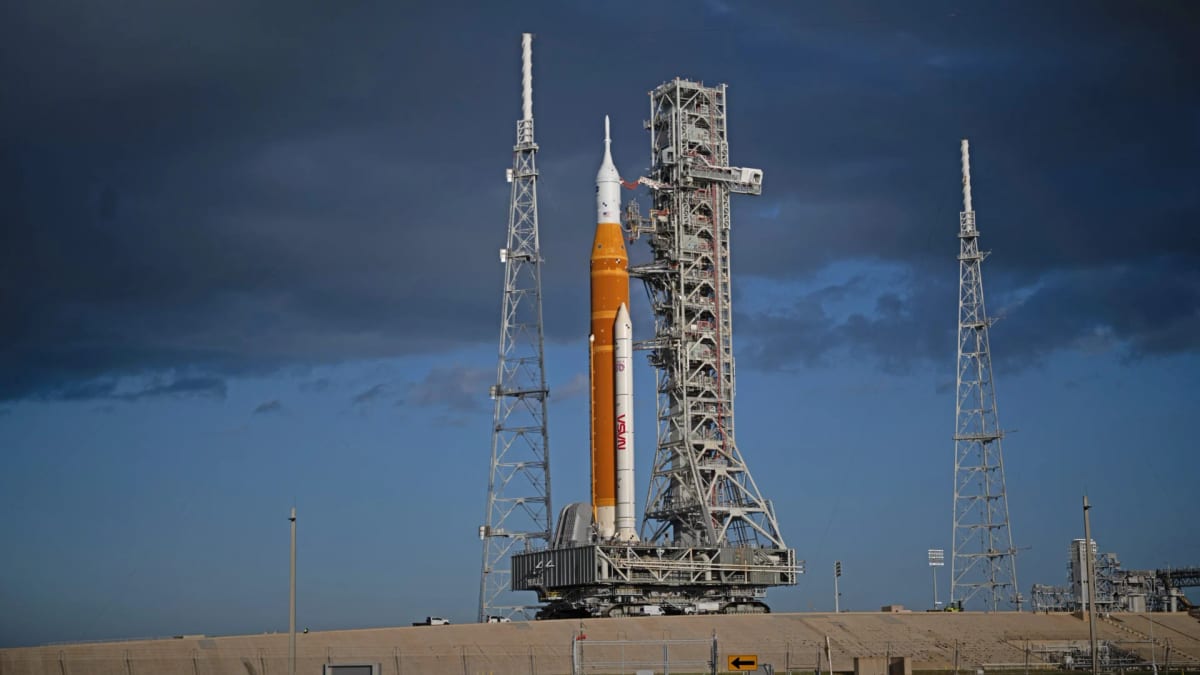
Image by AeroTime
Astronauts, launch window and mission profile
Publicly available information shows that Artemis II is currently targeting a launch no earlier than April 1, 2026, from Launch Complex 39B at NASA’s Kennedy Space Center in Florida, with a formal launch window that runs through early April. The mission is planned as a roughly 10-day flight that will loop around the Moon before returning to Earth, testing systems ahead of a future landing mission.
The crew of four reflects both continuity and firsts in human spaceflight. NASA astronaut Reid Wiseman will command the mission, joined by pilot Victor Glover and mission specialist Christina Koch, as well as Canadian Space Agency astronaut Jeremy Hansen. According to published coverage, Glover is expected to become the first Black astronaut to travel beyond low Earth orbit, Koch the first woman to circle the Moon, and Hansen the first non-American to make the journey into deep space.
Mission plans indicate that, after launch, Artemis II will first enter a low Earth orbit as teams verify spacecraft performance. The Orion spacecraft and its interim cryogenic propulsion stage are then expected to execute a translunar injection burn, sending the crew onto a free-return trajectory that uses the Moon’s gravity to sling the spacecraft back toward Earth without requiring a major braking maneuver in lunar orbit.
The flight plan calls for the crew to pass the lunar far side on about the sixth day of the mission before heading home along a trajectory designed to test Orion’s systems at deep-space distances. The return will culminate in a high-speed atmospheric reentry and splashdown in the Pacific Ocean off the coast of California, supported by a U.S. Navy recovery ship.
Massive hardware: rocket power, height and rollout
At the heart of Artemis II is NASA’s Space Launch System, or SLS, the giant rocket that combines a core stage, twin solid rocket boosters and an upper stage with the Orion spacecraft on top. Data released by NASA indicate the integrated rocket and spacecraft stand about 322 feet tall, comparable to a 30-story building and similar in height to the historic Saturn V, though built with different technology and configuration.
The SLS Block 1 configuration for Artemis II is rated to generate around 8.8 million pounds of thrust at liftoff, more than any previous crew-rated launcher. Reports indicate that this power comes from four RS-25 engines on the core stage, repurposed from the Space Shuttle program, and two five-segment solid boosters derived from earlier shuttle hardware. Together, they are designed to push the 5-million-kilogram stack off the pad and into space within minutes.
Those numbers become more striking at ground level. Recent coverage of the January 17, 2026, rollout to Pad 39B described the SLS and Orion stack, mobile launcher and crawler-transporter weighing roughly 11 million pounds as they crept the 4.2 miles from the Vehicle Assembly Building to the pad. The slow-motion trip, at around 1 mile per hour, is a reminder that even moving the hardware into position is a carefully choreographed operation.
The rocket’s performance is matched by Orion’s capacity. Technical documentation notes that the spacecraft is designed to support up to 21 days of active mission time with crew aboard, giving Artemis II margin beyond its planned 10-day profile and allowing room for contingencies during the flight.
Distances, speeds and record-breaking trajectory
By the numbers, Artemis II is as much about distance and speed as it is about hardware. Mission analyses published by NASA describe a path that will take the crew farther from Earth than any humans have traveled before, surpassing the record set by Apollo 13 in 1970.
According to a NASA mission table and trajectory visualizations, Orion is expected to travel to an apogee of around 280,000 miles, or roughly 450,000 kilometers, from Earth at the farthest point of the flight. During the lunar flyby itself, current planning calls for the spacecraft to pass between about 5,000 and 9,000 nautical miles, or approximately 9,300 to 16,700 kilometers, above the lunar surface, depending on the exact launch date and time.
The path to get there involves several distinct orbital steps. After reaching an initial low Earth orbit lasting about 90 minutes, the upper stage is scheduled to raise the orbit to tens of thousands of miles, setting up the final push into translunar space. From there, Orion will spend about four days coasting to the Moon, during which the crew will carry out systems checks, test manual control modes and begin observations in deep space.
On the way home, the numbers become even more unforgiving. Estimates indicate that Orion will reenter Earth’s atmosphere at around 24,500 miles per hour, or nearly 40,000 kilometers per hour, making it one of the fastest atmospheric reentries ever attempted by a crewed vehicle. The spacecraft’s heat shield, already tested without crew during Artemis I, is designed to withstand temperatures of nearly 5,000 degrees Fahrenheit generated by that plunge.
Inside the capsule: living volume, systems and science
While Artemis II is a test flight, it is also a lived experience for the four people on board, and the mission’s interior numbers tell that story. Orion’s pressurized crew module provides roughly 9 cubic meters of habitable volume, according to spacecraft specifications, which means each astronaut will share a compact but carefully designed space with workstations, sleep stations and life-support equipment.
Environmental control and life support systems, a key focus of this mission, are designed to maintain air, water and temperature for the crew over the full duration of the flight. Mission descriptions emphasize that one of Artemis II’s core objectives is to demonstrate these systems in deep-space conditions, validating performance ahead of longer and more complex lunar surface missions later in the decade.
The capsule’s power is provided by four solar array wings extending from the service module, collectively spanning about 63 feet tip to tip. These arrays generate enough electricity to run onboard systems and charge batteries, while also carrying cameras that will capture views of Earth, the Moon and Orion itself during critical phases of the journey.
Science plans for the mission remain modest compared with later flights, but figures still stand out. NASA materials describe a suite of experiments and technology demonstrations that will ride along, including radiation monitoring to characterize the deep-space environment and potential small secondary payloads, such as CubeSats, that could be deployed from the SLS upper stage as it heads into its own heliocentric orbit.
Timelines, budgets and what comes next
The path to this point has been measured in years and billions of dollars. Oversight reports from U.S. government auditors estimate that the combined cost of developing SLS, Orion and related ground systems runs into the tens of billions, spread across more than a decade of work since the program’s post-shuttle origins. Schedule assessments published in late 2024 and 2025 projected an Artemis II launch readiness date in 2026, reflecting delays from earlier targets in 2024 and 2025.
These delays have been driven by several technical issues, including problems with the SLS core stage and upper stage hardware, as well as the need to refurbish or replace components after the uncrewed Artemis I test flight in 2022. More recent coverage in early 2026 has indicated that repairs and additional testing cleared the way for the current April window, while still emphasizing that any anomalies in the final checks could trigger further postponements.
In terms of program milestones, Artemis II is intended to bridge the gap between the uncrewed flight and the first planned human landing mission, Artemis III. Current planning documents frame Artemis II as the mission that must prove out life support, navigation, communications and high-speed reentry with crew on board, providing the data needed to certify Orion and SLS for more ambitious endeavors at the lunar south pole.
For travelers and observers on Earth, the mission’s numbers add up to a new era in deep-space exploration: a 10-day flight, four astronauts, hundreds of thousands of miles traveled and a launch scheduled to ignite global attention as humanity traces a new path around the Moon.