

I split my last Tanzania trip between Arusha and Dar es Salaam specifically to answer a question I kept getting from readers: should you base yourself in the northern safari gateway or the big coastal city? I went in with a neat mental picture.
Arusha would be all khaki-clad guides and Land Cruisers lined up at sunrise. Dar es Salaam would be palm trees and an easy hop to Zanzibar. On the ground, the reality was more nuanced, occasionally frustrating, and ultimately very helpful for understanding who each city really suits.
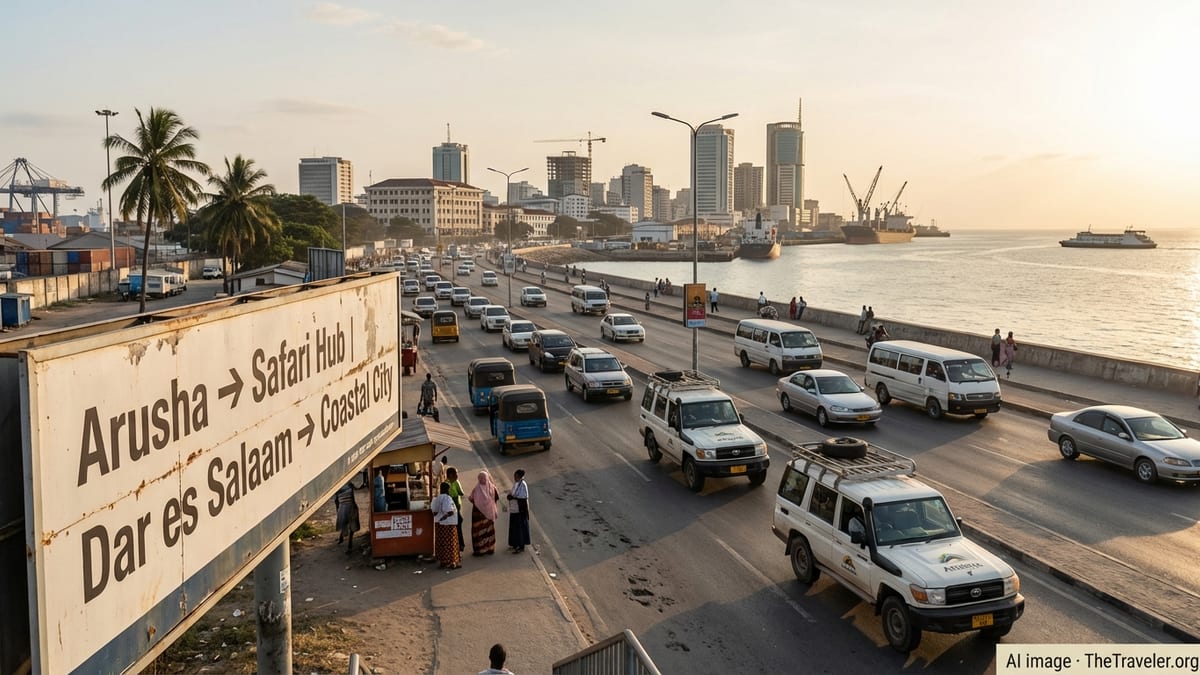
First Impressions: Safari Hub vs Sprawling Port City
Landing in Kilimanjaro International Airport on my way to Arusha felt surprisingly low-key. The terminal is compact, immigration lines moved slowly but steadily, and within an hour I had my bag and was in a shuttle. The 50-60 minute drive into Arusha was my first reminder that this is very much a working regional town first and a safari hub second: small shops, traffic circles, and only the occasional safari vehicle cutting through the everyday local life.
Dar es Salaam was the opposite kind of arrival. Julius Nyerere International Airport is larger and more intense, with three terminals and more airlines funneling in. International flights mostly arrive into the newer Terminal 3, which looks and feels like a modern regional hub, then you spill into a maze of taxis, drivers holding signs, and relatives greeting returning passengers. With current security checkpoints and periodic traffic controls on the road to the airport, I found it essential to allow extra time both in and out of the city.
My instinctive first reaction was that Arusha is where you go to get things done efficiently for a safari, and Dar is where you go if you enjoy big cities and can tolerate some chaos. What surprised me in those first days was that Arusha felt calmer but also more limited after dark, while Dar was messy, noisy, but full of energy and small discoveries if I accepted the rough edges.
Getting There and Getting Around
From an air-travel perspective, both cities are well connected, but not in the same way. Dar es Salaam is Tanzania’s busiest airport, with major carriers like Emirates, Qatar Airways, KLM, Turkish Airlines and regional airlines such as Air Tanzania and Precision Air running frequent services. International flights use Terminal 3, while domestic and regional flights mostly run out of Terminal 2, and I could walk between the two terminals in about five minutes when I connected to a domestic flight. There is free Wi-Fi across the airport, which sounds trivial until you are trying to re-confirm a delayed domestic connection on patchy mobile data.
Arusha does not have a large international airport of its own. Most travelers, including me, arrive via Kilimanjaro International Airport, about 45 kilometers from town. That means accepting an extra transfer after a long-haul flight. I tried both a shared shuttle and a private transfer; the shuttle cost less but departed infrequently and waited for passengers on delayed flights, which stretched a nominal one-hour ride into nearly two. The private transfer cost more, but I walked out of arrivals and was moving within fifteen minutes. For anyone landing late at night or with kids in tow, that extra cost is worth it.
Within Arusha, I could walk between central guesthouses, restaurants, and safari offices by day, but traffic gets surprisingly heavy around rush hour. Small local buses and tuk-tuks dominate the roads. In practice, I stuck to pre-arranged taxis from my lodge after dark. In Dar, moving around is a bigger decision. Distances are longer, traffic jams are normal rather than exceptional, and the heat makes walking less appealing. I relied on a mix of hotel taxis and ride-hailing apps, building in generous time buffers for airport runs and ferry departures. One evening, an unexpected road checkpoint and congestion turned a 25-minute ride into a 70-minute crawl. I did not miss my ferry, but only because I had padded my timing.
Safaris and Nature: Arusha’s Clear Edge
If your main reason to be in Tanzania is a classic northern-circuit safari, Arusha wins decisively. I was able to meet operators face to face, tweak itineraries that included Serengeti, Ngorongoro Crater, Tarangire and Lake Manyara, and even add a last-minute day trip to Arusha National Park. Many safari companies have their headquarters or at least a booking office here, which made it easy to compare quotes and get a feel for how responsive they were in person compared with email.
From Arusha, domestic flights and road transfers to the main national parks are straightforward. Small regional carriers and charter flights connect from the nearby Arusha Airport or from Kilimanjaro to airstrips inside the parks. I found that most itineraries involved a night in Arusha at the start or end simply to align with flight schedules and park transfers. That stopover did not feel wasted. I used it to recover from jet lag, rent any last bits of gear I had forgotten, and adjust cash and SIM cards before heading into more remote areas where ATMs are scarce.
Dar es Salaam has its own nature draws, but they are not the textbook northern safaris many people picture. From here, it is easier to reach southern parks like Nyerere (often still called Selous) and Ruaha, usually by domestic flight. These reserves are wilder and less crowded than the north, with better opportunities in some seasons to feel truly alone in the bush. The tradeoff I experienced was higher costs per day and fewer operators to choose from. I found planning these trips trickier, with less price transparency and less shared information among fellow travelers.
For pure wildlife access, Arusha felt like a fine-tuned machine. Days started on time, vehicles were where they should be, and every hotel seemed to be used to guests arriving in dusty boots after long drives. Dar was far more of a generalist: business travelers, people in transit to Zanzibar, families visiting relatives, and a smaller subset of safari guests heading south. That does not make Dar bad for nature lovers, but it does mean you need a clearer plan and a stronger budget to unlock its best wild areas.
Coast, Islands and Urban Atmosphere
On the coastal and island side, Dar es Salaam obviously has more to offer. The city hugs the Indian Ocean, with local beaches and frequent ferries to Zanzibar. I used Dar as a base to explore the waterfront, local seafood restaurants, and to take the fast ferry to Stone Town. The ferry terminal area was one of the few places on the trip where I felt real pressure from touts and ticket “helpers,” and where showing up early was crucial. Recent security routines and occasional schedule adjustments meant bag checks, ID controls, and longer boarding lines than I expected. Once on board, the ride was comfortable, but the whole process was more draining than brochures suggest.
Within Dar itself, the urban atmosphere is intense but interesting. The Kariakoo market area is a sensory overload of traffic, vendors, and noise, but I found it a fascinating window into everyday Tanzanian life. The central business district has a more formal feel, with offices, banks, and mid-range hotels. Along the Msasani Peninsula, the vibe softens with coastal breezes, expat-oriented bars, and more upscale lodging. None of these areas felt geared primarily to tourists; that was both refreshing and occasionally inconvenient when English was limited or I needed clear signage.
Arusha, by contrast, sits inland, framed by distant mountain silhouettes and with Mount Meru looming on clear days. There are no beaches and no ferries. The compensation is a gentler, more manageable town where the focus is on pre- and post-safari life: souvenir markets selling kanga fabrics and carvings, a modest café scene, and a cooler climate in the evenings. On nights back from the bush I appreciated being able to walk to a pizza place or coffee shop, but I never forgot that Arusha is primarily a gateway, not a destination in itself, unless you are very into trekking and nearby parks.
Costs, Accommodation and Real Decision Moments
On paper, both cities offer a full spread of accommodation from hostels to boutique hotels. In practice, the value felt different. In Arusha, mid-range safari lodges and guesthouses often include breakfast, airport transfers (from either Arusha Airport or sometimes Kilimanjaro for a fee), and storage for luggage while you are out on safari. I found plenty of clean, functional rooms from around the low double digits per night equivalent, with more characterful lodges costing more. The main decision point was whether to stay closer to the city center to walk to operators and restaurants, or on the outskirts where some lodges sit in quieter, greener compounds. I chose the outskirts for one stay and regretted having to taxi in even for small errands.
In Dar es Salaam, the pricing dynamics were more like any large regional capital. Near the airport, I could get simple transit hotels that traded charm for proximity; in the central districts, prices climbed quickly, especially at international chains. The Msasani Peninsula and beach-adjacent areas charged a premium for sea views and pools. I paid more per night in Dar for comparable room quality than in Arusha, particularly once I factored in the cost of regular taxis through traffic.
One of my biggest decision moments was how to split days when combining safari and coast. It is tempting to fly straight into Dar, spend a night, then jump to Zanzibar and only later work your way north to Arusha. After doing a version of that, I would reverse the order next time. Starting with Arusha lets you get the logistics-heavy safari portion done while your energy is highest, then decompress on the coast afterwards. On my trip, doing a long, hot, city day in Dar in between had my jet-lagged brain juggling ferry timetables, domestic flights, and bag storage in a way that felt more stressful than it needed to be.
Another real decision moment came when I was booking domestic flights. I had the option to connect through Dar or Kilimanjaro. Connecting through Dar meant using the larger hub with more flight options, but also dealing with its unpredictable traffic and heavier security footprint. Connecting through Kilimanjaro meant smaller facilities, but much smoother transfers onward to Arusha and the parks. Having experienced both, I now aim for Kilimanjaro when my main target is the northern circuit, and keep Dar for when I am also using the ferries or heading south.
Safety, Comfort and On-the-Ground Realities
In terms of personal safety, both cities required the same basic common sense I would exercise anywhere in East Africa: avoid displaying expensive gear in crowded markets, be cautious after dark, and use trusted taxis. I felt broadly comfortable walking short distances in daylight in both, but there were differences in nuance. In Arusha, I experienced more low-key hustling from safari touts near the central clock tower, but it was easy to brush off with a polite no. In Dar, I felt the density of the city more acutely. Around the ferry terminal and in tight market streets, bags needed to be zipped and attention sharp.
Comfort-wise, climate matters. Arusha’s elevation keeps temperatures noticeably cooler, especially at night. I could sleep without air conditioning in some lodges and wake up feeling refreshed. In Dar, heat and humidity were constant companions. Even rooms with air conditioning sometimes struggled to keep fully cool, and stepping outside at midday felt draining. If you are sensitive to heat or traveling with elders, this is not a small consideration.
The airport experiences also differed. At Kilimanjaro, recent traveler reports and my own experience suggest that arriving about two hours before departure is usually sufficient for international flights if you already have a boarding pass, though lines can spike when several flights leave close together. Security is present but low-drama. At Julius Nyerere, multiple layers of security and ID checks, combined with occasional controls on airport access, made it necessary to give myself three hours or more for international departures and extra time to account for traffic. I did not find the process unsafe, just slower and more procedural than some travel blogs still describe.
One disappointment in both cities was the reliability of some mid-range hotels’ “free airport transfer” promises. In Arusha, one lodge’s driver simply did not appear at the agreed time at Kilimanjaro, leaving me to negotiate with local taxis in the small arrivals area. In Dar, a hotel that advertised a free shuttle quietly reclassified it as “subject to availability” on arrival, which translated to “no shuttle at this hour.” In both cases, I learned to confirm transfers in writing the day before, including the exact terminal and flight number.
Seasonality, Crowds and When To Go
Seasonal differences reinforced the contrast between the two cities. Arusha mirrors the northern safari rhythm. High season around the dry months brings more safari vehicles passing through, busier lodges, and slightly higher prices, but the town itself never felt overwhelmed. The main impact I felt was in availability of specific guides and jeep configurations when booking late. During shoulder seasons, rains can make some park roads challenging, but the town is quieter, and last-minute deals are easier to find.
Dar es Salaam’s seasonality, at least from a traveler’s perspective, relates more to heat, humidity, and school holidays than to wildlife movements. The coastal climate stays warm year-round, with more intense heat around some months and heavier rains that can flood streets and slow traffic. My visit during a relatively humid period made urban exploring more draining, but hotel prices did not fluctuate as dramatically as safari lodge rates do.
On the crowd front, Arusha’s visitor density shows mostly in certain cafés, souvenir markets, and the early morning line of safari vehicles heading out of town. It is easy to step one or two streets away and be in a more local-feeling space. In Dar, crowds felt built-in: commuters, street vendors, students, and visitors all moving at once. This gave the city an energy I came to appreciate, but also meant I rarely had the kind of quiet, reflective walks I could enjoy around Arusha’s residential streets before dinner.
Another timing-based decision point I faced was whether to rely on same-day connections between cities. Guidance from recent advisories emphasized that airport access to Julius Nyerere can be slowed by checkpoints and that ferries may run on adjusted schedules. When I tested a same-day pattern involving the Dar ferry, airport transfer, and evening international flight, it technically worked, but only because every piece lined up. It was more stressful than I like to recommend. If I repeat that route, I will separate Zanzibar or Dar days from my long-haul flight by at least one overnight to allow for schedule tweaks.
The Takeaway
If I stripped this comparison down to one sentence, it would be this: Arusha is the efficient safari launchpad with cooler air and calmer streets, while Dar es Salaam is the dense coastal hub that rewards patience but punishes poor planning. That one sentence, though, hides many of the tradeoffs I only understood after doing both back to back.
For travelers whose main goal is a northern-circuit safari, I would choose Arusha almost every time. It is closer to the parks, better aligned with the local operators who run those trips, and easier to manage logistically after a long flight. The climate is kinder, mid-range lodging offers strong value, and the town is large enough to be interesting without being overwhelming. I would land at Kilimanjaro when possible, book at least one night in Arusha before heading out, and stay within practical distance of the town center unless a lodge’s setting is truly exceptional.
For travelers more drawn to coastal culture, island-hopping, and the idea of a bustling African port city, Dar es Salaam is still worth it, but only if you go in with realistic expectations. You trade some convenience for variety: busy roads, stronger heat, heavier security procedures, and more layered logistics in exchange for waterfront sunsets, dynamic markets, and easy onward movement to Zanzibar and the southern parks. Here, I would spend time choosing neighborhood carefully, build big time buffers around airport and ferry connections, and accept that not every system runs on a tourist’s clock.
Personally, if I were planning this route again for myself or for a first-time visitor, I would start in Arusha, focus hard on safari and nearby highland experiences, then finish with a shorter, better-planned coastal segment that includes Dar only as much as needed for ferries and flights. Dar has its own charm if you like big cities, but it is less forgiving if you misjudge distances or schedules. Arusha, in contrast, does a quietly excellent job of exactly what most travelers need it to do: get you into the wild and back again, with a minimum of drama.
FAQ
Q1: Which city is better as a base for a first-time safari, Arusha or Dar es Salaam?
For a first-time safari focused on Serengeti, Ngorongoro, Tarangire, or Lake Manyara, I strongly prefer Arusha. The town is geared toward the northern circuit, most operators are based there, and transfers to parks are shorter and more straightforward than from Dar.
Q2: Is Dar es Salaam safe enough for a short stay before or after Zanzibar?
Yes, with normal big-city precautions. I felt reasonably safe using trusted taxis, keeping valuables out of sight, and avoiding poorly lit streets at night. The ferry and market areas demand extra attention to bags, but for a short coastal or transit stay, Dar is manageable.
Q3: How much time should I allow at Julius Nyerere International Airport before an international flight?
Based on my experience and current guidance, I allow at least three hours at the terminal itself, plus generous buffer for traffic and possible checkpoints on the way. Two hours felt uncomfortably tight; three gave me room for check-in, security layers, and unexpected queues.
Q4: Can I rely on same-day connections between Dar es Salaam and Zanzibar before an international flight?
Technically yes, but I would not plan it that way again. Adjusted ferry schedules, boarding delays, and traffic to and from the port mean a missed connection is very possible. I now recommend an overnight in Dar between Zanzibar and any long-haul flight.
Q5: Is it worth paying extra for a private transfer between Kilimanjaro International Airport and Arusha?
For me, yes, especially after a long overnight flight or if arriving late. Shared shuttles are cheaper but can involve long waits for other passengers. A pre-booked private transfer meant I left the airport quickly and arrived at my lodge without unnecessary delays.
Q6: Which city felt more comfortable climate-wise?
Arusha felt noticeably more comfortable because of its higher elevation and cooler evenings. In Dar es Salaam the heat and humidity were constant, and even with air conditioning I felt more drained after walking around during the day.
Q7: If I want both safari and beach, in what order should I visit Arusha and Dar es Salaam?
After trying a less optimal sequence, I would now go to Arusha first for safari, when my energy is highest, then head to the coast and possibly Dar and Zanzibar afterwards to relax. Ending with the beach makes the heavy logistics of safari feel like they naturally wind down into slower days.
Q8: Are hotels in Arusha and Dar es Salaam used to late arrivals and early departures?
Yes, but in inconsistent ways. Many properties will arrange very early or late airport transfers, but I learned to confirm specifics in writing. Some “free shuttles” turned out to be limited or unavailable at certain hours, which mattered for pre-dawn flights.
Q9: Do I need to book domestic flights and ferries far in advance?
I found it wise to book domestic flights at least a few weeks ahead in high season to secure reasonable times and prices. For ferries between Dar and Zanzibar, last-minute tickets were sometimes available but not always at the most convenient times, so advance booking gave me better options and peace of mind.
Q10: Who should choose Arusha, and who should choose Dar es Salaam?
I recommend Arusha for travelers whose priority is northern safaris, trekking, and cooler highland air, and who care most about efficient logistics. Dar es Salaam suits travelers who enjoy big, busy cities, want direct access to the coast and Zanzibar, or are heading to the southern parks and accept more complex transport in exchange for urban energy and ocean views.