

More news on this day
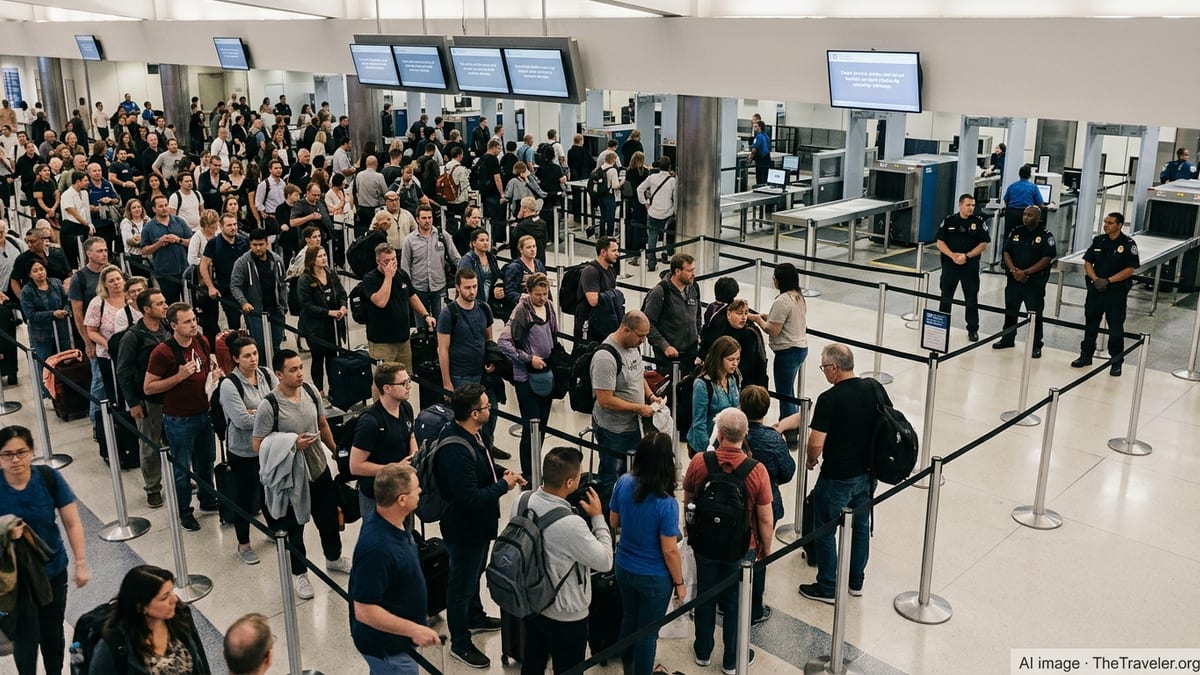
Hours-long airport lines across the United States are colliding with a striking new reality for travelers: many major hubs are scaling back or quietly scrubbing public wait-time estimates just as pressure on the system peaks and Immigration and Customs Enforcement personnel are sent in to help.
Get the latest news straight to your inbox!
Wait-Time Dashboards Go Dark as Queues Lengthen
In recent days, travelers passing through some of the country’s busiest airports have reported that familiar digital tools meant to predict security and immigration delays are suddenly missing or far less detailed. Screens that once cycled live wait estimates at security and customs checkpoints have been switched to static messages advising passengers to arrive earlier. Airport websites that previously showed near real-time figures have been pared back to broad guidance, with language warning that conditions can change rapidly.
The retreat from publishing granular wait times is coinciding with a partial shutdown of the Department of Homeland Security that has left the Transportation Security Administration operating with thinning ranks. Publicly available coverage indicates that airports in Houston and Atlanta are among those experiencing multi-hour security lines, with local advisories urging travelers to plan for as much as four to five hours between arrival at the terminal and departure.
Industry analysts note that airports have long relied on posted wait times as a customer-service tool, but they also create expectations. When staffing is unpredictable, those estimates can quickly become inaccurate, exposing operators to frustration from passengers who miss flights despite assurances that lines should move more quickly.
Some airport authorities now appear to be opting out of the wait-time race altogether. Instead of digital countdowns to the front of the line, passengers are encountering generic warnings that “higher than normal volumes” and “reduced lane availability” may result in extended processing times, with little concrete data to plan around.
Shutdown Strains TSA Staffing and Traveler Confidence
The shift away from public metrics comes against the backdrop of a funding impasse that has left tens of thousands of TSA officers working without pay. National coverage describes a steady rise in sick calls, attrition and mandatory overtime as officers confront missed paychecks, with union representatives warning that morale is deteriorating.
Reports from Houston’s George Bush Intercontinental Airport and other hubs show security lines spilling deep into ticketing halls during peak periods, with some passengers waiting multiple hours to clear screening. At Atlanta’s international airport, coverage indicates that airlines have encouraged travelers to arrive at least four hours early for domestic flights and even earlier for international departures in anticipation of bottlenecks.
Aviation experts quoted in recent analyses argue that such extended waits, combined with the disappearance of transparent queue data, risk eroding confidence in the air travel system. Business travelers facing uncertain clearance times may avoid connecting itineraries through the worst-affected hubs, while leisure flyers could rebook through secondary airports that appear to have shorter delays or more predictable operations.
Airlines are responding by waiving some change fees and adjusting minimum connection times in their booking systems. Yet without reliable airport-side wait-time information, carriers have limited visibility into how long it will actually take passengers to move from curb to gate, making schedule planning more complicated.
ICE Officers Step In, But Impact on Waits Remains Murky
Into this stressed environment, Immigration and Customs Enforcement officers have been dispatched to select airports in an attempt to relieve pressure on frontline operations. According to recent national and local coverage, ICE personnel have appeared at airports in Houston and other cities, where they are being positioned as supplemental support while TSA grapples with staffing shortfalls.
However, publicly available information underscores that ICE officers are not trained in aviation security screening. Their core mission centers on immigration enforcement and removal operations rather than passenger and baggage screening procedures. That distinction has raised questions among travel advocates and policy analysts about how effectively ICE staff can bolster throughput without compromising the specialized protocols that govern airport checkpoints.
Reports suggest ICE officers have been assigned to non-screening roles such as managing passenger flow, directing travelers within crowded terminals and assisting with secondary document checks under the supervision of airport security teams. Even so, civil liberties groups and some airport-area communities have expressed concern that a visible ICE presence in security zones could heighten anxiety for certain travelers and discourage the use of already congested airports.
For now, available reporting does not indicate a clear, measurable reduction in wait times attributable to ICE deployments. Long queues persist at many of the same hubs where immigration officers have been spotted, suggesting that the fundamental constraint remains the limited number of fully trained TSA screeners and CBP officers available to staff checkpoints and inspection booths.
Technology Tools Clash With Reality on the Ground
In parallel with these emergency measures, federal agencies have continued to promote technology that purports to streamline border crossings and customs inspections. Customs and Border Protection has highlighted mobile tools such as Mobile Passport Control and other biometric and self-service options that can, in principle, move pre-vetted travelers more quickly through immigration halls.
Separate from official tools, third-party smartphone apps have emerged that analyze historical CBP wait-time data to forecast typical processing durations at international arrivals facilities. These apps promise travelers the ability to choose flights that avoid the worst peaks, using color-coded dashboards and charts based on recent trends.
The present crisis is testing the limits of those predictive systems. With staffing patterns disrupted by the shutdown and ad hoc deployments of ICE officers and other personnel, historical averages provide only rough guidance. Travelers have described arriving to find customs halls far more crowded than expected, while others report breezing through at times when models suggested longer waits, underscoring how volatile airport conditions have become.
As airports pull back their own live wait-time feeds and federal agencies focus on contingency staffing, the gap between app-based forecasts and on-the-ground reality may widen. Travel advisors are increasingly telling clients to treat both official and third-party wait-time tools as conservative baselines rather than guarantees, and to build generous buffers into their itineraries.
Airports Reassess Transparency, Equity and Long-Term Fixes
The decision by some airports to stop posting precise wait times is also prompting a broader debate about transparency and equity in how limited capacity is allocated. Without clear, public data on queue lengths, it becomes harder for passengers to compare terminals or checkpoints, and easier for any priority lanes linked to premium tickets or paid programs to operate without public scrutiny.
Advocacy organizations focused on travel access argue that opaque queue management can disadvantage occasional or lower-income travelers who are less likely to pay for expedited screening products. They warn that hiding wait-time information at the very moment lines are at their worst risks deepening perceptions that airport efficiency is increasingly reserved for those able to purchase it.
Airport planners and policy researchers, meanwhile, view the present disruption as a stress test of long-discussed reforms. Proposals range from stable, dedicated funding streams for TSA and CBP staffing to greater use of automated screening lanes, expanded trusted traveler programs and redesigned terminal layouts that can absorb surges without pushing lines into common areas.
Until those structural changes materialize, passengers are left navigating a system where hours-long lines are possible, digital dashboards offer few specifics and the sight of ICE uniforms at airports adds a new layer to an already tense experience. For travelers this spring, preparing for uncertainty has become as essential as packing a passport.