

More news on this day
Asia–Europe airfares are climbing sharply this week as airlines scramble to reroute or cancel flights around closed Gulf hubs and conflict-hit Middle Eastern airspace, squeezing capacity on key long-haul corridors and driving up ticket prices for millions of travelers.
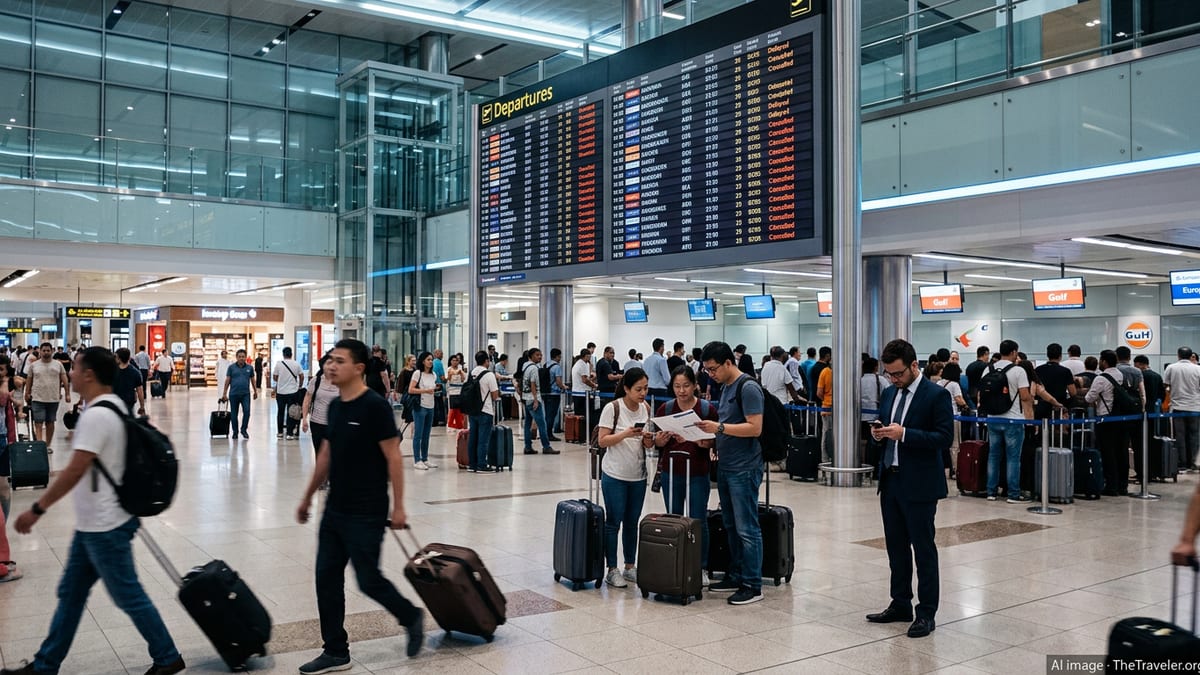
Gulf Airport Shutdowns Choke Global Transit Flows
Global aviation is facing its most severe disruption since the pandemic as escalating conflict involving Iran, the United States and Israel has effectively shut down major Gulf gateways. Dubai, Abu Dhabi and Doha remained closed to regular traffic into Monday, 2 March 2026, with only limited special operations permitted, cutting off some of the world’s busiest long-haul transfer points between Asia and Europe.
With airspace over parts of the United Arab Emirates, Qatar and several neighboring states either closed or heavily restricted, schedules at Emirates, Etihad and Qatar Airways have been gutted. Data from aviation analytics firms show cancellation rates running above a third of planned services at some Gulf carriers, wiping out thousands of daily seats that normally carry connecting passengers between Europe, South Asia and East Asia.
The cascade of cancellations has left well over 150,000 travelers stranded at or en route to the Gulf hubs, according to industry estimates, and has severed a network that routinely channels close to 90,000 transit passengers a day through these airports alone. For would-be travelers trying to reach Europe from Asia in the coming days, the effect is fewer options, longer journeys and rapidly rising fares.
Officials and airport operators caution that the pace of recovery will be constrained even if partial reopenings are authorized, citing crew dislocation, aircraft out of position and ongoing security advisories for conflict-zone airspace. That means pricing pressure on remaining routes is likely to persist at least through the coming week.
Rerouted Flight Paths Drive Up Costs and Fares
With direct high-altitude corridors over the Persian Gulf and parts of Iran closed or deemed high risk, airlines operating between Asia and Europe are now tacking on substantial detours. Many services are shifting north over Central Asia or south around the Arabian Sea and Red Sea, adding one to three hours of flying time to typical long-haul sectors.
Each additional hour in the air significantly raises operating costs on widebody jets, from fuel burn to crew duty expenses. Aviation economists estimate that for a fully loaded long-haul flight, every extra hour can add several thousand US dollars in direct costs. Multiplied across dozens of rotations per airline each day, the industry-wide expense of the current disruption is already projected in the hundreds of millions of dollars and could surpass one billion dollars if the crisis continues.
Carriers are responding by tightening capacity where possible: consolidating flights, prioritizing higher-yield routes and limiting low-fare inventory. While many are still honoring existing tickets and offering waivers, new bookings on core Asia–Europe city pairs are pricing markedly higher than just a week ago. Revenue managers are recalibrating fares in real time as available seat capacity shrinks and demand from displaced Gulf passengers spills over onto alternative routings.
At the same time, operational buffers built into schedules since the pandemic are eroding. Longer flight times, tighter turnarounds at secondary hubs and air traffic congestion over alternative corridors are all reducing punctuality. The more irregular operations become, the more costly each seat is to operate, reinforcing upward pressure on ticket prices.
Asia Departures See Sharp Spikes in Europe-Bound Fares
The price shock is particularly acute for travelers originating in South and Southeast Asia, many of whom typically connect to Europe via Gulf carriers. In major Indian markets, industry fare trackers and local travel agents report that one-way economy tickets to London, Frankfurt, Paris and other European cities have in many cases doubled compared with mid-February levels.
Flights out of Hyderabad, Delhi and Bengaluru have seen some of the steepest increases as services that would normally overfly the Middle East or connect via Dubai, Doha or Abu Dhabi are either canceled or rerouted via longer paths. Travel agents in these cities report last-minute economy fares to London ranging from the equivalent of roughly 65,000 to 90,000 rupees, with premium cabins climbing much higher and some routings via North Asia or Africa selling out entirely.
Across wider Asia, similar patterns are emerging. Passengers in Pakistan, Sri Lanka and Bangladesh who often rely on Gulf airlines for affordable connections to Europe now face a combination of cancellations and sharply higher fares on the remaining routes operated by European or Asian carriers. In Southeast Asia, where many itineraries to Europe were priced aggressively thanks to competition from Middle Eastern hubs, travelers are seeing fewer promotional fares and more restrictive inventory on historically busy routes such as Bangkok–London and Kuala Lumpur–Frankfurt.
For students, migrant workers and family travelers planning spring journeys, the sudden fare inflation is forcing painful choices. Many are postponing trips, downgrading from peak travel dates or rerouting through less direct paths that can add substantial travel time, multiple stops and overnight layovers in secondary hubs.
Secondary Hubs and Non-Gulf Carriers Under Strain
As Gulf hubs remain largely offline, traffic is being pushed onto secondary connecting points across Europe and Asia. Istanbul, Jeddah and Riyadh are absorbing some flows where airspace allows, while carriers in Europe and East Asia are rapidly adjusting capacity to capture demand that would otherwise pass through Dubai, Doha or Abu Dhabi.
European network airlines are seeing a surge in Asia-origin passengers connecting through their hubs, straining already busy banks of long-haul departures. In some cases they are upgauging aircraft or adding extra sections, but slot limits, crew availability and fleet constraints mean they cannot fully replace the lost Gulf capacity. That imbalance is feeding further fare hikes, particularly on trunk routes linking major European hubs with cities such as Delhi, Mumbai, Bangkok and Singapore.
Low-cost and hybrid carriers are also being pulled into the disruption. Some budget airlines operating to Gulf destinations have temporarily suspended flights, while others are reconfiguring schedules and pricing. The result is reduced choice on key intra-Asia legs that used to align conveniently with overnight Middle East departures, complicating itineraries for cost-conscious travelers attempting to piece together multi-ticket journeys.
Analysts note that as long as conflict-zone advisories remain in effect for large portions of Middle Eastern airspace, this hub substitution will continue to distort global traffic flows. That dynamic tends to privilege airlines with more northerly or southerly long-haul corridors and penalize those whose network strategies depend on overflying or transiting the Gulf.
Uncertain Timeline Keeps Pressure on Summer Travel Plans
The outlook for ticket prices on Asia–Europe routes now hinges on both geopolitics and regulatory decisions. European aviation safety authorities have issued conflict-zone bulletins warning airlines to avoid specified airspace, and national regulators across Asia and Europe are maintaining heightened scrutiny of any proposed routings near the Persian Gulf and adjacent conflict areas.
If Gulf airports begin a phased reopening in the coming days, airlines will still need time to rebuild regular schedules, reposition aircraft and crew, and restore consumer confidence. Industry insiders say that even in an optimistic scenario, irregular operations and elevated fares could persist well into late March. Any renewed escalation or further attacks on aviation or energy infrastructure could quickly reverse progress and trigger additional closures.
Forward bookings for the spring and early summer travel season are already being reshaped as corporate travel managers and leisure travelers reassess itineraries. Some multinational companies are temporarily restricting employee trips that would overfly the region, while tour operators are exploring alternative routings via North Asia, Central Asia or Africa, often at higher cost.
For now, passengers looking to travel between Asia and Europe face a volatile pricing environment, in which each new airspace bulletin or military development can send fares swinging. Travelers able to delay nonessential trips, accept indirect routings or shift to less congested origin and destination pairs may find some relief, but the era of plentiful, relatively affordable one-stop connections through the Gulf has, at least temporarily, come to an abrupt halt.