

More news on this day
Asia’s aviation sector is tightening its grip on global air travel in 2026, as fresh rankings place Qatar Airways and Singapore’s Changi Airport at the top of industry league tables, highlighting a shift in both passenger expectations and the geography of long-haul connectivity.
Get the latest news straight to your inbox!
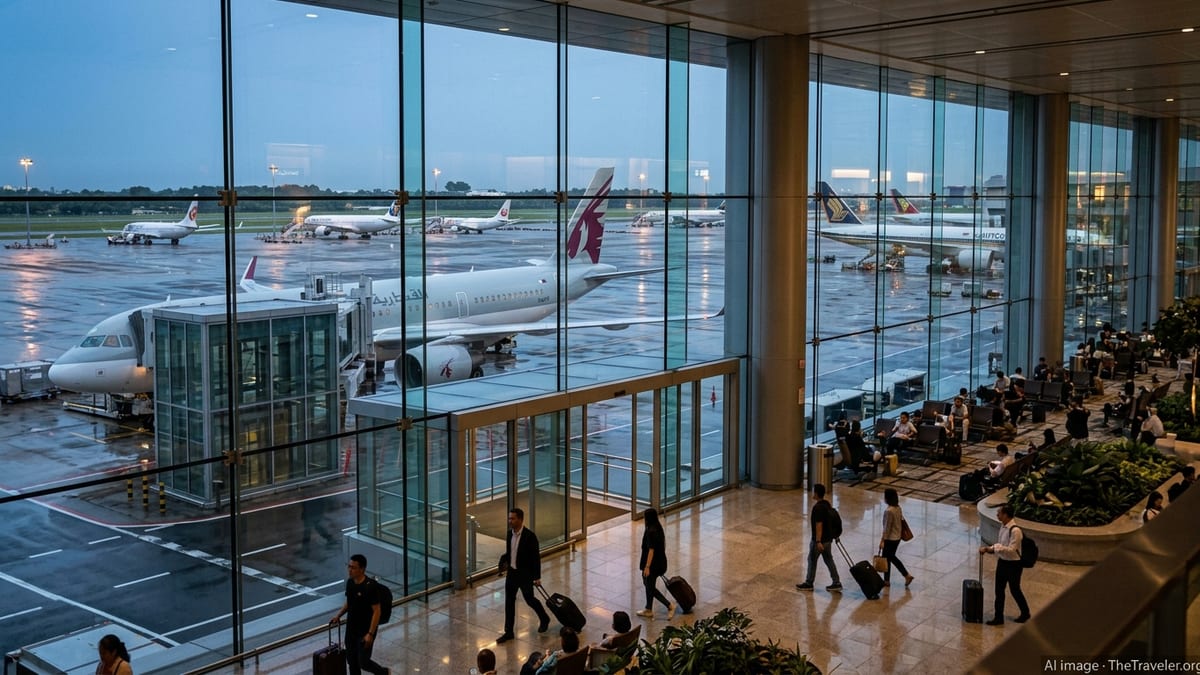
New Rankings Confirm Qatar Airways at the Front of the Pack
Qatar Airways has consolidated its status as a benchmark for premium air travel in 2026, after a run of major industry awards over the past two years placed the Doha-based carrier consistently at or near the top of global rankings. Skytrax’s World Airline Awards named the airline World’s Best Airline in 2025 for a record ninth time, while more recent league tables for 2026 continue to position the carrier as the leading full-service airline worldwide.
Industry roundups of the latest Skytrax and AirlineRatings assessments indicate that Qatar Airways retains a clear edge in long-haul service quality, cabin innovation and network breadth. Observers point to the airline’s investment in business-class suites, upgraded lounges and digital customer tools as key differentiators, particularly on high-yield routes linking Europe, Asia and Africa through its Doha hub.
Financial results have reinforced this reputation. Publicly available figures for the most recent fiscal year show record profits and passenger numbers for Qatar Airways Group, underlining how sustained demand for premium travel through the Gulf is supporting the carrier’s award performance. Analysts note that profitability and strong rankings are increasingly moving in tandem, as airlines with more robust balance sheets are better positioned to invest in service upgrades.
Yet the airline’s dominance also highlights growing competitive pressure. Rival carriers in East Asia and the Middle East are accelerating fleet renewals and cabin refresh programs, suggesting that the standards set in 2026 may quickly become the minimum expected by frequent flyers across the premium long-haul market.
Singapore Changi Tightens Its Grip on the “World’s Best Airport” Title
On the ground, Singapore Changi Airport continues to set the pace for global hubs, retaining its status in 2026 as one of the world’s top-ranked airports for overall passenger experience. Skytrax’s most recent World Airport Awards place Changi at or near the top of their global list, with the airport widely cited as the leading international hub in Asia.
Changi’s performance builds on a long record of recognition. The airport has collected more World’s Best Airport titles than any of its peers since the early 2000s, and 2025 rankings saw it reclaim the top spot ahead of regional rival Hamad International Airport in Doha. In 2026, commentary around the awards increasingly emphasizes not only Changi’s design and amenities, but also its reliability and use of automation to manage surging passenger numbers.
Recent operational data and industry analyses show that Changi has climbed into the top tier of the world’s busiest international airports by passenger volume, while still maintaining strong scores for punctuality and connection times. This combination of scale and service has become a central part of Singapore’s strategy to remain the preferred gateway between Southeast Asia, Europe and the Pacific.
At the same time, the airport’s dominance feeds debate inside the industry about the concentration of awards among a small group of hubs. Some aviation commentary in 2026 notes that while Changi consistently leads global passenger satisfaction surveys, other Asian airports such as Tokyo Haneda, Seoul Incheon and Hong Kong International have also made significant gains in technology and efficiency, narrowing the gap at the top.
Asia-Pacific Routes and Hubs Drive the Global Aviation Map
The latest global route and traffic statistics for 2025 and early 2026 underline how decisively Asia-Pacific and the Gulf have reshaped international air travel. Industry data compiled by OAG and other analytics firms shows that seven of the ten busiest international routes by seat capacity now link cities within Asia or between Asia and the Middle East.
Services such as Hong Kong to Taipei and major Southeast Asian trunk routes continue to dominate the international rankings by volume, while hubs including Singapore, Doha, Dubai, Istanbul and Seoul are handling a growing share of world connecting traffic. Aviation analysts describe this as a structural shift away from a transatlantic-centric model, with Asia and the Middle East now acting as the principal crossroads for long-haul journeys.
These trends are mirrored in hub rankings that track global connectivity rather than just passenger counts. Recent megahub indices list several Asian airports among the world’s most connected, citing dense short-haul networks feeding into long-haul services as a key competitive asset. For travelers, this network density translates into more itinerary options, shorter connection windows and increasingly, a choice between multiple high-quality stopover hubs on the same long-distance route.
For North American and European airports, the shift raises strategic questions about how to retain relevance on intercontinental routes. With Asia-Pacific carriers and Gulf airlines expanding into secondary cities, passengers are being offered one-stop options via Doha, Singapore or other Asian hubs that bypass traditional gateways in Western Europe and the United States.
Operational Performance and Punctuality Reinforce Asia’s Edge
Service quality awards are being reinforced by hard operational metrics. Cirium’s latest punctuality reports for 2025, released in early 2026, show several Asia-Pacific and Middle Eastern airlines ranking among the world’s most on-time global carriers. Airports across the region also feature prominently in lists of the most punctual large hubs, with major connecting airports in Istanbul, Doha and parts of East Asia posting strong on-time performance despite rising traffic.
Industry observers say this operational reliability is becoming as important to travelers as in-flight amenities. With global flight schedules approaching or exceeding pre-pandemic levels, disruption can cascade quickly through major hubs. Airlines and airports that combine high capacity with resilient operations are therefore gaining a competitive advantage, particularly among business travelers and time-sensitive passengers.
Qatar Airways’ recognition in punctuality-focused awards, alongside its cabin and service accolades, underscores how integrated performance benchmarks are reshaping the idea of a top-tier airline. Rankings in 2026 are no longer based solely on soft-product assessments such as meals or seat comfort, but increasingly on how well carriers and hubs manage complex, high-frequency operations across multiple regions.
As regulatory scrutiny and passenger expectations around reliability intensify, analysts expect investment in real-time data systems, predictive maintenance and airport process automation across Asia and the Middle East to accelerate, further entrenching the region’s leadership in this dimension.
What the 2026 Rankings Mean for Global Travelers
The consolidation of Qatar Airways and Singapore Changi at the top of 2026 aviation rankings has immediate implications for travelers planning long-haul itineraries. For many routes between Europe, Asia, Africa and Australasia, the most competitive one-stop options increasingly involve a transfer through Doha or Singapore, often on aircraft and in terminals that score at the highest levels for comfort, connectivity and reliability.
Travel planners note that award tables now function as a kind of shorthand for likely experience, with Qatar Airways and Changi frequently appearing in the top tier of multiple independent assessments. As a result, corporate travel policies and high-end leisure travelers are more likely to prioritize routings that use these hubs, even if that involves slightly longer great-circle distances or higher fares.
At the same time, the focus on Asia and the Middle East in global rankings is prompting other regions to sharpen their offerings. North American and European carriers continue to perform strongly in certain categories, particularly domestic and transatlantic operations, but the 2026 award cycle suggests that the global benchmark for premium travel is now being set further east.
For passengers, the message of the latest rankings is clear: in 2026, many of the most seamless journeys, highest-rated cabins and most efficient connections are found on itineraries routed through Asia-Pacific and Gulf hubs, with Qatar Airways and Singapore Changi at the forefront of a competitive landscape that is rapidly redefining what constitutes world-class air travel.