

More news on this day
Air travelers across Asia faced a fresh wave of disruption on March 31, 2026, as a patchwork of security concerns, airspace restrictions, and operational strains led to more than 20 flight cancellations and schedule changes involving major carriers such as AirAsia, Malaysia Airlines, IndiGo, United Airlines and several regional operators.
Get the latest news straight to your inbox!
Mixed Picture for AirAsia and Malaysia Airlines in Southeast Asia
In Southeast Asia, publicly available operational data and regional media coverage indicate that carriers linked to the AirAsia brand and Malaysia Airlines are navigating a volatile environment, particularly on routes touching Kuala Lumpur, Bali and Jakarta. While a senior AirAsia-linked executive recently stressed that the group is not broadly cancelling flights in response to rising fuel prices and regional instability, scattered cancellations and retimings have still appeared in daily schedules as airlines adjust capacity and routing.
Services from Kuala Lumpur to popular leisure destinations such as Denpasar in Bali and Jakarta have generally continued, but passengers report same-day adjustments and isolated cancellations where demand has softened or where connections onward to the Middle East and Europe have been disrupted. Kuala Lumpur to Taipei operations, historically an important corridor for AirAsia’s medium-haul arm, have also been subject to schedule fine-tuning as carriers respond to changing traffic flows.
Malaysia Airlines, which maintains a significant hub presence at Kuala Lumpur International Airport, has focused on preserving long-haul connectivity while trimming or consolidating some regional frequencies. According to published timetable changes, the airline is prioritising core trunk routes and adjusting departure times to avoid bottlenecks caused by overflight restrictions and airport congestion in parts of West Asia.
For travelers starting their journeys in Jakarta or Bali on AirAsia or Malaysia Airlines, the immediate impact has been a higher risk of short-notice changes rather than mass cancellations. Nonetheless, when regional legs are tied to onward connections across disrupted corridors, entire itineraries have occasionally been cancelled, contributing to the perception of travel chaos even where basic point-to-point services remain intact.
IndiGo Still Feeling Strain After Earlier Scheduling Crisis
India’s IndiGo, one of the largest low-cost carriers in Asia, is still working through the operational aftershocks of its high-profile scheduling crisis that began in late 2025. Public records of the disruption show that the airline cancelled thousands of flights following challenges in adapting to tighter crew duty regulations, and regulators later imposed temporary constraints and fare caps that remained in place into early 2026.
Although government-imposed caps were lifted in late March 2026 as conditions stabilised, recent traveler accounts and flight-tracking information suggest that IndiGo continues to operate on a thin margin, with periodic cancellations affecting both domestic and international routes. Cancellations on services linking India to major Asian gateways have been reported in recent days, particularly where flights rely on airspace that remains constrained or where demand has been unpredictable.
New route launches, such as IndiGo’s recently inaugurated Shanghai to Kolkata service, underline that the airline is still in expansion mode even as it manages the tail end of its scheduling problems. This combination of network growth and lingering operational complexity has raised the risk of day-of-travel disruption, especially when unplanned maintenance or weather issues arise.
For passengers transiting through hubs to reach Jakarta, Bali, Kuala Lumpur or Taipei on IndiGo-operated sectors, the result has been an uneven experience. Some travelers have reported smooth journeys, while others have faced last-minute cancellations and limited rebooking options, heightening concern among those planning multi-leg itineraries across Asia.
United Airlines Adjusts Asia and Middle East Operations
United Airlines’ global network has been heavily influenced in recent weeks by a series of travel waivers related to unrest in the Middle East. Automated public tracking of these waivers shows repeated extensions of flexibility for itineraries involving affected regions, with options for passengers to change or postpone travel without standard fees in many cases.
Alongside these policy measures, schedule updates published by independent travel and aviation outlets show that United has temporarily suspended certain routes into the Gulf, including services to Dubai. These suspensions have ripple effects across the carrier’s wider network, as connecting itineraries from North America to Asian cities via the Middle East are reduced or removed from sale, prompting cancellations of through-tickets that once relied on those links.
United’s Asia operations have therefore become more reliant on direct transpacific and transpacific-plus-one-stop routings, with some flights retimed or consolidated as aircraft and crews are redeployed. Travelers bound for Asian destinations such as Taipei have seen a mixture of unchanged nonstops, altered connection patterns, and in some cases complete itinerary cancellations where Middle East segments were involved.
While the number of United-operated departures within Asia itself is smaller than that of regional low-cost rivals, the carrier’s high share of long-haul connecting traffic means that each cancellation affects large groups of passengers. Publicly available waiver details encourage customers to monitor their reservations closely through official channels and to act quickly if presented with new rebooking options.
Jakarta, Bali, Kuala Lumpur and Taipei Face Uneven Disruptions
The impact of the latest cancellations has varied markedly across major Asian gateways. In Jakarta and Denpasar, the main airport for Bali, most domestic flights and short-haul regional services have continued to operate broadly as planned, but long-haul and multi-stop itineraries involving carriers such as AirAsia, Malaysia Airlines and IndiGo have seen a higher rate of disruption.
In Kuala Lumpur, a combination of schedule trimming, aircraft rotation challenges and connections to disrupted Middle East routes has translated into cancellations scattered across the day. Though the overall number of scrapped flights remains a small percentage of total movements, travelers on affected departures often face limited same-day alternatives, particularly on heavily booked holiday and business routes.
Taipei’s Taoyuan International Airport has experienced its own share of adjustments as airlines tweak capacity for regional links and long-haul flights. Carriers including AirAsia-branded operators and full-service airlines have modified departure times and, in some cases, cancelled lightly booked services. For passengers flying in from Southeast Asia on low-cost carriers with onward connections on other airlines, these changes can easily cascade into missed flights and forced overnight stays.
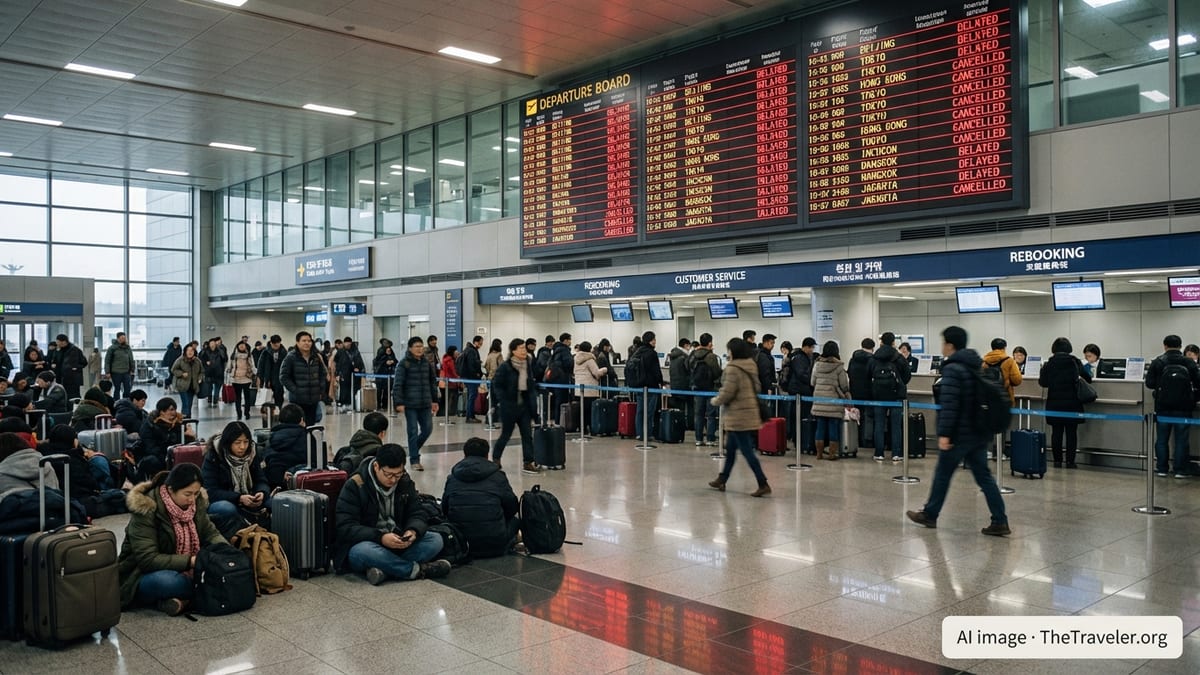
Across these hubs, the most tangible effect of more than 20 combined cancellations and retimings has been longer queues at service counters, crowding at transfer desks and a heightened sense of uncertainty among travelers who booked complex, multi-airline itineraries. Those on direct point-to-point flights generally face fewer issues, but even they are increasingly urged by operators and airports to double-check status updates before setting out.
What Travelers Should Watch in the Coming Days
As March turns to April 2026, publicly available schedules and waivers suggest that the situation remains fluid rather than fully resolved. Airlines are still grappling with a mix of geopolitical tensions, shifting fuel costs, regulatory changes and staffing constraints, any of which can trigger further adjustments with little warning.
For passengers planning trips through Jakarta, Bali, Kuala Lumpur, Taipei and other major Asian gateways, the most important step is close monitoring of their bookings through airline and airport communication channels. Many carriers, including United and several Asian low-cost airlines, continue to offer varying degrees of flexibility on rebooking when changes are driven by external factors or operational needs.
Travelers connecting between different airlines on separate tickets are particularly exposed to disruption, as a cancellation on one leg may not automatically trigger protection on the next. In this environment, booking longer connection windows, considering travel insurance that covers missed connections, and having backup routing options mapped out can significantly reduce stress.
While the latest wave of more than 20 cancellations and schedule changes has not brought Asia’s aviation system to a standstill, it highlights how quickly conditions can shift across multiple carriers and hubs. Until geopolitical and operational pressures ease more decisively, regional travel is likely to remain vulnerable to sudden pockets of chaos, especially on complex, multi-stop itineraries.