

More news on this day
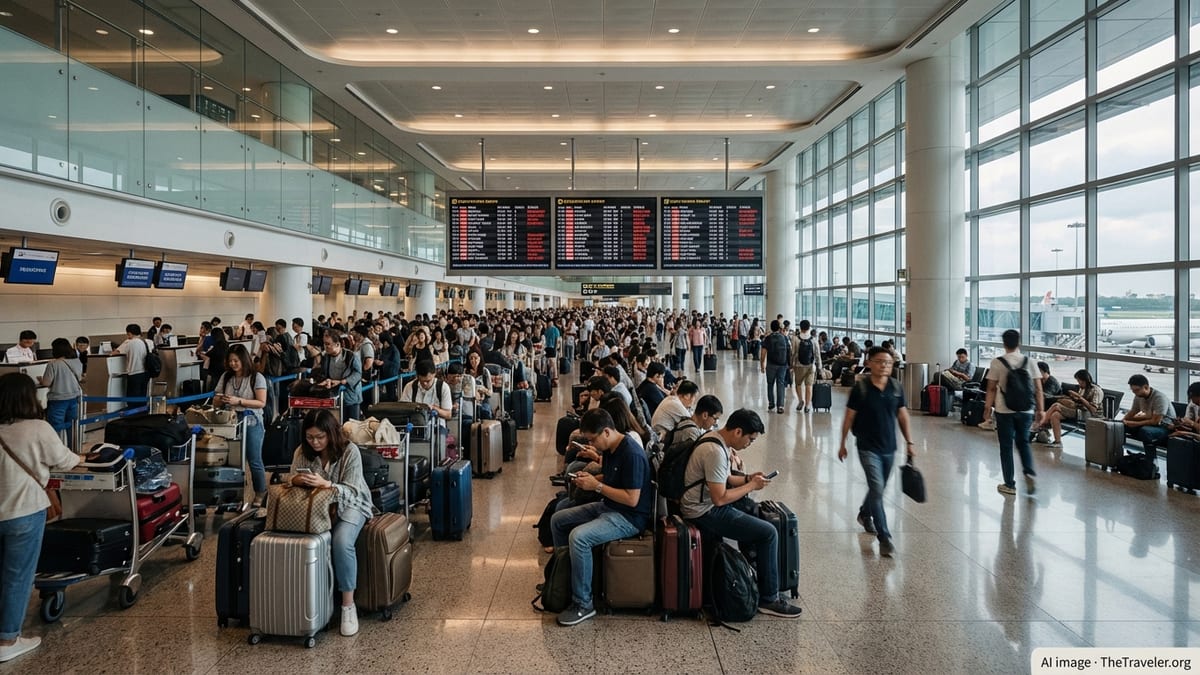
Thousands of passengers across Asia and the Gulf faced hours of disruption as flight-status boards in Tokyo, Beijing, Jakarta, Dubai and other hubs lit up with 294 cancellations and 3,030 delays in a single day, disrupting operations at airlines including ANA Wings, Batik Air, IndiGo and Saudia.
Get the latest news straight to your inbox!
Storms, Airspace Closures and Congested Hubs Combine
Publicly available flight-tracking dashboards and regional media reports indicate that the latest wave of disruption is the result of several overlapping pressures on Asian aviation. Severe spring storms have swept across parts of East and Southeast Asia, slowing arrivals and departures at major airports and forcing temporary ground stops at times. This has coincided with ongoing airspace restrictions linked to conflict in and around the Middle East, compounding the strain on already busy regional networks.
Airspace closures over Iran, Iraq and parts of the Gulf continue to push Asia–Europe and South Asia–Middle East traffic onto longer routings and a smaller number of viable corridors. Capacity reductions at key Gulf hubs have created knock-on effects for flights beginning and ending thousands of kilometres away, as aircraft and crews fail to reach their next scheduled rotations on time. Airlines that rely heavily on connections through Dubai, Abu Dhabi and other Gulf cities have been particularly exposed to these structural delays.
Within Asia, the growing volume of domestic and short-haul international travel has left limited slack in airline schedules. As storms triggered runway capacity cuts at several airports, carriers had little choice but to cancel some services outright and delay many more. Once aircraft miss their assigned slots at one hub, late arrivals cascade through the system, creating rolling delays that can last well into the night and into the following day.
Operational capacity constraints at air-traffic control centres have also played a role. When thunderstorms or reduced visibility force controllers to increase spacing between aircraft, the number of movements that can be safely handled per hour falls sharply. This pushes airlines into holding patterns, diversions or last-minute schedule changes, with passengers bearing the brunt of the disruption.
Tokyo, Beijing, Jakarta and Dubai Among Worst Affected
According to published coverage focused on the current disruption, Japan, China, Indonesia, South Korea, India and the United Arab Emirates feature prominently among the hardest-hit countries. Major hubs such as Tokyo, Beijing and Jakarta have reported large clusters of delayed departures and arrivals, affecting both domestic services and international links across Asia and beyond.
At Japan’s airports, regional carriers and feeder operators like ANA Wings have faced notable schedule challenges. These smaller airlines play a critical role in connecting secondary cities to big intercontinental gateways. When short-haul legs are delayed or cancelled, passengers can miss long-haul departures, forcing rebookings that ripple through wider alliances and codeshare networks.
In China, busy hubs such as Beijing and other coastal megapolises have experienced periods of heavy congestion, with aircraft queuing for takeoff slots and arrivals forced into holding patterns. This has affected Chinese carriers as well as foreign airlines that rely on China’s airports as key waypoints in their Asia networks. Delays in one direction have often made it impossible for aircraft to operate their return sectors on time, adding to the cancellation tally.
Jakarta has been another focal point in the disruption. Indonesia’s position as a major domestic aviation market and a growing regional connector has left its carriers vulnerable to any deterioration in weather or regional airspace conditions. Batik Air, a significant player in the Indonesian market, has been among those seeing schedules revised as crews and aircraft struggle to stay in sync with their planned rotations.
IndiGo, Saudia and Other Airlines Scramble to Rebuild Schedules
The impact on individual airlines has varied, but publicly available information highlights several names repeatedly associated with the latest disruptions. IndiGo, India’s largest carrier by market share, has already spent recent months working to stabilise its operations after earlier network strains. The current environment of diverted routes and constrained Middle East access has added fresh complexity to its scheduling picture, especially on high-demand corridors linking Indian cities with the Gulf.
Saudia and other Middle Eastern airlines have also been drawn into the turbulence. With parts of Gulf airspace restricted and some airports operating at sharply reduced capacity, services connecting Asia with Saudi Arabia and neighbouring states have faced a mix of delays, rerouting and cancellations. Passengers flying between South and Southeast Asia and religious or labour destinations in the Gulf have been particularly exposed, as these routes often operate close to full capacity even in normal times.
Regional carriers such as ANA Wings, as well as Indonesia’s Batik Air, have been trying to restore punctuality amid evolving daily constraints. For airlines operating dense short-haul schedules, even a small number of weather or airspace-related interruptions can spill over into dozens of affected flights as aircraft circulate through multiple cities per day. This dynamic helps explain how fewer than 300 outright cancellations, paired with more than 3,000 delays, could still produce large crowds of grounded passengers across Asia.
Larger global airlines that rely on Asian feeder traffic are watching the situation closely. When connecting legs are disrupted in Tokyo, Beijing, Jakarta or Delhi, it often becomes impossible to hold widebody departures indefinitely for late-arriving passengers. In those cases, travellers may be rebooked onto later flights or alternate routings, further swelling demand on already-constrained services.
Knock-On Effects for Travelers Across the Region
For passengers, the operational details translate into missed connections, unplanned overnight stays and extended time in terminal queues. Reports from affected airports describe long lines at check-in and transfer counters as travellers attempt to secure new itineraries or accommodations. Families and business travellers alike face the prospect of arriving many hours or even days later than intended, particularly on complex multi-leg journeys between Asia, the Middle East and Europe.
Travel-industry analyses suggest that the current pattern of disruption may also push fares higher on some routes over the coming weeks. With aircraft and crew resources stretched, airlines have limited ability to add extra sections to clear backlogs. As a result, remaining seats on later flights can quickly become more expensive, especially on popular Asia–Gulf and Asia–Europe corridors where alternative routings are limited.
Insurance and passenger-rights regimes vary widely across the countries affected, leaving travellers with very different levels of protection depending on their airline and itinerary. In some jurisdictions, compensation may be available when cancellations stem from factors within an airline’s control, such as crew scheduling, but not when they result from airspace closures or severe weather. Public information services and consumer advocates are urging passengers to document delays carefully and review the conditions of carriage for their specific tickets.
With storms forecast to continue across parts of East and Southeast Asia and no rapid resolution in sight for Middle East airspace restrictions, analysts expect intermittent disruptions to persist. Travelers with upcoming itineraries through Tokyo, Beijing, Jakarta, Dubai and other regional hubs are being advised by airlines and industry observers to check flight status frequently, allow additional connection time where possible and remain flexible about routings and travel dates.