

More news on this day
Thousands of passengers across Asia and the Gulf faced hours-long queues, missed connections and abrupt itinerary changes as 294 flights were cancelled and a further 3,030 delayed in a fresh wave of aviation disruption affecting key hubs from Tokyo and Beijing to Jakarta, Delhi and Dubai.
Get the latest news straight to your inbox!
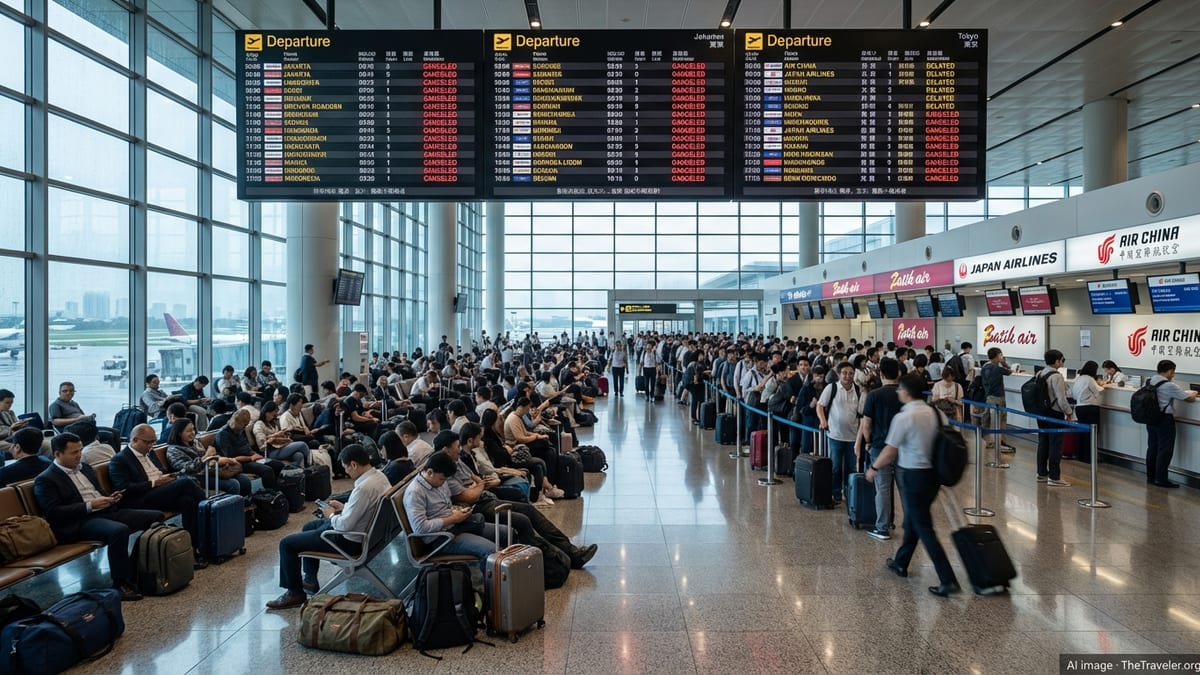
Major Hubs From Tokyo to Dubai Buckle Under Strain
Published coverage and live flight-tracking data indicate that the latest disruption is concentrated at some of the region’s busiest international gateways, including Tokyo, Beijing, Jakarta, Delhi and Dubai. Airports in South Korea, Japan, China, India and the United Arab Emirates have reported clusters of cancellations and rolling delays as schedules struggle to absorb earlier disruptions.
Industry-focused reports show that the 294 cancellations and 3,030 delays are spread across domestic and international routes, with regional connectors bearing a significant share of the impact. Short-haul services between Northeast Asian cities, Southeast Asia and the Indian subcontinent have experienced repeated pushbacks, leading to knock-on effects for long-haul departures to Europe, North America and the Middle East.
Travel-analysis outlets describe crowded terminals, long waits at transfer desks and growing backlogs at baggage reclaim areas as disrupted flights arrive out of sequence. With many services departing close to full during the busy spring travel period, spare capacity to rebook stranded passengers is limited, amplifying the effect of each individual cancellation.
Operational data compiled by aviation trackers suggest that delays of 60 to 120 minutes have become common on affected routes, turning routine point-to-point journeys into all-day odysseys for travelers caught up in the latest wave of disruption.
ANA Wings, Batik Air, IndiGo, Saudia and Others Among Affected Carriers
Regional reporting points to a broad cross-section of airlines caught up in the disruption, including Japanese regional operator ANA Wings, Indonesian-based Batik Air, Indian low-cost giant IndiGo and Saudi Arabia’s Saudia. Other carriers active across the affected hubs, including Gulf and East Asian airlines, have also adjusted schedules or faced rolling delays as congestion ripples through the network.
Publicly available information shows that ANA-affiliated services in and out of Japanese airports have had to trim frequencies and retime some flights, particularly on high-density domestic routes feeding into Tokyo. In Southeast Asia, Batik Air operations at Jakarta have faced a mix of outright cancellations and late departures, complicating onward connectivity across Indonesia and to neighboring countries.
In India, IndiGo remains a central player in any regional disruption due to its large domestic market share and dense schedule. Recent months have already seen the carrier under scrutiny for prior operational strains, and the latest bout of delays and cancellations is adding fresh pressure on its tightly wound network.
Middle Eastern gateways have not been spared. Saudia and other airlines operating through Gulf and Red Sea hubs have experienced knock-on effects from Asia-originating delays, especially on services linking the Indian subcontinent and East Asia with the Middle East and onward to Europe.
Weather, Airspace Reroutes and Capacity Limits Feed a Vicious Circle
Aviation analysts note that no single cause explains the current pattern of 294 cancellations and more than 3,000 delays. Instead, a combination of adverse weather episodes, lingering airspace restrictions linked to regional tensions and tight aircraft and crew utilization is creating a fragile operating environment across Asia and adjoining regions.
Recent reports have highlighted how periodic storms and low-visibility conditions around key coastal airports in Japan, South Korea and eastern China can quickly disrupt landing and departure flows. When these conditions coincide with already congested schedules, delays accumulate rapidly and can take many hours to unwind.
At the same time, airspace closures and rerouting across segments of the Middle East have forced airlines to adopt longer flight paths between Asia and Europe or North America. This adds block time, complicates crew duty planning and can leave aircraft out of position for subsequent rotations, increasing the risk that minor schedule disturbances escalate into widespread cancellations.
Capacity constraints are compounding the problem. With travel demand strong in many Asian markets, airlines have limited slack in their fleets to deploy spare aircraft at short notice. Once a rotation is lost to a cancellation, downstream flights often face late departures or further cuts, feeding a rolling cycle of disruption that can persist for days.
Passenger Impact: Missed Connections, Extra Costs and Limited Options
For travelers, the practical consequences of the latest wave of disruption are immediate: missed connections, unplanned overnight stays and uncertainty over compensation or rebooking options. Consumer-focused travel advisories describe scenes of passengers queueing at transfer desks in Tokyo, Beijing and Dubai, seeking replacement itineraries after tightly timed connections evaporated.
Those booked on multi-leg journeys via regional hubs are particularly vulnerable. When a short-haul feeder flight is delayed or cancelled, there may be no remaining seats on later departures that would still connect with long-haul flights, especially on heavily booked routes between Asia, Europe and North America. This often results in travelers being reprotected on services 12 to 24 hours later, or rerouted via alternative gateways at short notice.
Financially, the impact is also mounting. Travel-industry analyses point to costs for last-minute hotel stays, meals, ground transport and rebooked tickets, while airlines shoulder expenses for crew repositioning, fuel burn on elongated routings and potential compensation under applicable passenger-rights regimes. For many travelers, insurance coverage and the specific conditions of their tickets will determine how much of the burden they ultimately bear.
With disruption spread across multiple jurisdictions, understanding rights and available remedies can be challenging. Consumer advocates encourage passengers to keep documentation of delays and cancellations, monitor airline digital channels closely, and explore options ranging from free rebooking to partial refunds or travel vouchers, depending on the carrier and route.
What Travelers Can Expect in the Coming Days
Forecasts from airline schedulers and aviation data providers suggest that ripple effects from the 294 cancellations and 3,030 delays may persist for several days, particularly on routes linking East and Southeast Asia with the Middle East and Europe. Aircraft and crews displaced by the initial disruption need time to cycle back into position, and upcoming peak travel periods leave limited room to reinsert lost capacity.
Travel publications advise that passengers departing in the near term from major hubs such as Tokyo, Beijing, Seoul, Jakarta, Delhi and Dubai should plan for potential schedule changes, even if their specific flights are currently listed as operating. Longer check-in and security lines are also likely as airports work through backlogs and staff redeployments.
Some airlines have begun adjusting timetables and consolidating lightly booked services to stabilize operations, a move that may reduce day-of-flight surprises but could also result in pre-emptive cancellations as networks are reshaped. Publicly available statements indicate that carriers are prioritizing heavily used trunk routes while trimming frequencies on secondary city pairs.
For now, the picture across Asia and the Gulf remains one of heightened volatility. As weather systems shift, airspace configurations evolve and airlines fine-tune their schedules, passengers are being advised across multiple outlets to remain flexible, build extra time into connections and stay alert to real-time updates from their carriers and airports.