

More news on this day
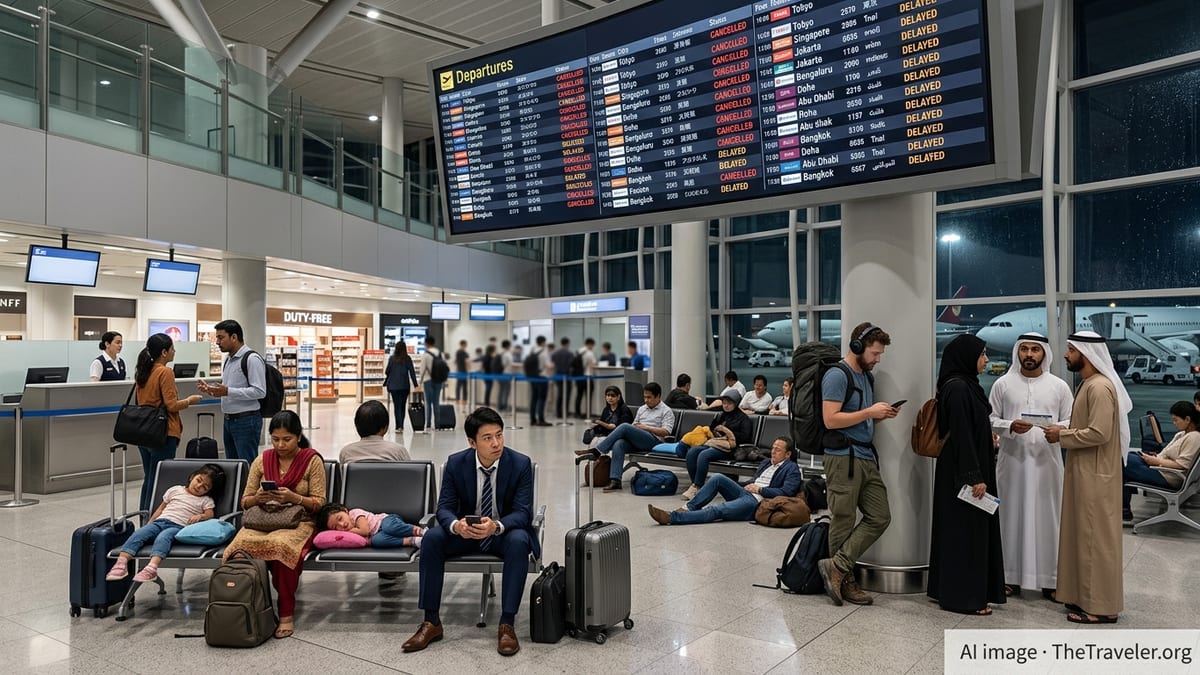
Thousands of travellers across East and Southeast Asia faced long queues, missed connections and overnight airport stays as major hubs in Japan, South Korea, Singapore, China, the Philippines and Hong Kong collectively recorded 3,072 delayed flights and 154 cancellations in a single day, disrupting schedules for carriers including Cathay Pacific, Korean Air, Japan Airlines, Air China and All Nippon Airways.
Get the latest news straight to your inbox!
Major Asian Hubs Struggle With Heavy Operational Disruptions
Publicly available aviation data and industry coverage indicate that the latest wave of disruption has hit some of Asia’s busiest airports, including Tokyo Haneda and Narita, Seoul Incheon, Hong Kong International, Singapore Changi and Manila’s Ninoy Aquino International Airport. The combined figures show thousands of departure and arrival delays alongside more than one hundred cancellations, underscoring the vulnerability of tightly timed schedules at high‑volume hubs.
Tokyo’s two main airports together accounted for hundreds of delayed flights and a cluster of cancellations, with Haneda alone reporting well over 300 delays. In South Korea, Seoul Incheon recorded more than 230 delays and at least one cancellation, while Hong Kong logged close to 300 delayed flights. Singapore Changi, a critical transit point between Southeast Asia, Europe and Australia, also reported over 130 delays and several cancellations.
In mainland China, the impact stretched across multiple major and secondary cities. Guangzhou, Shenzhen, Beijing Capital and Beijing Daxing, along with Hangzhou, Kunming, Chengdu and Xi’an, all saw elevated numbers of delayed flights, with some airports also reporting double‑digit cancellations. In the Philippines, Manila experienced close to 140 delays, adding further strain to an airport system that already operates near capacity during peak periods.
While individual causes varied from airport to airport, the cumulative effect was a continent‑wide slowdown that rippled through airline networks, leaving transit passengers particularly exposed to missed onward connections and last‑minute rebookings.
Flag Carriers And Regional Airlines Face Network Knock‑On Effects
The disruption figures translated directly into operational challenges for leading Asian airlines. Reports from flight tracking platforms and timetable data show that Cathay Pacific, Korean Air, Japan Airlines (JAL), All Nippon Airways (ANA), Air China and several regional affiliates all encountered irregular operations as their flights moved through congested hubs in Tokyo, Seoul, Hong Kong, Singapore, Beijing and Manila.
For full‑service carriers such as Cathay Pacific and Korean Air, dense long‑haul and regional schedules mean that even short delays can cascade across the day. When an inbound flight arrives late into a slot‑constrained hub, turnaround times tighten, crew duty limits approach regulatory thresholds and aircraft availability shrinks, raising the likelihood of further delays or selective cancellations later in the rotation.
Japanese carriers JAL and ANA, which rely heavily on the seamless transfer of passengers through Tokyo for both intra‑Asia and transpacific connections, were particularly exposed to congestion at Haneda and Narita. Publicly available performance data and timetables suggest that delays on popular routes linking Tokyo with Seoul, Hong Kong, Singapore and major Chinese cities created timing mismatches with onward flights to North America and Europe, increasing missed‑connection risks.
On the mainland side, Air China and other Chinese carriers faced similar challenges as disruptions at Beijing, Guangzhou, Shenzhen and Hangzhou affected their complex domestic‑international networks. Each cancellation removed an aircraft from the day’s planned flow, often requiring unscheduled aircraft swaps, re‑crewing and re‑routing of passengers, especially on heavily booked services.
Weather, Congestion And Tight Scheduling Combine To Slow Operations
Although no single catastrophic event has been reported across the region, aviation monitoring services and local media coverage point to a familiar mix of contributing factors: periods of adverse weather, air traffic congestion, tight scheduling and localized operational issues at individual airports.
Even moderate weather disturbances such as low visibility, strong winds or heavy rain can reduce runway capacity and increase separation between aircraft, particularly at already busy hubs. When combined with peak‑hour traffic, this can quickly generate long queues for takeoff and landing, forcing airlines to hold aircraft on the ground or in holding patterns, which then disrupts departure times for subsequent legs.
Operational strains are exacerbated by the high utilization models many airlines employ, particularly for narrowbody fleets serving short‑haul regional routes. Aircraft often operate multiple sectors per day with minimal buffer time. Once the first rotation is delayed, the probability that later legs will also depart late rises sharply unless spare aircraft and crews are available, which is not always the case in competitive markets.
Industry analysts note that these pressures are occurring against a backdrop of robust travel demand across Asia, with many carriers having restored or exceeded pre‑pandemic capacity on key routes. That recovery has left less slack in the system to absorb shocks, meaning that a day of widespread minor disruptions can quickly escalate into thousands of delayed flights, as reflected in the latest figures.
Travellers Confront Long Queues, Missed Connections And Limited Options
For passengers, the statistical picture translated into long check‑in and security lines, crowded boarding gates and uncertainty over arrival times. Publicly shared accounts from travellers in Tokyo, Seoul, Manila and Hong Kong describe waits stretching for hours, along with scrambling to rebook missed onward segments once it became clear that original itineraries could not be maintained.
Transit passengers routed through major hubs bore much of the disruption. Those connecting between regional services and long‑haul flights to North America or Europe often faced a narrow connection window; when an inbound flight arrived late, rebooking options were limited, especially on popular routes that already operated close to full capacity. Some travellers reported being moved to flights the following day, requiring overnight stays near airports.
Within Asia, where many business and leisure trips rely on tight same‑day schedules, even shorter delays had tangible consequences. Late‑evening flights that pushed into night curfews at certain airports risked diversion or cancellation, while early‑morning departures delayed by late‑arriving aircraft compressed time available for meetings or onward domestic transfers.
Consumer advocates point out that, while compensation frameworks differ significantly between jurisdictions, passengers are often left to navigate complex airline policies and local regulations when disruptions span multiple countries. The patchwork of rules across Japan, South Korea, China, Hong Kong, Singapore and the Philippines can make it challenging for travellers to understand their entitlements to refunds, rebooking or accommodation.
What The Latest Turmoil Signals For Asia’s Peak Travel Season
The scale of the latest disruptions is drawing attention to the resilience of Asia’s aviation infrastructure ahead of upcoming holiday peaks. With travel demand rising and airlines planning dense summer and Golden Week schedules, analysts suggest that the current episode offers an early warning about the margin for error at major hubs such as Tokyo, Seoul, Hong Kong, Singapore, Beijing and Manila.
Capacity expansions, runway improvements and upgraded air traffic management systems are expected to ease some of the pressure over the medium term, but many of these projects remain years from completion. In the nearer term, operational discipline, realistic scheduling and contingency planning are emerging as critical tools for carriers determined to avoid repeating a day in which more than three thousand flights across the region departed late.
For travellers, the events highlight the importance of building buffer time into itineraries, especially when transiting through multiple hubs on a single ticket. Travel planners increasingly recommend allowing longer connection windows, favouring morning departures where possible and closely monitoring flight status apps and airline notifications as departure time approaches.
As Asia’s skies grow busier, the latest wave of delays and cancellations underscores that recovery in demand has outpaced the speed of infrastructure and staffing adjustments. Unless airlines and airports can find additional flexibility, similar days of mass disruption may remain a recurring feature of the regional travel landscape.