

More news on this day
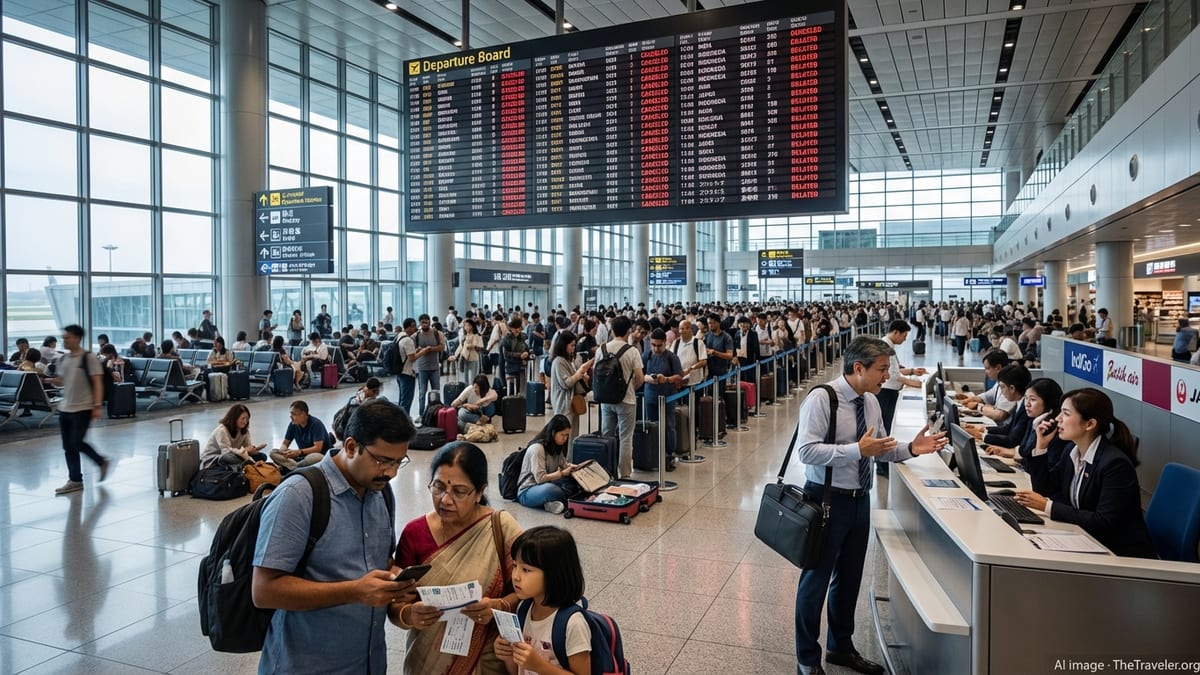
Thousands of air travelers across Asia are facing long queues, missed connections, and overnight airport stays as widespread disruption leads to 3,251 delayed flights and 134 cancellations affecting major carriers in Thailand, Japan, Singapore, China, India, Hong Kong, and Indonesia.
Get the latest news straight to your inbox!
Widespread Disruption Across Asia’s Busiest Corridors
Publicly available flight tracking data and regional aviation reports indicate that a fresh wave of operational disruption has swept across Asia’s main air corridors, piling pressure on already busy hubs from Bangkok and Beijing to Kolkata and Singapore. The combined impact amounts to 3,251 flight delays and 134 cancellations in a short window, creating a knock-on effect that is being felt throughout the region’s dense network of domestic and international services.
The latest disruption is particularly visible along routes linking Southeast Asia and North Asia, where traffic volumes have surged with the recovery of international travel. Congested airspace, weather-related constraints, and local operational challenges are combining to push airport and airline systems close to capacity. As schedules slip, recovery windows are narrowing, leaving less room to absorb additional shocks.
Travelers connecting between regional hubs and long haul services to Europe, the Middle East, and North America are among the hardest hit. Missed onward flights and rebookings are stretching airline inventory, especially in premium holiday and business travel periods, while ground handling and customer service teams work through mounting backlogs at service desks and call centers.
The pattern of disruption reflects the highly interconnected nature of Asian aviation. When one or two strategic hubs fall behind schedule, delays radiate quickly across the network, often reaching secondary cities hours later in the form of late arrivals, reduced turnaround time, and further schedule slippage.
Bangkok, Beijing, And Kolkata Emerge As Pressure Points
Bangkok, Beijing, and Kolkata have emerged as notable pressure points in the current wave of disruption, according to real time airport statistics and regional media coverage. Bangkok’s role as a key Southeast Asian gateway means even modest delays can rapidly escalate as aircraft cycle through multiple short haul legs in a day, pushing subsequent departures further behind schedule.
In Beijing, traffic density and ongoing airspace management constraints amplify the effect of any disruption. High volumes on trunk routes into and out of the Chinese capital make it challenging to reschedule flights within narrow operational windows. Congested departure and arrival banks are especially vulnerable when weather or technical issues force flow restrictions or extended spacing between aircraft.
Kolkata, while smaller than Bangkok or Beijing, occupies a critical position on east India routes that link to Southeast Asia and the wider Asia Pacific region. When flights into Kolkata are delayed or cancelled, it can sever important feeder links that many passengers rely on for international onward travel, including flights that connect via Delhi, Mumbai, or foreign hubs in Southeast and East Asia.
These hubs also act as crew and aircraft bases for a range of carriers. When a single aircraft rotation is disrupted in one city, it can prevent that aircraft and its crew from operating a subsequent sector elsewhere, compounding the effects hundreds or even thousands of kilometers away.
Major Carriers Struggle To Maintain Schedules
Flag carriers and leading regional airlines including Cathay Pacific, Japan Airlines, Air China, and Air India feature prominently in the disruption picture, alongside other operators that serve the affected hubs. Publicly available on time performance summaries for Asia Pacific airlines already show how tight margins are between planned and actual operations, and the latest events are adding further strain.
Cathay Pacific’s complex hub structure in Hong Kong means it is particularly sensitive to delays across North and Southeast Asia. Disruptions in Bangkok, Beijing, or major Indian cities can quickly cascade into the carrier’s tightly timed connection banks, making it more difficult to keep onward flights operating within scheduled slots and to preserve guaranteed connection times for transfer passengers.
Japan Airlines faces similar challenges in protecting its schedules, as delays ripple from regional routes into the carefully choreographed departure waves from Japanese airports that feed long haul flights to Europe and North America. Any disruption in Asia’s southern or western sectors can leave aircraft and crews out of position for these critical long haul departures, forcing last minute swaps, consolidations, or cancellations.
Air China and Air India, both with large domestic networks feeding high demand international services, are contending with the double pressure of internal congestion and cross border constraints. Recent reports about crew duty time expiries after extended delays, as well as technical checks on aircraft, illustrate how operational safeguards can themselves lead to cancellations when the system is already under stress.
Regional Factors Behind The Latest Wave Of Disruption
While each individual delay or cancellation may have a specific cause, regional aviation data and recent analytical coverage suggest several recurring factors behind the latest disruption across Asia. These include localized weather systems around major hubs, air traffic control flow management measures, ongoing maintenance and fleet availability issues, and tighter crew duty limits in response to safety standards.
Weather remains a persistent variable, particularly around coastal and monsoon influenced airports such as Bangkok, Singapore, and a number of Chinese and Indonesian cities. Even when conditions remain safe for operations, lower visibility, storms in approach paths, or high winds can force reduced arrival and departure rates, quickly leading to backlogs during already busy periods.
Air traffic management systems in parts of the region are also operating close to capacity at peak times. When controllers are required to introduce additional spacing between aircraft or reroute flights around congested sectors, average delay minutes rise and recovery takes longer. This is especially evident in high density corridors linking major Chinese cities with Southeast Asian tourism and business centers.
At the airline level, rebuilding capacity after the pandemic era has brought challenges in matching aircraft, maintenance resources, and trained crews to restored networks. Several carriers have periodically grounded aircraft for inspections or modifications, and reported that crew rosters leave little flexibility when operations run late. Once ground times shrink below planned levels, small operational issues can tip flights into significant delay or cancellation.
Passengers Face Long Waits, Tight Rebooking Options
The most visible consequence of the current disruption is at the passenger level. Travelers in Bangkok, Beijing, Kolkata, Singapore, Hong Kong, and other affected cities are encountering crowded terminals, long check in and security queues, and packed departure halls as airlines work through the backlog of delayed services.
Because many of the affected flights operate as part of multi leg journeys, passengers with tight connections are particularly exposed. Missed long haul departures can translate into full day or overnight delays, as alternative flights may be fully booked or operate only once per day on certain routes. In some cases, regional media coverage notes that travelers have had to split groups or accept rerouting via alternative hubs to reach their destinations.
Rebooking is further complicated by the limited spare capacity that remains in many Asian markets during peak periods. Even where airlines provide waivers or flexible rebooking options in response to disruption, finding available seats on suitable flights can take time. This is especially true for routes where a small number of carriers dominate, or where bilateral traffic rights and slot constraints limit how quickly additional flights can be added.
Observers note that the recent wave of delays and cancellations highlights the importance for travelers of monitoring real time flight status, allowing additional buffer time for connections within Asia, and considering alternative routing options when itineraries rely on a single busy hub that may be vulnerable to regional disruptions.