

More news on this day
Air travel across Asia and key Gulf hubs suffered a fresh wave of disruption on April 10, 2026, as operational data showed 573 flights cancelled and 6,324 delayed across China, Indonesia, Japan, South Korea, the United Arab Emirates and neighboring markets, snarling schedules for Korean Air, ANA Wings, IndiGo, Saudia and a long list of regional carriers.
Get the latest news straight to your inbox!
Regional Disruptions Stretch From Beijing to Dubai
Published tallies compiled from airport and aviation tracking data indicate that the latest disruption has hit a broad swath of the Asia Pacific network, affecting services at major hubs including Beijing, Jakarta, Jeju City, Taipei and Dubai. The figures, circulating widely across specialist travel and aviation outlets on April 10, point to a day of acute operational strain at some of the world’s busiest airports.
In mainland China, recent days have already seen mounting delays at airports such as Beijing Capital, Beijing Daxing, Shanghai Pudong, Guangzhou Baiyun and Shenzhen Bao’an. A separate data snapshot from early April highlighted more than 100 cancellations and over 1,300 delays concentrated at Chinese and Indonesian gateways, underscoring how quickly disruption in these hubs can cascade through regional schedules.
Jakarta Soekarno Hatta International Airport, Indonesia’s primary international gateway, has repeatedly appeared in disruption reports this month, with dozens of cancellations and several hundred delays logged across multiple days. Travel-industry coverage notes that the airport’s central role in linking Southeast Asian capitals with domestic Indonesian destinations means even modest operational issues can ripple outward across the archipelago and into connecting long haul services.
In the Gulf, Dubai International Airport remains a focal point for the current episode. Publicly available information from recent days highlights a series of cancellations and extended delays affecting services into and out of the city, compounded by wider schedule adjustments by airlines serving Gulf routes. With Dubai acting as a key bridge between Asian cities such as Beijing, Jakarta and Taipei and onward connections to Europe and North America, disruptions there are magnified across multiple continents.
Airlines From Korean Air to IndiGo Feel the Strain
The latest figures show that the impact is distributed across a wide range of airlines rather than confined to a single carrier. Regional reporting points to Korean Air, ANA Wings, IndiGo and Saudia among the operators most visibly affected on April 10, alongside Chinese, Japanese, Indonesian and Gulf-based airlines that dominate traffic flows through the busiest hubs.
South Korean carriers have faced repeated operational challenges in recent weeks. Coverage of conditions at Jeju, Gimpo, Incheon and Gimhae airports has described a steady pattern of delays and cancellations, with one recent snapshot citing more than 400 delays and dozens of cancellations in a single day across those four airports alone. Jeju in particular, one of the world’s busiest domestic airports, has seen repeated waves of disruption, leaving carriers juggling tight aircraft rotations and slot constraints.
In Japan, regional operators such as ANA Wings and the broader All Nippon Airways group are contending with congestion at Tokyo Haneda, Narita and Kansai, which continue to experience high volumes as demand recovers. Aviation data published on April 10 links Japanese delays not only to local weather and traffic but also to knock on effects from upstream disruptions at Chinese and Korean airports.
Indian low cost carrier IndiGo and Saudi Arabia’s Saudia also feature in daily tallies tracking the 573 cancellations and 6,324 delays, reflecting the way Middle East routing changes and congestion in Gulf hubs are intersecting with Asia’s intra regional networks. Additional published updates on Air India’s curtailed Gulf schedules this week have underlined the fragile balance facing carriers that rely heavily on West Asia connections.
Weather, Airspace Restrictions and Operational Bottlenecks Converge
Industry analysis over the past week suggests that no single factor is responsible for the 573 cancellations and 6,324 delays logged on April 10. Instead, the disruption appears to stem from a convergence of seasonal weather systems, lingering airspace restrictions linked to Middle East tensions and persistent operational bottlenecks in several fast growing markets.
Recent coverage by regional business media has highlighted how partial airspace closures and rerouting requirements over parts of West Asia have extended flight times and complicated scheduling for airlines linking Asia with the Gulf and beyond. This has increased fuel consumption at a time of volatile jet fuel prices, while also tightening the margins carriers rely on to keep aircraft and crews rotating smoothly across dense multi leg networks.
Weather has also been a recurring trigger. In the first week of April, multiple travel publications reported that storm systems over eastern China and the Korean Peninsula contributed to hundreds of cancellations and thousands of delays over several days, creating backlogs that some carriers have struggled to fully absorb. When airports already coping with those residual effects encountered further strain on April 10, the result was a sharp spike in same day cancellations and late departures.
Operational constraints at key hubs are amplifying the impact. Several of Asia’s largest airports are operating near or at capacity during peak periods, leaving limited flexibility to re accommodate disrupted flights or reposition aircraft. Analysts cited in recent transport and tourism bulletins note that even small disruptions in such environments can trigger rolling delays throughout the day, particularly when carriers are also managing crew duty limits and maintenance windows.
Passengers Face Long Delays and Patchwork Recovery
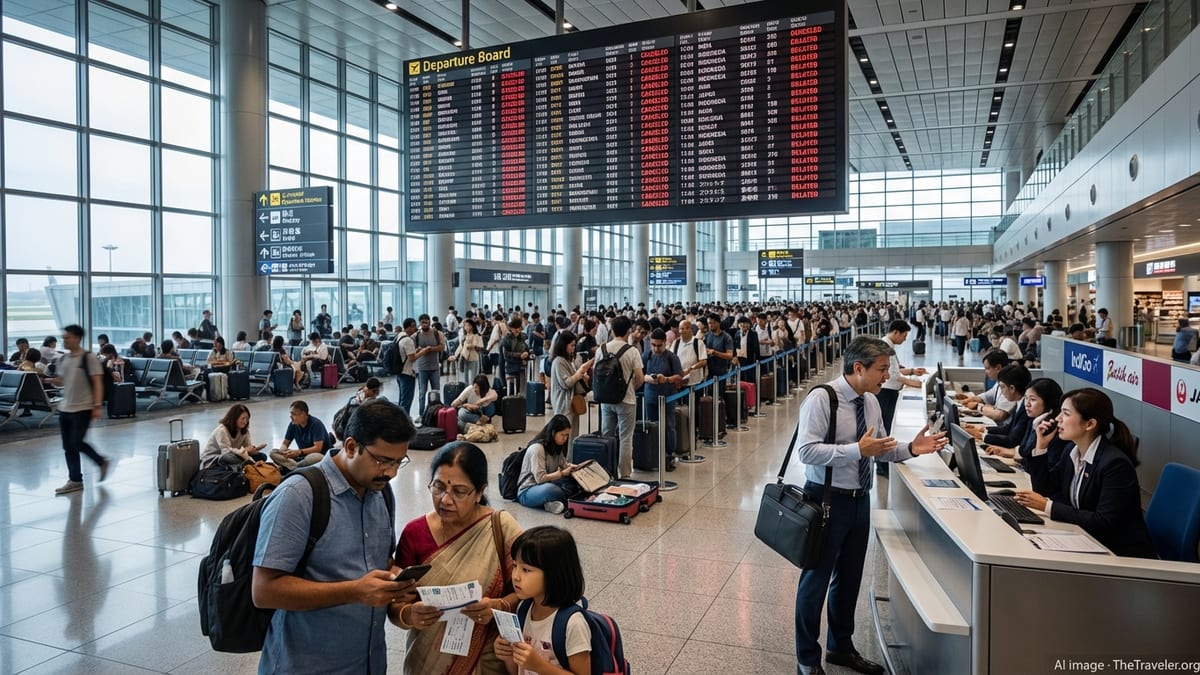
For travelers, the latest disruption has translated into long queues, extended layovers and missed connections across multiple countries. Reports from travel and tourism outlets describe passengers stranded at terminals from Beijing to Dubai as departure boards filled with delayed and cancelled flights, with some travelers facing rebookings many hours or even days later, depending on their route.
Data driven coverage of early April’s disruptions suggests that delays are far outpacing outright cancellations, a pattern that appears to be continuing with the April 10 figures. While this means that many flights are still operating, they are often departing substantially behind schedule, creating uncertainty for passengers and stretching airport resources as crowds build at gates and check in counters.
Publicly available guidance from airports and travel platforms continues to emphasize the importance of checking live departure and arrival boards, as well as airline communication channels, for the most current status information. With conditions varying widely between airports and even between terminals on the same day, generalized assumptions about punctuality remain unreliable.
Recovery from such widespread disruption is typically uneven. Aviation observers note that some hubs, particularly those with more spare runway and gate capacity, can return to near normal operations within a day or two, while others may experience lingering knock on effects for several days as crews, aircraft and passengers are repositioned. Given the scale of April’s cumulative disruptions, travelers across Asia may continue to encounter irregular operations even after the single day figures of 573 cancellations and 6,324 delays subside.
Tourism and Business Travel Outlook Clouded
The timing of the April 10 disruption is particularly sensitive for Asia’s tourism and business travel sectors, which have been counting on a strong spring and early summer to consolidate their post pandemic recovery. Previous data releases on passenger volumes show that airports such as Jakarta, Taipei and Jeju have been handling tens of millions of travelers annually, leaving little margin for extended operational shocks.
Travel trade publications observe that repeated waves of delays and cancellations can erode traveler confidence, especially among long haul visitors planning multi stop itineraries that depend on reliable connections through hubs like Beijing, Tokyo, Seoul and Dubai. Corporate travel planners are also monitoring the situation closely, balancing cost considerations against the need for schedule resilience when routing staff through the most affected gateways.
Analysts quoted in recent aviation and tourism bulletins suggest that if weather related and geopolitical pressures persist into late April and May, airlines may need to further adjust schedules, build in larger time buffers between rotations or temporarily trim frequencies on certain routes to restore reliability. Such measures could support more stable operations but may also limit capacity just as demand remains robust, potentially pushing fares higher on the most popular city pairs.
For now, the figures from April 10 capture a snapshot of an Asian aviation system still under significant strain. With 573 flights cancelled and 6,324 delayed in a single day across multiple countries and carriers, the episode underscores how interconnected the region’s air networks have become and how quickly localized challenges in places such as Beijing, Jakarta, Jeju City, Taipei and Dubai can cascade into a broader disruption affecting travelers far beyond Asia’s borders.