

More news on this day
Air travel across Asia and the Gulf faced another wave of disruption as publicly available aviation data for April 5, 2026 indicated at least 514 flight cancellations and 5,262 delays affecting South Korea, China, Japan, India, the United Arab Emirates and surrounding markets, hitting carriers such as All Nippon, Batik Air, China Eastern and FlyDubai and snarling operations at key hubs from Beijing and Tokyo to Jakarta, Delhi and Dubai.
Get the latest news straight to your inbox!
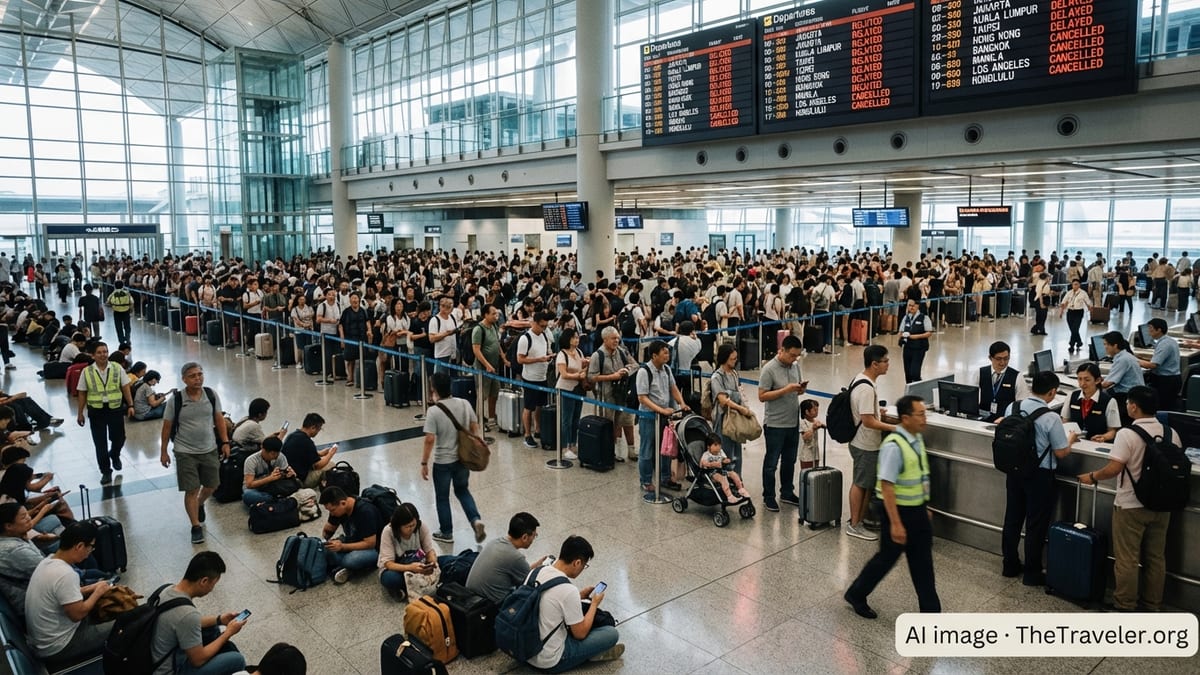
Wide Ripple Effect Across Asian and Gulf Skies
Aggregated figures drawn from airport disclosure and flight-tracking dashboards on April 5 point to an unusually high volume of disruption concentrated in a single regional trading day, with cancellations passing the 500 mark and delays comfortably exceeding 5,000. The pattern reflects sustained operational strain that has been building over recent weeks as airlines balance strong demand with congested airspace, weather complications and lingering aircraft and crew imbalances.
China, Japan, South Korea and India accounted for a substantial share of the affected services, while major Gulf gateways that serve as connectors between Asia, Europe and Africa also reported knock-on disruption. Publicly available data shows that several of the region’s biggest hubs logged triple-digit tallies for late-running departures and arrivals, pointing to a network-level issue rather than isolated local problems.
The scale of delays means that many passengers experienced missed connections and extended time on the ground, particularly at airports where turnaround windows are already tight. Aviation analysts cited in regional coverage note that once delays reach this volume, recovery often takes more than a single day, with rotations and crew duty limits forcing further timetable adjustments.
Industry observers say the situation underscores how sensitive the Asian and Gulf aviation system remains to any combination of capacity stress and weather or operational shocks, despite the robust rebound in passenger volumes since 2023. Carriers are flying close to schedule limits on popular trunk routes, leaving limited room to absorb cascading disruption.
Major Hubs from Beijing to Dubai Under Pressure
Beijing, Tokyo, Jakarta, Delhi and Dubai emerged as some of the most heavily affected airports, according to live and historical flight-status feeds reviewed for April 5. In China, large international and domestic gateways such as Beijing Capital have repeatedly appeared near the top of regional rankings for delayed operations, reflecting dense traffic banks and complex interlining between domestic and international services.
In Japan, reports indicate that airports including Tokyo Haneda and Fukuoka faced notable waves of delayed departures and arrivals, with several services either cancelled outright or rescheduled to later time slots. These hubs play central roles in the country’s domestic business and leisure markets, so disruption there tends to propagate quickly to secondary cities.
In India, Delhi featured prominently in the day’s disruption profile, with late-running departures contributing to missed onward connections on both domestic and international routes. Mumbai and Chennai also recorded elevated delay levels, magnifying the strain on carriers that rely on multi-leg itineraries through the country’s largest cities.
Dubai International Airport, one of the world’s busiest long-haul connectors, registered substantial delay volumes tied to the broader regional pattern. Public flight-information boards showed clusters of late departures and arrivals on services linking Dubai with Asian cities including Beijing, Jakarta and Delhi, reinforcing the extent to which a bad day in Asia can ripple into the Gulf’s tightly timed connecting banks.
Flag Carriers and Low-Cost Operators Alike Affected
The disruption did not spare any particular market segment. Publicly available airline-level data and regional reports highlight a diverse list of affected carriers, including full-service and low-cost operators. All Nippon Airways and other Japanese brands experienced a mix of late operations and select cancellations on domestic and regional routes, especially at Haneda and key western Japan airports.
In Southeast Asia, Indonesia’s Batik Air once again appeared prominently in delay and cancellation tallies associated with Jakarta and other Indonesian gateways. The carrier operates a dense schedule across the archipelago and into neighboring countries, and even modest schedule slippage can cascade quickly through that network.
From China, China Eastern Airlines featured among the operators contending with elevated disruption, in line with its heavy exposure to major hubs in Beijing, Shanghai and key provincial cities. Public statistical snapshots of Chinese operations show that large state-linked carriers often shoulder a disproportionate share of schedule volatility when weather or airspace constraints emerge.
In the Gulf, FlyDubai was among the airlines recorded as experiencing delayed operations during the April 5 turbulence, particularly on routes that connect Dubai with South and Southeast Asian cities. With many of these services feeding into onward connections, delays on short and medium-haul sectors can have outsized effects on long-haul itineraries for both leisure and labor traffic.
Weather, Congestion and Operational Constraints Drive Disruption
Published coverage across the region attributes the latest spike in cancellations and delays to a familiar mix of factors rather than a single extraordinary event. Seasonal weather systems affecting parts of East Asia and the Indian subcontinent, including thunderstorms and low-visibility conditions, constrained airport movements at several key hubs and forced temporary holding patterns or diversions.
At the same time, structural congestion remains a central challenge. Many of Asia’s busiest airports are operating near declared capacity in peak periods, and any weather or airspace restriction can quickly create backlogs. Once departure queues lengthen, arriving flights may also be held, further eroding schedule reliability even if aircraft and crews are available.
Operational constraints add another layer of complexity. Airlines across the region are still calibrating fleet deployments after previous capacity reductions and aircraft grounding cycles, while global supply-chain pressures continue to affect maintenance turnaround times. Crew rosters must also comply with duty-time limits, which can force additional cancellations when delays stretch into a second or third rotation.
Industry watchers note that these dynamics are not unique to Asia, but the density of traffic, the mix of domestic and international routes, and the reliance on a handful of mega-hubs in China, Japan, India and the Gulf make the region particularly vulnerable to short-notice disruption spikes of the kind seen on April 5.
Passengers Face Missed Connections and Growing Calls for Clarity
For travelers, the practical impact of 514 cancelled flights and more than 5,000 delays across a single day is measured in missed holidays, interrupted business trips and extended airport waits. Social media posts and local news segments from cities such as Beijing, Jakarta, Delhi and Dubai highlighted queues at transfer desks and rebooking counters as passengers sought alternative connections or overnight accommodation.
Consumer-rights groups and travel commentators across several markets have renewed calls for clearer, more harmonized communication from airlines and airports when large-scale disruption develops. While most carriers now offer real-time updates through mobile apps and messaging channels, passengers still report confusion when flights shift from delayed to cancelled status with limited advance warning.
There is also growing attention on compensation and assistance frameworks, which vary significantly by jurisdiction. Some Asian markets have codified passenger protection rules for long delays and cancellations, while others rely primarily on airline policies. The latest disruption wave has reignited debate over whether more consistent regional standards are needed as cross-border air travel continues to expand.
With demand for seats across Asia and the Gulf expected to remain strong through the northern summer, analysts following the sector suggest that the events of April 5 serve as another stress test of the region’s resilience. Unless additional capacity, infrastructure upgrades and more flexible operational buffers are put in place, similar episodes of widespread disruption are likely to recur when weather or other pressure points converge.