

More news on this day
Air travel across Asia faced fresh disruption on April 7 as a cluster of major hubs in China and Southeast Asia, including Beijing Daxing, Chengdu Tianfu, Guangzhou Baiyun, Shanghai Hongqiao, Jakarta and Bali, reported dozens of cancellations and hundreds of delays, leaving passengers stranded and schedules in disarray.
Get the latest news straight to your inbox!
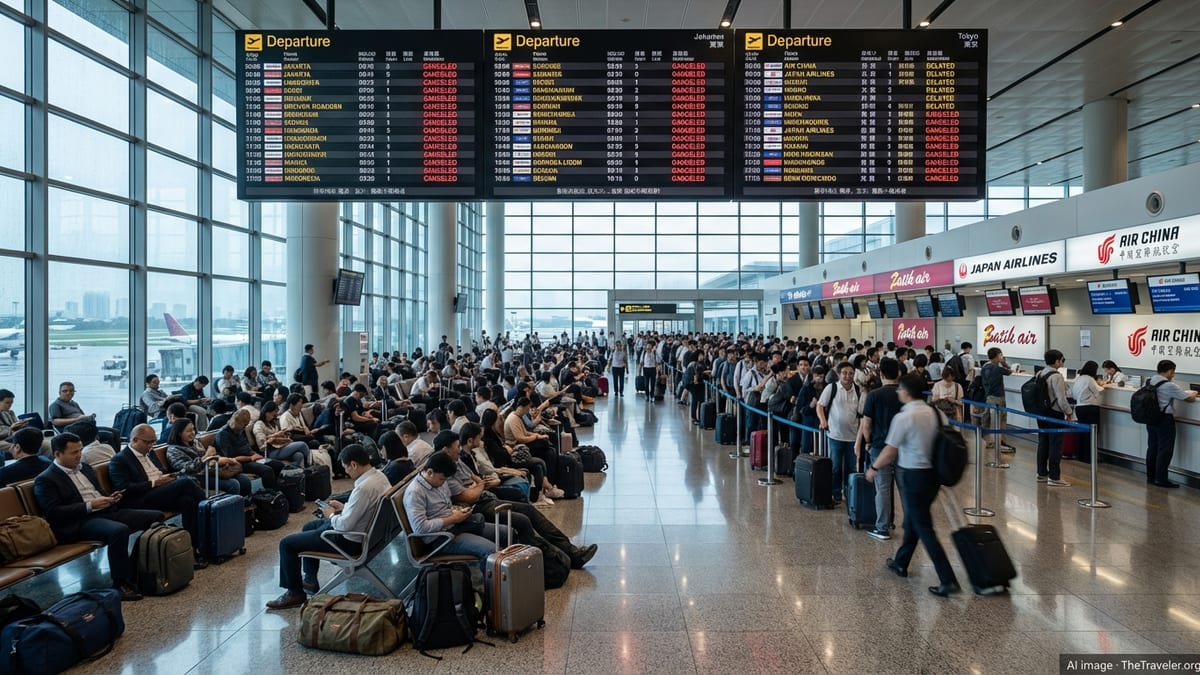
Cluster of Disruptions at Leading Asian Gateways
Operational data compiled from flight-tracking and aviation information platforms for April 7 indicates that at least 57 flights were cancelled and around 576 were delayed across a group of key airports: Beijing Daxing, Chengdu Tianfu, Guangzhou Baiyun, Shanghai Hongqiao, Jakarta’s main international gateway and Bali’s Ngurah Rai International Airport. These figures capture only a slice of wider regional disruption, but they highlight how pressure points at a handful of busy hubs can reverberate through broader networks.
Chinese airports have been particularly affected. Beijing Daxing, Chengdu Tianfu and Guangzhou Baiyun all reported elevated levels of disruption, with cancellations concentrated on short and medium haul routes within China and across Northeast and Southeast Asia. Parallel reporting from regional travel outlets points to a broader spike in Chinese flight cancellations and delays this week, underscoring ongoing strain on airport and airline operations.
In Southeast Asia, Jakarta and Bali have seen knock-on effects from congestion and schedule changes on China-linked services and regional leisure routes. Indonesia’s role as both a major outbound market and a gateway for travelers heading to popular destinations such as Bali and beyond means that even modest operational hiccups can translate quickly into long queues and missed connections.
Shanghai Hongqiao, a key domestic and regional hub, has also emerged as a pressure point, particularly for travelers shuttling between financial centers and manufacturing hubs in eastern and southern China. Real-time timetable and tracking information shows that disruptions at Hongqiao have coincided with issues at Guangzhou Baiyun, amplifying delays on one of China’s busiest air corridors.
China’s Network Under Strain
China’s rapidly recovering air travel market is placing sustained demand on major hubs, and publicly available statistics for early April show a delay-dominant pattern at airports such as Guangzhou, Beijing Daxing and Chengdu Tianfu. Travel industry coverage notes that Guangzhou Baiyun alone has seen well over one hundred delayed movements on several recent days, alongside a smaller but still significant number of cancellations.
Reports summarizing national flight data highlight that Chinese carriers, including big state-owned groups and regional airlines, are contributing heavily to congestion at these hubs. A combination of tight turnaround times, slot constraints, and dense wave-bank scheduling for connections inside China appears to be leaving limited margin to recover when individual flights go off-schedule.
Weather has not been cited as the primary driver for the latest round of interruptions, which suggests that airline and airport operational factors, including crew rotation, aircraft positioning and maintenance scheduling, may be central to the current wave of disruption. Analysts tracking Chinese aviation performance have previously pointed to a pattern where even isolated technical or staffing issues at one or two bases can cascade through the tightly interconnected domestic network.
At Beijing Daxing and Chengdu Tianfu, which both serve as important nodes for routes linking inland China with coastal economic centers and international destinations, the impact of cancellations has been especially visible in the form of rebooked passengers spilling into later departures. Travel data platforms show some flights being zeroed out or re-timed on short notice, forcing airlines to consolidate passengers and contributing to crowding during peak periods.
Ripple Effects on Jakarta and Bali Leisure Flows
Jakarta’s Soekarno Hatta and Bali’s Ngurah Rai International Airport serve as critical gateways for leisure and business traffic between Indonesia, China and the wider Asia Pacific region. According to flight-status aggregators, cancellations and delays on routes touching Chinese hubs such as Guangzhou and Shanghai have translated into missed connections and extended layovers for passengers routing through Jakarta.
For Bali, even a relatively small cluster of cancellations or late arrivals can be highly disruptive. Many visitors arrive on evening or late-night flights and have onward ground or domestic air segments to reach resorts around the island or further afield. When flights arrive hours behind schedule, it complicates hotel check-ins, transfers and tour departures, creating a visible knock-on effect in the local tourism ecosystem.
Published travel commentary also notes that Indonesia’s aviation sector is still managing uneven capacity and schedule adjustments in response to shifting demand patterns. Airlines are continuing to recalibrate frequencies on routes to and from China alongside other regional markets, which can result in late timetable changes and, in some cases, consolidation of lightly booked flights.
These dynamics mean that disruptions originating at Chinese hubs do not stay confined within China’s borders. Instead, they propagate along popular leisure corridors, affecting travelers from Australia, Europe and North America who have booked multi-leg itineraries to Bali that connect via Jakarta or Chinese transit points.
Shanghai Hongqiao and Guangzhou Corridor Bottlenecks
Shanghai Hongqiao and Guangzhou Baiyun anchor one of China’s busiest domestic corridors, supporting dense business and visiting friends and relatives traffic between the Yangtze River Delta and the Pearl River Delta. Flight schedule databases and aviation analytics bulletins list both airports among the highest in China for daily movements and recent delay counts.
Recent operational snapshots show that both airports have faced simultaneous waves of delays, particularly during morning and evening peaks when banks of departures and arrivals are tightly packed. When one leg on the Hongqiao to Guangzhou axis experiences a technical delay or crew timing issue, it can quickly affect aircraft rotation plans for multiple subsequent sectors, compounding congestion.
Guangzhou Baiyun has undergone terminal reassignments and expansions in early 2026, with some domestic and international carriers shifting to a new terminal. Publicly available information suggests that such transitions can temporarily increase the risk of misalignments between flight schedules, gate availability and ground handling resources, especially when combined with robust passenger demand.
For travelers, the practical impact is longer waits at security checkpoints and boarding gates, tighter connection windows, and in some cases missed onward flights. With Hongqiao focused heavily on short-haul and high-frequency services, any sustained disruption can quickly fill rebooking options, forcing some passengers to wait several hours or overnight for open seats.
What Travelers Can Expect in the Coming Days
With regional air traffic volumes rising into the northern spring travel period, analysts expect continued pressure on punctuality at major Asian hubs, particularly those already identified as disruption hotspots. Data trends from the past several days show that once delay numbers cross certain thresholds at airports such as Guangzhou Baiyun, Beijing Daxing or Shanghai Hongqiao, recovery to normal operating tempos can take much of the day.
Industry guidance consistently stresses the importance of monitoring flight status through airline and airport channels and allowing extra buffer time for connections, especially when itineraries involve multiple stops between China and Southeast Asia. Same-day self-connect itineraries that rely on tight layovers at busy hubs carry a heightened risk of misconnection while irregular operations remain elevated.
Passengers holding tickets on routes linking Chinese hubs with Jakarta and Bali, in particular, may experience schedule changes, equipment swaps or consolidations as airlines attempt to smooth operations and optimize aircraft utilization. Travel planners are already advising clients to consider more flexible arrangements, including travel insurance that covers delays and cancellations, when routing through the most congested airports.
For now, the wave of 57 cancellations and 576 delays across Beijing Daxing, Chengdu Tianfu, Guangzhou Baiyun, Shanghai Hongqiao, Jakarta and Bali underscores how fragile Asia’s recovering aviation network can be when several major hubs come under strain at the same time, and how quickly that strain is felt by travelers across the region.