

More news on this day
A rapidly escalating wave of cancellations and delays has disrupted more than 4,200 flights across Asia and the Middle East in recent days, paralyzing key aviation corridors and forcing airlines to redraw some of the busiest routes in the Eastern Hemisphere.
Get the latest news straight to your inbox!
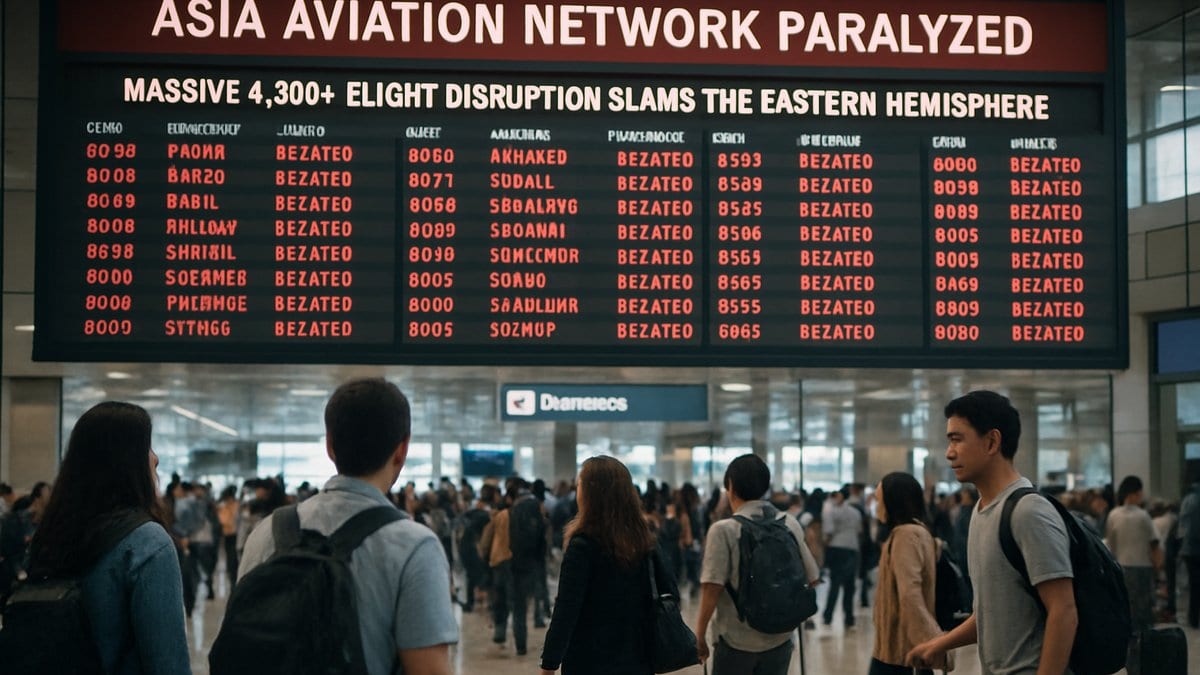
Multiple Crises Converge Across Asia’s Skies
Publicly available flight tracking data and operational updates from major hubs indicate that Asia’s aviation network has come under severe strain as several overlapping crises converge. Airspace closures linked to conflict in the Middle East, capacity reductions on crucial Gulf corridors, and knock-on delays at major Asian hubs have together triggered a cascading disruption that now extends from East Asia to Europe and Africa.
Recent coverage of operations on March 31, 2026, shows Asia Pacific hubs such as Beijing, Jakarta, Tokyo, Riyadh, and Dubai already grappling with hundreds of cancellations and thousands of delays in a single day, with ripple effects projected to continue into the April peak travel period. Airlines serving these airports have reported tight aircraft rotations and stretched crew schedules, conditions that amplify even modest schedule shocks into systemwide snarls.
In parallel, extensive reporting on airspace restrictions over Iran, Iraq, and parts of the Gulf since late February details a sharp reduction in viable flight corridors between Asia and Europe. Middle East carriers have cut millions of weekly seats from their schedules, severing many of the one-stop options that previously funneled travelers between Asian cities and destinations in Europe, Africa, and North America.
These constraints have pushed traffic into remaining open corridors and forced widespread rerouting, increasing flight times, fuel use, and operational costs. As airlines adjust, connections that once depended on tightly timed bank structures at hubs across the Gulf, Turkey, and South Asia are now exposed to chronic delay risk.
Middle East Airspace Closures Hit Asia Europe Links
Reports from airline schedule trackers and regional aviation analyses indicate that the closure or restriction of airspace over Iran, Iraq, and adjacent Gulf regions has been the single most disruptive factor for long haul routes touching Asia. Carriers in the Middle East, Europe, and Asia have suspended or sharply reduced services to major hubs such as Dubai, Doha, and Tel Aviv, while also diverting flights that would normally overfly the affected areas.
For travelers in Asia, the impact is felt most acutely on itineraries to and from Europe. Routes that once relied on short polar or West Asia transits are now being pushed onto longer paths that loop south via Egypt or north via Central Asia and the Caucasus. This has increased block times by hours in some cases, compressing connection windows and forcing airlines to rework timetables that were designed around precise wave patterns.
Analysts note that this disruption comes on top of existing diversions around Russian airspace, which have already lengthened many Asia Europe sectors since 2022. The combination has left network planners with fewer efficient options, particularly for secondary cities that depended on mid sized hubs in the Gulf. Many of those routes are now temporarily suspended or consolidated into larger trunk services, reducing choice and driving higher fares in affected markets.
Industry data also suggests that cargo capacity has been hit alongside passenger operations, with freighter and belly hold networks facing the same routing constraints. The result is growing pressure on supply chains that rely on Asia Europe air freight, especially for time sensitive goods in the technology and pharmaceutical sectors.
Asia Pacific Hubs Struggle With Cascading Delays
Within Asia Pacific, airports from Tokyo and Hong Kong to Bangkok and Kuala Lumpur have reported surging volumes of disrupted flights as long haul reroutes and equipment shortages reverberate through regional networks. Operational snapshots from March 31 highlighted nearly four hundred cancellations and more than five thousand delays in one day across key hubs, illustrating how quickly localized problems can spill over into broader gridlock.
Carriers such as IndiGo, AirAsia, Cathay Pacific, Malaysia Airlines, and several Gulf and East Asian airlines have all appeared on disruption tallies in recent days. The pattern is often similar: a long haul aircraft or crew that fails to arrive on time strands an outbound rotation, which then forces a series of late departures or cancellations across domestic and short haul routes.
Travel industry guidance notes that this form of cascading delay is particularly acute in Asia, where dense intra regional networks depend on fast turnarounds and high aircraft utilization. Once irregular operations set in, spare capacity to recover schedules can be limited, especially at slot constrained airports where adding extra sections is not always feasible.
Passengers connecting through these hubs have faced unpredictable waits, missed onward flights, and in some cases overnight stays as airlines work to rebook on remaining services. Travel advisories circulating across consumer channels urge passengers to build in longer connection times and to monitor airline apps closely, as same day reaccommodation is becoming more challenging during peak travel periods.
Egypt and Alternative Corridors Take Center Stage
As traditional Gulf and West Asia corridors seize up, new routings are emerging. Recent coverage from North African and Middle Eastern outlets highlights Egypt’s increasingly central role as a bridge between Europe, Africa, and Asia. With Egyptian airspace remaining open and strategically located between the Mediterranean and Red Sea, airlines have been redirecting traffic flows through Cairo and other regional gateways.
Civil aviation briefings and ministerial statements cited in regional media describe a surge in transit passenger numbers as airlines from Europe and Asia string together new one stop combinations over Egyptian territory. These reroutes are helping to absorb some of the pressure from closed or restricted Middle Eastern skies, even as they present fresh operational challenges for air traffic management and airport infrastructure.
Observers point out that this shift mirrors earlier reconfigurations of global aviation networks, such as the widespread rerouting of flights around Russian airspace. In each case, geopolitical developments have redrawn the map of commercially viable corridors, with secondary hubs gaining prominence almost overnight as carriers search for safe and efficient alternatives.
However, aviation experts quoted in public reports also caution that these substitute corridors have finite capacity. Extended holding patterns, congestion in nearby airspace, and the limited number of available slots at newly strategic airports could become future choke points if hostilities or closures in the Gulf persist into the busy summer travel season.
Travelers Face Longer Journeys and Persistent Uncertainty
For travelers, the immediate effects of the current turbulence are visible on departure boards and booking platforms across the Eastern Hemisphere. Itineraries that once featured straightforward one stop connections between Asian cities and Europe, the Middle East, or Africa now frequently involve longer routings, additional stops, or scarce seat availability on remaining services.
Consumer facing travel guidance circulating this week emphasizes the importance of flexibility. Passengers are being urged to verify flight status repeatedly in the days and hours before departure, consider alternative routing through less congested hubs, and prepare for extended travel times. Many airlines have introduced temporary rebooking policies that allow itinerary changes without standard fees, though options may be limited on heavily affected dates.
Industry commentary suggests that pricing is also beginning to reflect the new reality. With millions of seats removed from Middle East centered networks and operational costs rising due to detours and longer flight times, one way and round trip fares on surviving Asia Europe and Asia Africa routes have started to climb. Budget carriers, which often operate with tighter margins and fewer spare aircraft, may be particularly constrained in how much capacity they can redeploy.
Looking ahead, analysts observe that the duration of airspace closures and the pace of diplomatic developments will largely determine how long Asia’s aviation network remains under this degree of strain. Unless additional corridors reopen or demand falls back from current peaks, the region’s travelers may need to prepare for a prolonged period in which 4,200 disrupted flights is not a one off shock but a recurring feature of long haul planning.