

More news on this day
Thousands of travelers across Asia and the Gulf faced extensive delays and cancellations on Tuesday as flight-tracking data indicated 5,993 services running late and 278 scrapped, disrupting operations for Thai AirAsia, Japan Airlines, ANA, Air India, Air China and other carriers across key hubs including Tokyo, Bangkok, Beijing and Dubai.
Get the latest news straight to your inbox!
Ripple Effects From Conflict And Congested Airspace
Publicly available aviation data and recent regional coverage point to a network strained by weeks of disruption linked to the conflict in West Asia and associated airspace restrictions. Airlines serving routes over or into the Gulf have been forced to reroute or trim schedules, adding time and cost to journeys between Europe and Asia and placing additional pressure on alternative corridors through South and Southeast Asia.
Industry analyses released in recent days describe a patchwork recovery in the United Arab Emirates, with Dubai and Abu Dhabi airports gradually restoring capacity while still warning of rolling delays and selective cancellations. As services resume, aircraft and crews positioned away from their normal bases are feeding irregularly back into the system, leading to late departures and missed connections that are now showing up in delay statistics from East Asia to the Indian Ocean.
In India, previous bouts of cancellations at Mumbai and Delhi tied to the same geopolitical shock have left airlines juggling aircraft rotations and prioritizing trunk routes. While many services are operating, today's elevated delay count suggests carriers are still working through congested airways, crew duty-time limits and operational knock-on effects that began when multiple Middle Eastern airspaces partially closed earlier this month.
China and Japan are also absorbing part of the shock as long-haul flights reroute to avoid sensitive areas. Flight-tracking feeds show additional traffic funneled through Beijing and Tokyo area airports in recent weeks, intensifying congestion at already-busy hubs and creating narrow margins to recover from even minor schedule hiccups.
Major Hubs In Thailand, Singapore, Japan And China Under Strain
Across East and Southeast Asia, the weight of 5,993 delayed flights is falling heavily on large international gateways. Recent operational snapshots from regional travel outlets have highlighted Bangkok Suvarnabhumi and Don Mueang, Singapore Changi, and major Chinese hubs such as Beijing Capital and Shanghai Pudong as key pressure points whenever wider network disturbances occur.
In Thailand, where tourism recovery has been a central economic priority, crowded terminals and departure boards filled with late-running flights are emerging again as a concern. Analysts tracking the country’s visitor numbers have warned that prolonged volatility in long-haul connectivity, especially from Europe and the Middle East, could slow expected arrivals during the northern summer peak. With Thai AirAsia and other carriers operating dense regional schedules out of Bangkok and secondary airports, even small disruptions can ripple quickly across multiple short-haul legs in a single day.
Singapore’s Changi Airport, a critical hub connecting Southeast Asia with Europe, Australia and North Asia, has also been operating under tight conditions. Coverage of the broader Middle East disruption notes that some travelers are rebooking itineraries to bypass Gulf carriers in favor of connections through Singapore, Tokyo or Northeast Asia. That shift, combined with today’s surge in delays, is likely compounding gate and runway congestion, stretching airport handling resources and baggage systems.
In North Asia, Tokyo’s Haneda and Narita airports and Beijing’s dual gateways are managing a mix of rescheduled long-haul flights and heavy regional traffic. Japan Airlines and ANA, which already adjusted capacity and routes in response to rising fuel costs and longer detours, are now contending with aircraft returning late from Europe and Southeast Asia, while Air China and other Chinese carriers juggle both domestic peaks and rerouted international services.
Thai AirAsia, JAL, ANA, Air India And Air China Among Most Affected
Low-cost and full-service airlines alike are prominently represented in today’s disruption figures. Thai AirAsia, with its hub-and-spoke network centered on Bangkok and strong presence at leisure destinations such as Phuket and Chiang Mai, is particularly exposed when aircraft and crews fall out of rotation. Recent incidents at Thai airports have also illustrated how quickly a runway closure or diversion can cascade into missed slots and late arrivals across the region.
Japan Airlines and ANA continue to sit at the heart of long-haul links between Japan, Europe and Southeast Asia. Aviation industry commentary over the past month notes that Japanese carriers have seen schedule volatility and softer booking confidence on some Westbound sectors amid uncertainty about airspace availability and flying times. Those pressures, layered onto a complex domestic schedule, help explain why even modest operational snags today can translate into wider delays for travelers moving through Tokyo.
For Air India, today’s tally of delays and cancellations follows an already demanding period of schedule adjustments involving West Asia. Recent advisories from the carrier describe a patchwork of regular and special services on Gulf routes, reflecting the difficulty of maintaining stable timetables when conditions in transit corridors remain fluid. As aircraft rotate between India, Southeast Asia and the Middle East, late inbound arrivals are feeding directly into outbound knock-ons.
Air China faces a similar dynamic, combining large domestic banks of flights with long-haul services that have been rerouted or retimed. With Beijing and Shanghai acting as funnels for both regional and intercontinental traffic, even short disruptions to one long-haul arrival can reverberate across multiple connecting flights, contributing to the elevated delay count reported today across Chinese hubs.
Passenger Impact: Missed Connections, Overflowing Terminals And Rising Costs
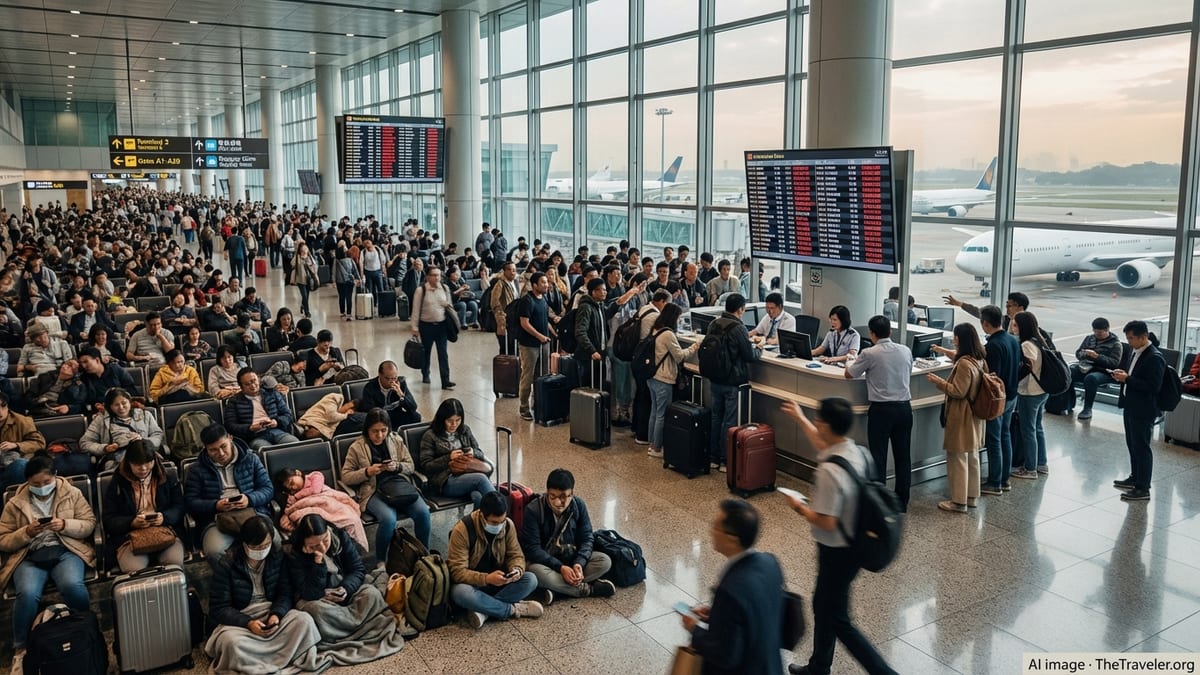
For passengers, the headline figures of 5,993 delays and 278 cancellations are translating into hours spent in terminals, missed onward connections and, in some cases, unplanned overnight stays. Social media posts and traveler forums from recent weeks have already chronicled crowded departure halls in Mumbai, Dubai, Bangkok and other hubs as people attempt to rebook away from affected corridors.
Consumer advocates and travel planners observing the current situation describe a pattern in which even flights that do depart often do so outside their scheduled windows, reducing the viability of tight connections. Travelers heading between Europe and Australasia, or between South Asia and North America, appear particularly vulnerable, as their multi-leg journeys rely on precise timing through one or more of today’s affected hubs.
Additional costs are emerging as a secondary consequence. With demand shifting toward alternative routings via Singapore, Tokyo or non-Gulf hubs, published coverage indicates higher fares on some corridors and pressure on premium cabin availability. At the same time, airlines are absorbing higher fuel and crew expenses on longer detours, factors that may limit their ability to add capacity quickly in response to stranded passengers.
Airport services, including ground handling, catering and security processing, are also under stress. Crowd surges tied to rolling delays can cause bottlenecks at check-in, immigration and baggage reclaim, making it harder for airports to recover normal flows once a disruption wave passes.
Outlook: Prolonged Volatility Likely Across Asia’s Skies
Analysts tracking Asia’s aviation rebound caution that today’s elevated delay and cancellation numbers fit into a broader pattern rather than a one-off shock. The conflict in West Asia and resulting airspace restrictions have come at a time when airlines were still rebuilding networks and balance sheets after the pandemic period, leaving less buffer capacity to absorb fresh disruptions.
Forecasts for tourism in countries such as Thailand highlight the risk that continued volatility could dampen visitor arrivals, especially from long-haul markets. Any sustained reluctance among travelers to route via Middle Eastern hubs is likely to redirect more traffic through Asian alternatives, keeping pressure on airports in Singapore, Tokyo, Beijing and across India.
Publicly available guidance from aviation consultants and travel risk advisories suggests that passengers with upcoming itineraries through affected regions may need to plan for longer journey times, flexible routings and last-minute schedule changes. As airlines like Thai AirAsia, JAL, ANA, Air India and Air China work to stabilize their operations, the sheer scale of today’s delays and cancellations underscores how interconnected Asia’s air networks have become, and how disturbances in one region can quickly ground travelers thousands of kilometers away.