

More news on this day
Thousands of air travelers across Asia were stranded today as a fresh wave of disruption hit major hubs in Japan, Singapore, South Korea, India, and China, with publicly available tracking data indicating 3,674 flight delays and 351 cancellations affecting carriers including Korean Air, Japan Airlines, Singapore Airlines, China Eastern, and several regional operators.
Get the latest news straight to your inbox!
Major Asian Hubs Struggle Under Heavy Operational Strain
Airports across Tokyo, Seoul, Delhi, Shenzhen and other key cities reported extensive knock-on delays as tightly timed schedules began to unravel through the morning and afternoon peaks. Aggregated flight-tracking information shows densely scheduled short-haul routes were particularly vulnerable, with late-arriving aircraft cascading into subsequent rotations and compressing already narrow turnaround windows.
In Japan, disruption built steadily across domestic and regional networks, mirroring recent patterns in which Osaka and Tokyo have recorded some of the region’s highest same-day delay totals. Publicly available data from recent days has pointed to more than a thousand delayed departures in Japan alone on particularly strained dates, and today’s figures followed a similar trajectory as carriers worked to re-time or consolidate services where possible.
India’s capital Delhi again emerged as one of the hardest-hit South Asian gateways. The airport’s role as a connecting hub for both domestic and long-haul services meant schedule slippage on regional flights quickly translated into missed connections and last-minute gate changes. Travelers connecting onward to Europe, Southeast Asia, and the Gulf reported extended waits as ground handlers and airline operations teams attempted to re-accommodate disrupted itineraries.
In China, major coastal hubs such as Shenzhen continued to see elevated levels of disruption after a period of repeated strain across the country’s dense domestic network. Recent aviation coverage has highlighted that large Chinese airports are consistently among the global leaders for daily delay volumes, a trend that resurfaced as today’s weather and congestion pressures interacted with already busy peak travel periods.
Flag Carriers and Leading Airlines Face Network-Wide Ripple Effects
The disruption hit a cross-section of Asia’s leading airlines, with Korean Air, Japan Airlines, Singapore Airlines, China Eastern, and multiple low-cost and regional carriers all experiencing significant schedule impacts. For full-service network airlines, the immediate challenge was not only the delayed or cancelled individual flight, but the downstream effect on aircraft rotations, crew duty limits, and inbound connection banks.
Recent operational snapshots have already shown Korean Air managing elevated delay levels at its Seoul Incheon hub as late arrivals from China, Japan, and Southeast Asia compress connection windows. Today’s figures suggest those pressures intensified, as connections from delayed regional services forced rebooking onto later departures and, in some cases, overnight stays for passengers who missed final banks of the day.
Japan Airlines and other Japanese operators have likewise been contending with high delay counts across their domestic networks in recent days. On particularly disrupted days, more than a thousand flights across Japan have run behind schedule, with even modest initial delays compounding as aircraft cycle through multiple short sectors. That pattern again appeared in today’s data, impacting travelers on both domestic shuttles and regional international routes.
In Southeast Asia, Singapore Airlines and other carriers using Changi as a regional hub reported a smaller number of outright cancellations but a noticeably higher proportion of late-running flights. Industry reporting in recent months has emphasized that many airlines now prioritize preserving overall network integrity, even if that means operating flights significantly late rather than cancelling outright, a strategy that can help passengers eventually reach their destinations but often at the cost of missed onward connections.
Weather, Congestion, and Tight Schedules Combine to Disrupt Operations
While no single incident appears to have triggered the latest disruption, publicly available information points to a familiar combination of factors: localized weather challenges, air traffic control constraints, and increasingly tight airline schedules across the region. Aviation bulletins in recent weeks have noted that parts of East and Southeast Asia are entering periods of more volatile weather, with heavy rain, low visibility, and wind shifts periodically curbing airport capacity.
At the same time, recent data on air traffic trends show that major hubs including Tokyo, Seoul, Singapore, and large Chinese airports are operating at or near pre-pandemic traffic levels, with some surpassing earlier records. As airlines seek to maximize aircraft utilization and capture robust travel demand, turnarounds have been compressed, leaving less buffer to absorb minor disruptions such as extended taxi times or ground-handling delays.
Industry analyses also highlight structural congestion in certain national airspace systems, including around South Korea and parts of eastern China, where strong traffic growth has outpaced incremental increases in capacity. When traffic peaks collide with weather-related flow restrictions or runway works, delays can quickly spread across an entire day’s schedule, producing the kind of multi-country disruption visible in today’s aggregated numbers.
Recent conflict-driven rerouting between Asia and Europe has added another layer of complexity. With some long-haul flights now operating longer routings or reduced frequencies, regional feeder flights into affected hubs have less flexibility, meaning that delays or cancellations at one end of the network can more easily strand passengers part-way through journeys that rely on tight, multi-leg connections.
Passengers Face Long Queues, Missed Connections, and Limited Options
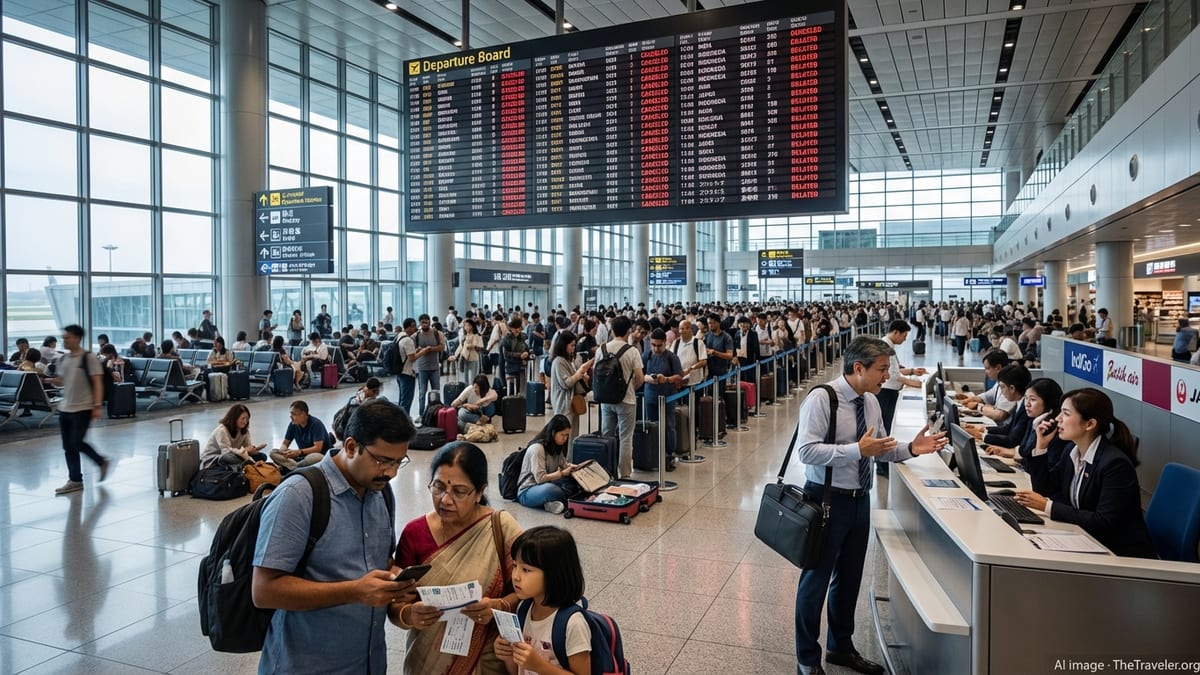
For travelers on the ground, today’s statistics translated into long lines at check-in, security, transfer desks, and airline help counters across multiple airports. Reports from passengers and consumer forums described scenes of crowded departure halls, with many travelers attempting to rebook itineraries on the same day as delays stretched into hours or connecting flights departed without them.
Disruption at hubs such as Tokyo Haneda, Seoul Incheon, Delhi, and Shenzhen proved particularly challenging for those relying on onward connections to Europe, North America, or other parts of Asia. Once long-haul banks closed for the evening, options for same-day rerouting narrowed sharply, and some travelers were left seeking overnight accommodation while waiting for seats on later departures.
Travel advocacy groups and specialist travel media continue to advise passengers affected by such mass disruption days to retain receipts for accommodation, meals, and ground transport, as well as to document boarding passes and delay notifications. Although compensation rules differ significantly between jurisdictions, clear records often prove important when seeking refunds, vouchers, or reimbursement after travel is complete.
Publicly available guidance also emphasizes the value of using airline apps and call centers promptly once a significant delay or cancellation is apparent. In large-scale disruption events, digital rebooking tools can sometimes offer new itineraries faster than airport desks, where physical queues can grow rapidly, particularly during evening peaks.
What Travelers Can Expect in the Coming Days
Operational experts note that the effects of a single day with thousands of delays can linger for several subsequent days, as airlines reposition aircraft and crews and work through backlogs of passengers awaiting re-accommodation. With forward bookings remaining strong across the region and many flights already operating with high load factors, spare seats for rebooked travelers may remain limited on popular routes.
Travel and aviation outlets suggest that passengers flying through affected hubs in Japan, Singapore, South Korea, India, and China over the next 24 to 72 hours should monitor flight status closely and anticipate the possibility of residual delays. Early-morning departures after a heavily disrupted day can sometimes run more smoothly if aircraft and crews have been correctly repositioned overnight, but a single new weather event or flow restriction can quickly revive bottlenecks.
Longer term, industry analyses point to ongoing investments in airspace modernization, runway expansions, and terminal improvements across Asia’s big hubs, aimed at easing congestion and improving on-time performance. However, most of these projects have multi-year timelines, meaning that travelers are likely to see continued bouts of significant disruption whenever weather, operational constraints, and surging demand coincide, as they did today.
For now, the latest figures underscore how interconnected Asian aviation networks have become. A spike of delays in one country can quickly propagate across borders, grounding thousands of passengers from Shenzhen to Tokyo, Seoul, and Delhi and reminding travelers that even in an era of sophisticated scheduling tools, the system remains vulnerable to sudden, region-wide shocks.