

More news on this day
Thousands of air travelers across Asia and the Gulf are facing significant disruption as nearly 300 flights are cancelled and more than 3,000 delayed, snarling operations for carriers including ANA Wings, Batik Air, IndiGo and Saudia at major hubs from Tokyo and Beijing to Jakarta and Dubai.
Get the latest news straight to your inbox!
Waves of Cancellations From Tokyo to Dubai
Publicly available aviation data and recent industry coverage indicate that a fresh wave of disruption has rippled across Asian and Middle Eastern air corridors in early April, with around 294 flights cancelled and approximately 3,030 delayed in a single operational window. The impact has been concentrated in large hub markets such as Japan, China, South Korea, India and the United Arab Emirates, where already busy spring schedules have left little slack to absorb irregular operations.
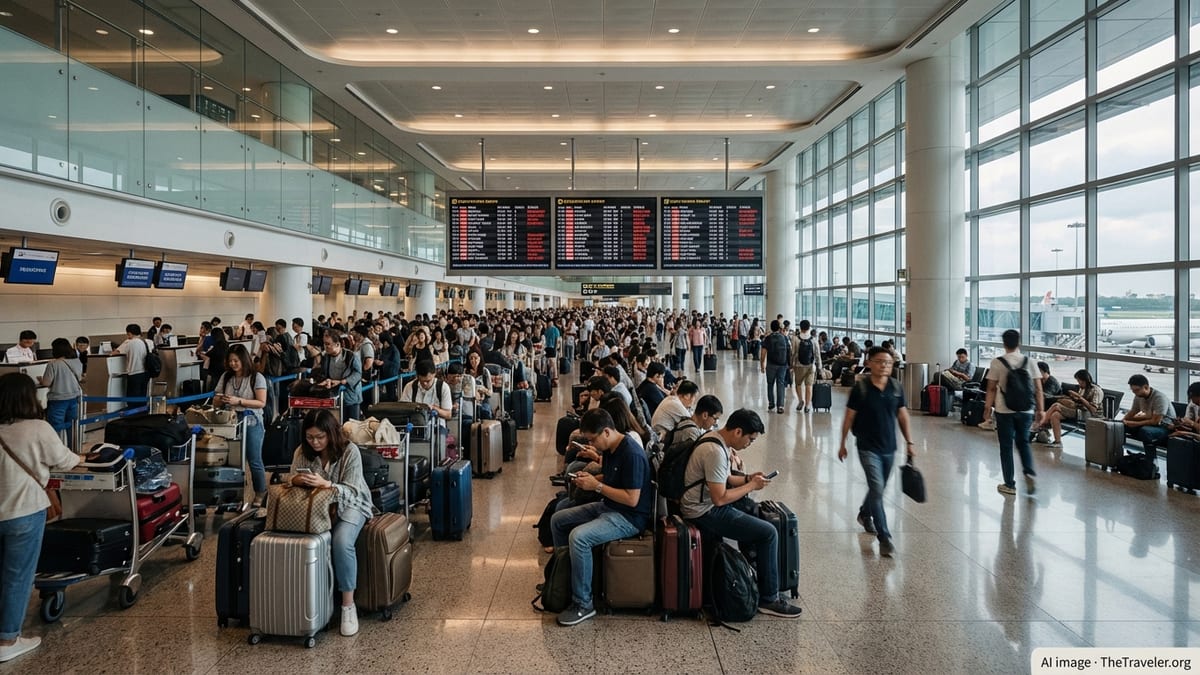
Tokyo’s Haneda and Narita airports, Beijing Capital, Jakarta Soekarno Hatta and Dubai International are among the locations reporting congested departure halls, rolling delay announcements and extended queues at rebooking desks. Passengers connecting between Asia and Europe through Gulf gateways have been particularly exposed, as late inbound aircraft trigger missed onward connections and overnight stays.
Operational summaries compiled by specialist aviation outlets show that airlines across the region have had to trim rotations, consolidate services and reroute aircraft at short notice. This has translated into a high ratio of delayed flights compared with outright cancellations, but the volume of late departures has still left travelers facing waits of several hours at a time.
The latest figures add to a series of severe disruption days recorded since late March, when several monitoring services logged more than 5,000 delayed flights and hundreds of cancellations across Asia Pacific and Gulf hubs in a single day. The current pattern suggests that the network remains under heavy strain, with relatively small operational shocks quickly cascading into region wide knock on effects.
Key Carriers Under Pressure
Network and low cost carriers alike are entangled in the latest disruption, with ANA Wings, Batik Air, IndiGo and Saudia among those highlighted in published operational tallies. Their exposure reflects both the density of their regional schedules and their reliance on a limited number of congested hubs.
In Japan, ANA Wings has seen a cluster of cancellations and a significantly larger number of delayed departures across domestic and short haul routes feeding into Tokyo. These disruptions amplify across the wider network when aircraft and crews arrive late into major hubs, compressing turnaround times and increasing the risk of further slippage later in the day.
Batik Air’s operations in Indonesia have also been affected, with data indicating a relatively small proportion of cancellations but a notable share of delayed flights. Given the airline’s role in linking Jakarta and secondary Indonesian cities with broader Asian networks, even moderate schedule disruption can create long rebooking queues and limited same day alternatives for passengers.
Indian carriers, led by IndiGo, continue to operate under heightened stress following months of capacity and scheduling challenges. Recent analyses note that while IndiGo has restored much of its core schedule, ongoing airspace constraints and tight aircraft utilization mean that any new disruption quickly converts into clusters of delays, particularly on routes connecting to the Middle East and Southeast Asia.
Airspace Constraints and Weather Complications
The latest operational turbulence does not stem from a single cause, but rather from overlapping pressures that have been building since late winter. Reports from aviation analysts point to continuing restrictions or diversions around parts of Middle Eastern airspace, forcing airlines in India, East Asia and the Gulf to adopt longer routings on some long haul sectors. These detours add flight time, require additional fuel and narrow the margin for on time arrivals.
At the same time, seasonal weather systems across East Asia have periodically reduced airport capacity, especially at coastal and high latitude hubs. When visibility or wind conditions deteriorate, air traffic flow is reduced, leading to holding patterns, diversions and last minute schedule reshuffles. Even when the weather improves, backlogs can take hours to clear, and disrupted aircraft rotations may continue to ripple through networks into the following day.
Infrastructure constraints at major airports add another layer of vulnerability. Many of the region’s busiest hubs are already operating near capacity at peak times, with limited spare gates and runway slots. When irregular operations force multiple wide body aircraft to arrive late or depart out of sequence, ground handling resources can quickly become overstretched, reinforcing the cycle of delay.
Industry commentary suggests that airlines are increasingly relying on tactical measures such as selective cancellations, aircraft swaps and temporary frequency reductions to stabilize their operations. While these steps can help prevent more severe knock on impacts, they also contribute to the headline totals of disrupted flights that travelers are now seeing across tracking platforms.
Passenger Impact From Seoul and Delhi to Riyadh
For travelers, the statistics translate into missed holidays, business trips cut short and unplanned overnight stays. Reports from airports in Seoul, Delhi, Riyadh and other affected cities describe passengers queuing to secure hotel vouchers, rebook onto later departures or retrieve baggage from flights that never left the gate.
Public guidance from consumer organizations and travel insurers emphasizes the importance of checking flight status repeatedly on the day of travel, as schedules have been subject to frequent same day changes. Travelers are also being encouraged to keep receipts for food, accommodation and ground transport in case they are later able to seek reimbursement under airline policies or travel insurance coverage, depending on the cause of the disruption and local regulations.
The disruption is particularly challenging for those connecting between different airlines or ticket types, where protection rules can be complex. A delayed arrival into one hub may invalidate a separate onward ticket, leaving passengers to negotiate new arrangements and potentially absorb extra costs out of pocket.
Families and travelers with limited flexibility have been advised, in recent public advisories, to build additional buffer time into itineraries that pass through heavily affected hubs. This might mean planning longer connection windows, avoiding last departures of the day on critical segments, or considering alternative routings where feasible.
What Travelers Can Expect in the Coming Days
Aviation analysts caution that the current pattern of disruption could persist in the short term, as airlines work to rebalance fleets, crews and schedules. With early April representing a busy period for intra Asian tourism and business travel, seat availability on many core routes is already tight, limiting the options for same day reaccommodation when flights are cancelled.
Some carriers have announced incremental capacity additions or one off extra flights on key routes linking India, the Gulf and East Asia, but these measures may only partially offset the impact of large scale irregular operations. Travelers on heavily booked city pairs such as Tokyo to Seoul, Beijing to Jakarta or Delhi to Dubai may find that the next available seat is many hours, or even a full day, after their original departure time.
Publicly available commentary from airline and airport stakeholders indicates that efforts are under way to improve communication, with more proactive push alerts, expanded use of messaging apps and clearer disruption dashboards on websites and in terminals. Even so, information gaps can remain, particularly during fast moving operational events.
For now, the combination of nearly 300 cancellations and more than 3,000 delays across Asia and the Gulf serves as a reminder of how interconnected the region’s aviation network has become. A technical fault in one hub, a weather system skimming another or a new airspace restriction along a key corridor can all send shockwaves through schedules from Tokyo and Beijing to Jakarta, Riyadh and Dubai, leaving thousands of passengers temporarily grounded.