

More news on this day
Air travel across parts of China, the Philippines and Indonesia is facing fresh turmoil this week, with at least 27 flights canceled and more than 450 schedules disrupted, leaving stranded passengers crowding terminals in Beijing, Xiamen, Manila and Jakarta as carriers scramble to reset their networks.
Weather and Network Strain Trigger a New Wave of Disruptions
Operational data from regional aviation trackers and airport authorities indicate that a combination of adverse weather and rolling knock-on effects from earlier schedule changes has driven a new round of cancellations across major hubs in East and Southeast Asia. While the overall numbers are modest by global standards, the concentration of changes on a handful of busy city pairs has magnified the impact on travelers.
Airlines serving Beijing, Xiamen, Manila and Jakarta report that 27 flights have been withdrawn from schedules over a several day period, with a further 453 services subject to significant delay, retiming or equipment changes. Many of these disruptions trace back to aircraft and crew rotations linked to northern China’s winter weather and tightening operational buffers following recent storms in other parts of the global network.
Beijing Capital and Beijing Daxing have absorbed a large share of the schedule turbulence as carriers re-time domestic and regional services to protect long-haul operations. Similar pressures are being felt in Xiamen, where connections to Southeast Asia are particularly exposed, and at Manila’s Ninoy Aquino International Airport and Jakarta’s Soekarno-Hatta, both of which rely heavily on tight turnarounds to keep dense regional schedules on track.
While no single catastrophic event is driving the current pattern, aviation analysts note that sustained winter volatility, limited spare capacity in some fleets and ongoing crew rostering challenges have left airlines with less room to absorb even minor operational shocks, leading to sharper schedule adjustments than passengers might typically expect this late in the season.
China Express, Air China and Xiamen Air Adjust Schedules
Three carriers lie at the center of the latest disruption picture: regional operator China Express, flag carrier Air China and Fujian-based Xiamen Air. Each airline has either temporarily suspended select rotations or pushed back departures as they work to consolidate demand, free up aircraft and prevent further rolling delays.
China Express, which plays a key role linking secondary and tertiary Chinese cities to Beijing and other major hubs, has trimmed a series of flights into the capital and coastal airports, focusing its limited resources on core trunk routes. Passengers booked on thinner midweek frequencies have been the most affected, often finding themselves re-accommodated on later services or routed via alternate cities within China’s dense domestic network.
Air China, meanwhile, has made targeted adjustments on regional routes that feed into its international banks, including services touching Beijing and other coastal gateways. Some departures have been combined or shifted by several hours to align aircraft and crew availability with peak demand banks. While the majority of Air China’s flights are still operating, travelers are being urged to monitor their bookings closely, as same-day timing changes have become more common.
Xiamen Air has faced particular scrutiny because of its expanding Southeast Asia footprint from coastal Chinese cities such as Xiamen and Nanjing. The carrier has temporarily suspended or retimed a limited number of services linking China with Manila and Jakarta, steps it says are designed to stabilize on-time performance for the remainder of its schedule and prepare for additional routes coming online with the northern summer season.
Scenes of Congestion in Beijing, Xiamen, Manila and Jakarta
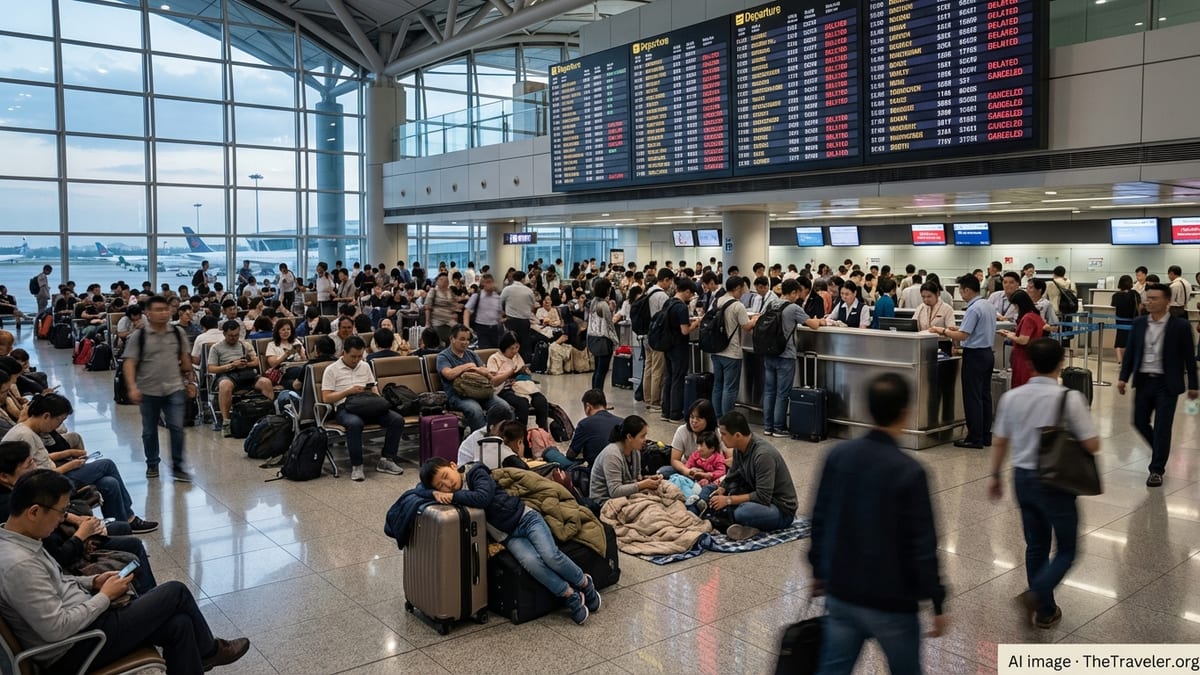
The operational changes have translated into familiar scenes on the ground: long rebooking queues, crowded seating areas and departure boards filled with red delay notices. At Beijing’s main terminals, passengers report extended waits at airline service counters as staff juggle rolling changes across both domestic and international networks. With many affected flights clustered in narrow time windows, congestion tends to spike around traditional morning and late-afternoon departure banks.
In Xiamen, a key link between mainland China and Southeast Asia, the impact is especially visible among connecting travelers. Passengers heading onward to Manila and Jakarta have described missed connections and overnight layovers when retimed arrivals land too late for the last evening departures. Airport hotels and nearby budget accommodations have seen a jump in last-minute bookings as travelers seek beds while waiting for newly assigned flights.
Similar pressure points are evident in Manila, where limited runway and terminal capacity leave little slack when multiple flights are delayed at once. Long security and immigration lines, combined with tight gate space, can turn even modest schedule changes into multi-hour headaches. In Jakarta, late-night waves of disrupted regional flights have created short-term surges at arrival halls and taxi stands as passengers spill into the city after unscheduled delays.
Despite the visible strain, aviation authorities in all four markets stress that safety margins remain intact. The decision to cancel or significantly delay flights, rather than attempt to operate them with compressed turnaround times or marginal weather windows, reflects a cautious operational stance that prioritizes safety over schedule integrity.
What Travelers Need to Know and Do Now
For passengers booked on China Express, Air China or Xiamen Air in the coming days, the most important piece of advice is to treat departure times as provisional until they are reconfirmed close to travel. Most major carriers in the region are pushing schedule updates through their apps and text or email alerts, but travelers with third-party bookings should also check directly with airlines for the most accurate status information.
Same-day flexibility has become critical. Experts recommend arriving at the airport earlier than usual, particularly for flights involving connections through Beijing, Xiamen, Manila or Jakarta. Allowing a wider buffer between domestic and international segments can reduce the risk of missed onward flights if initial departures slip by an hour or two. Where possible, choosing earlier departures in the day may also improve the odds of being rebooked if something does go wrong, as more later options remain.
Passengers whose flights are canceled outright should be prepared for limited same-day alternatives on popular routes, especially when several airlines are adjusting schedules at once. Many carriers in the region have temporarily relaxed change fees and are offering free rebooking within a defined window, but fare differences may still apply when moving to peak departures. Travelers are advised to document all expenses incurred due to disruption, such as hotel stays and meals, in case partial reimbursement or travel insurance claims are possible.
Above all, analysts stress that this week’s turbulence underlines a broader reality of post-pandemic aviation in Asia: capacity and resources are still finely balanced, and localized shocks can ripple quickly through interconnected networks. For now, those planning itineraries through Beijing, Xiamen, Manila and Jakarta should build in extra time, monitor their flights closely and be ready to adjust plans as airlines continue to fine-tune their schedules.
Outlook for the Coming Weeks
Looking ahead, airlines and airport operators in China, the Philippines and Indonesia expect a gradual easing of disruption if weather patterns stabilize and new seasonal schedules bed in smoothly. Xiamen Air’s planned Southeast Asia additions at the start of the northern summer season highlight both the opportunity and the operational challenge facing carriers seeking growth while coping with tight margins on aircraft and crew availability.
Industry observers say that regional flight networks remain in a transition phase, with carriers still refining route structures, frequencies and fleet plans in response to evolving demand between mainland China and Southeast Asia. That has made schedules more sensitive to short-term shocks such as winter storms, isolated technical issues or temporary airspace restrictions.
For travelers, the practical takeaway is that heightened vigilance will likely remain necessary through at least the early part of the summer timetable. While the intense congestion seen this week in Beijing, Xiamen, Manila and Jakarta is expected to subside, intermittent clusters of cancellations and delays are likely to persist as airlines fine-tune their operations. Those with fixed onward commitments, such as cruises, tours or business meetings, should consider additional buffers or overnight stops when routing through these hubs.
In the meantime, passenger volumes in Asia’s key airports continue to climb back toward pre-pandemic levels, even as airlines and regulators work to enhance resilience. The current wave of disruptions offers an unwelcome reminder that in a tightly interconnected regional network, small schedule shifts can quickly add up to crowded departure halls and a long wait for the next available seat.