

More news on this day
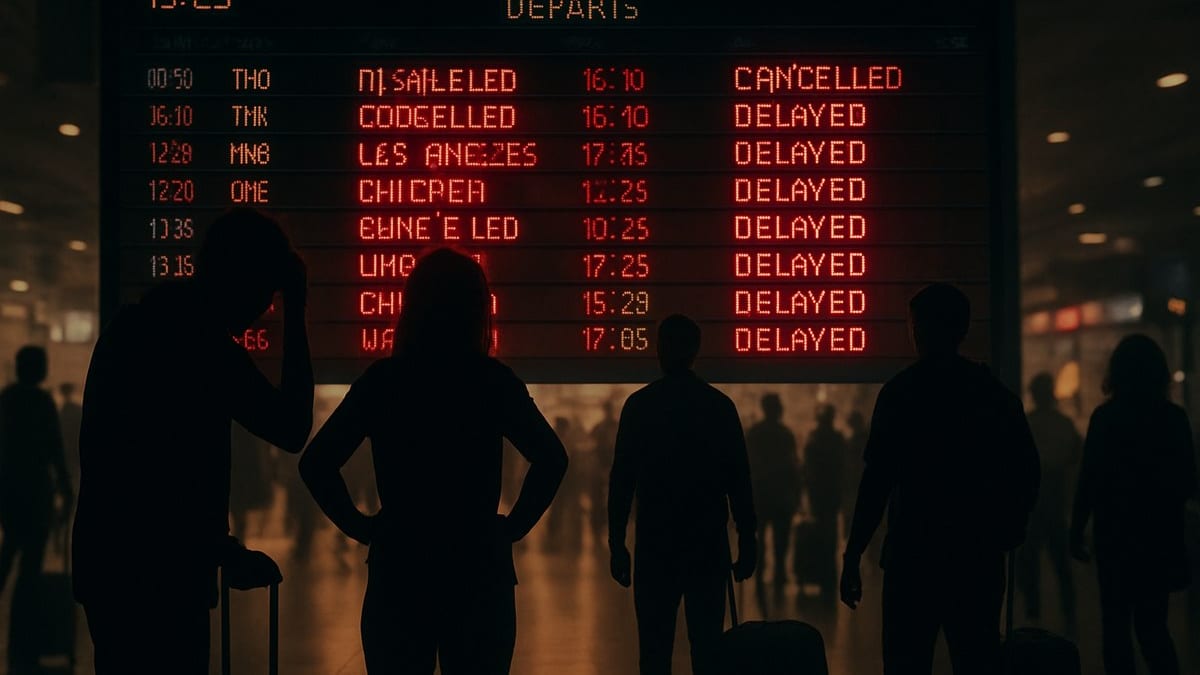
Air travel across Asia was severely disrupted today, with more than 600 flights cancelled and thousands more delayed at major hubs from Tokyo and Shanghai to Singapore and Manila, creating long queues, missed connections and widespread itinerary chaos for passengers at the start of the week.
Get the latest news straight to your inbox!
Major Hubs Buckle Under Mounting Operational Strain
Published data from aviation tracking platforms and industry outlets shows flight disruption on an exceptional scale across Asia today, with well over 600 cancellations recorded alongside several thousand delays. Aggregated figures from regional hubs indicate that airports in Japan, China, Southeast Asia and the Gulf handled far fewer on-time departures than scheduled, as airlines struggled to keep timetables intact.
Tokyo’s Haneda and Narita airports, two of the region’s busiest international gateways, were among the hardest hit, with hundreds of delayed departures and arrivals combined and dozens of cancellations reported. Hong Kong, Guangzhou, Shenzhen and other large Chinese hubs also reported heavy schedule disruption, while Manila and Singapore Changi recorded triple-digit delay counts.
Specialist travel industry coverage indicates that in some markets the disruption built on rolling operational issues over recent weeks, rather than a single incident. Persistent congestion, tight aircraft rotations and crew availability constraints have left little margin to absorb even minor disturbances, magnifying the impact on travelers when schedules slip.
The pattern across multiple hubs points to a system under sustained pressure rather than isolated problems at one or two airports. With many of these gateways also acting as key transfer points between Asia, Europe and North America, knock-on effects have been felt far beyond the region.
Weather, Congestion and Airspace Constraints Combine
Reports from airport operators and regional media attribute today’s upheaval to a mix of factors, including adverse weather in parts of East and Southeast Asia, chronic terminal congestion and continuing airspace restrictions linked to geopolitical tensions. In Indonesia, for example, recent extreme weather around Jakarta’s Soekarno Hatta International Airport prompted diversions and operational adjustments, underscoring the sensitivity of tight schedules to local conditions.
At the same time, ongoing airspace closures and rerouting requirements over parts of the Middle East and South Asia have pushed more long-haul traffic into already busy corridors. Publicly available aviation analyses note that carriers in India and the Gulf have been forced to add time and distance to key routes because of airspace restrictions, reshaping flight patterns across a wide arc connecting Europe and Asia.
Those reroutings can have a cumulative effect on Asian hubs, where even small delays at the start of a long-haul rotation can cascade throughout the day. Extended flight times reduce aircraft availability, complicate crew scheduling and leave little flexibility when weather or local congestion emerges at destination airports.
Industry observers say the combination of structural bottlenecks on the ground and constrained flexibility in the skies is making the region particularly vulnerable during peak travel days. With many airlines still rebuilding networks and staffing levels after previous shocks, recovery buffers remain thin.
Airlines Cut Capacity and Juggle Schedules
Several Asian and Gulf carriers have been adjusting schedules and capacity ahead of the current disruption wave, moves that are now intersecting with today’s turbulence. Recent announcements from low cost giant AirAsia, for example, highlight a cut of around 10 percent in flight capacity and higher fares on selected routes as the carrier responds to higher operating costs and regional instability. Other airlines in the Gulf have also been operating below pre-crisis levels as they navigate security risks and shifting demand.
In parallel, schedule data compiled by route-planning services shows that some long haul operators have trimmed frequencies or swapped aircraft types on Asia-Europe and Asia-North America routes in recent weeks. While those adjustments are intended to create more sustainable timetables, they also mean fewer spare seats are available when large numbers of passengers need to be rebooked on short notice.
Full service airlines across Japan, South Korea, China and Southeast Asia are also working within tighter turnaround windows as they seek to maximize utilization of existing fleets. When multiple flights are delayed early in the day, that optimization can quickly become a liability, prompting rolling delays and last minute cancellations later in the schedule.
The result today has been an uneven patchwork of disruption, with some carriers managing only minor delays while others experienced clusters of cancellations at specific hubs. For travelers, however, the outcome often looks the same: missed connections, unexpected overnight stays and extended hours in crowded terminals.
Travelers Face Long Queues and Limited Alternatives
Passenger accounts shared through social media and local news outlets describe long check in and security lines at several Asian airports, particularly during morning and late evening peaks. At key transit hubs, onward departures filled quickly as airlines attempted to reaccommodate travelers from cancelled services, leaving many with limited same day options.
In destinations where tourism demand is surging, such as Japan and parts of Southeast Asia, immigration and baggage systems have also been strained by higher volumes. Even when flights operated, processing delays on arrival added to overall journey times, contributing to missed rail connections and domestic transfer issues.
Standard passenger rights frameworks vary widely across jurisdictions in Asia, and publicly available consumer guidance notes that compensation or accommodation offerings depend heavily on local regulations and each carrier’s own policies. Travelers affected today often had to rely on individual airline channels for rebooking, with call centers and airport service desks reporting heavy traffic.
Analysts point out that the relative scarcity of available seats on alternative flights, particularly on popular regional and long haul routes, can make recovery from a single disruptive day slower than before. In some cases, passengers may need to accept longer routings or travel a day or two later to complete their journeys.
What Today’s Chaos Signals for the Peak Summer Season
Aviation data providers and travel industry commentators suggest that today’s turbulence is a warning sign ahead of the upcoming summer peak, when demand for intra Asian and long haul travel is expected to climb further. If structural issues such as airspace constraints, staffing gaps and terminal congestion are not eased, similar disruption patterns could recur more frequently.
Some airlines have already flagged plans to adjust flight banks at congested hubs, spreading departures more evenly across the day to relieve pressure at security, immigration and gates. Airport operators in several countries are also moving ahead with incremental capacity expansions and process changes, though many of those projects will not deliver significant benefits before the main holiday season.
For travelers planning trips through Asia in the coming months, industry advisories emphasize building in longer connection times, favoring through tickets on a single carrier or alliance, and monitoring flight status closely in the 24 hours before departure. Travel insurers have likewise highlighted the importance of checking policy terms around missed connections and extended delays.
Today’s wave of cancellations and delays underlines how interconnected Asia’s aviation network has become. Strains in one part of the system, whether linked to weather, geopolitics or airport capacity, can quickly reverberate across multiple countries, turning a localized issue into continent wide travel chaos in the space of a single day.