

More news on this day
Asia’s key air corridors were snarled again this week as a fresh wave of operational disruptions rippled across Japan, China, Indonesia and the Philippines, cancelling at least 35 flights and delaying more than 1,400 services for carriers including ANA, United Airlines, Batik Air, PAL Express, Garuda Indonesia and Air Seoul at busy hubs from Tokyo and Manila to Shanghai and Fukuoka.
Fresh Disruptions Across Asia’s Crowded Skies
The latest bout of travel turmoil struck during one of the region’s busiest winter travel periods, compounding a month already marked by rolling disruption at major Asian airports. Data compiled from airport departure boards and independent aviation trackers in mid February show 35 outright cancellations and around 1,453 delays concentrated across Japan, China, Indonesia and the Philippines, with knock on effects radiating to secondary hubs in South Korea and beyond.
Tokyo’s Haneda and Narita airports, Manila’s Ninoy Aquino International, Shanghai Pudong and Hongqiao, and Fukuoka Airport were among the hardest hit. Airlines including All Nippon Airways and its affiliates, United Airlines on transpacific runs, Indonesia’s Batik Air and Garuda Indonesia, Philippine low cost and regional operators such as PAL Express, and South Korea’s Air Seoul all reported services either grounded or heavily delayed as the day wore on.
The figures come on the heels of a broader surge in operational problems across Asia’s aviation network this month. Recent tallies have shown several days with more than 3,000 flights delayed and dozens cancelled across the region, underscoring how thin margins in aircraft availability, air traffic control capacity and ground handling can quickly translate into passenger facing chaos when conditions deteriorate.
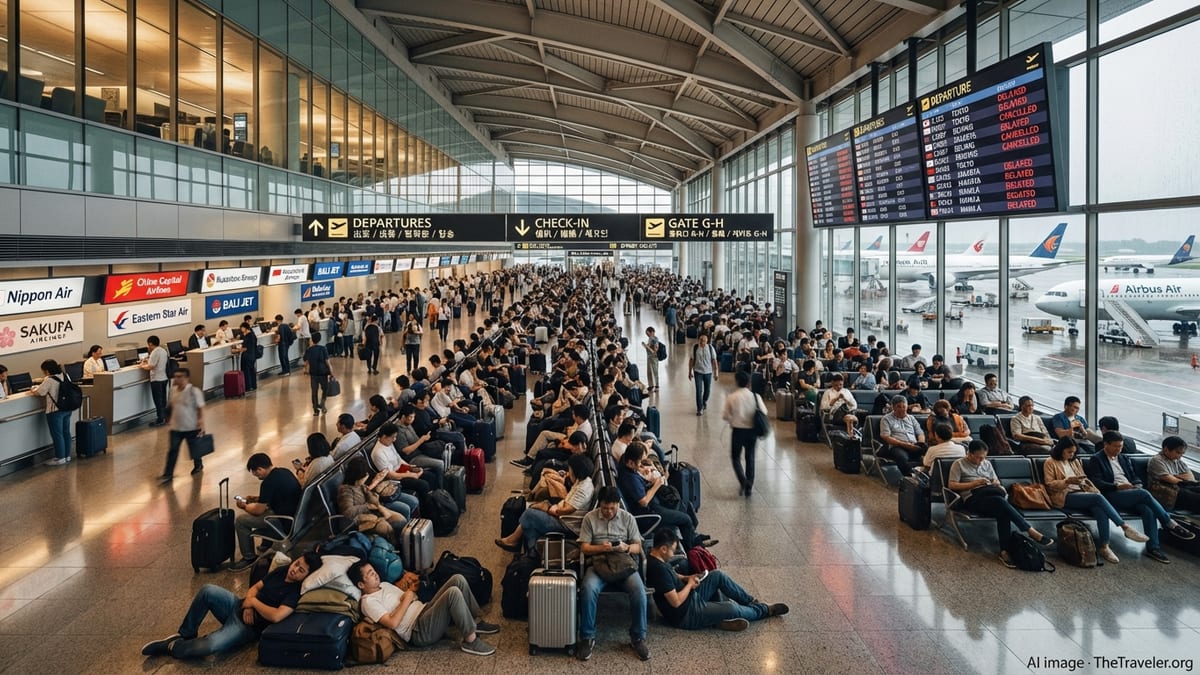
For travelers, the numbers translated into long lines at check in counters, packed boarding gates and makeshift camps on terminal floors as passengers waited for updates. Airlines scrambled to reassign aircraft, crew and slots in a bid to clear backlogs before the disruptions spilled fully into subsequent operating days.
Weather, Congestion and Operational Strain Combine
Behind the headline figures of cancellations and delays lies a familiar cocktail of contributing factors. In China, a series of winter weather systems sweeping across eastern and central provinces has repeatedly disrupted aviation in recent weeks, forcing the cancellation of dozens of flights and delaying hundreds more as carriers struggled to maintain schedules through low visibility and high winds at key hubs such as Shanghai and Beijing.
In Japan, where winter tourism to Hokkaido and northern Honshu is currently at its peak, bouts of snow and strong crosswinds have led airports including Fukuoka, Sapporo New Chitose and regional gateways to periodically curtail operations. Even modest weather related restrictions at busy fields like Haneda can quickly ripple through domestic networks, forcing carriers such as ANA and its subsidiaries to trim rotations or juggle aircraft assignments on already tight schedules.
Farther south, airports in Indonesia and the Philippines are contending with thunderstorms and seasonal weather alongside chronic congestion. Jakarta’s Soekarno Hatta and Manila’s Ninoy Aquino International operate close to their practical capacity on a typical day, leaving little slack when weather or technical issues arise. Philippine carriers including PAL Express and Cebu based operators have seen punctuality eroded whenever a few key aircraft are taken out of service or when air traffic flow restrictions are imposed around Manila.
The result in this latest episode was a patchwork of causes that nonetheless produced similar outcomes for passengers: late arriving aircraft that pushed back departure times across subsequent legs, crew duty time limits that forced cancellations when delays ran too long, and packed airways that limited the ability of controllers to clear backlogs quickly. Airlines were left to balance safety and regulatory requirements against mounting pressure from stranded travelers.
Key Hubs Under Pressure: Tokyo, Manila, Shanghai and Fukuoka
Tokyo has emerged as one of the central pressure points in Asia’s current wave of disruptions. Haneda, the capital’s primary domestic and regional international hub, and Narita, the main long haul gateway, have both recorded elevated levels of delays through February. ANA, Japan Airlines and foreign carriers such as United and other Star Alliance partners that rely on Tokyo for connections have been forced to adjust flight times and swap aircraft, particularly on routes linking Japan with North America and Southeast Asia.
In Manila, where infrastructure has notoriously lagged behind booming demand, the latest disruptions added strain to an already stretched system. With passenger volumes remaining close to holiday season highs, even a relatively small number of cancellations and extended delays at Ninoy Aquino can lead to overcrowded terminals and difficulty rebooking customers onto later services. Regional routes operated by PAL Express and other domestic airlines, which often depend on quick turnarounds and shared ground resources, were especially vulnerable.
Shanghai’s dual airport system at Pudong and Hongqiao has been handling sharply rising passenger numbers under the current winter and spring schedule, with international and regional flights increasing compared with last year. Under these conditions, the weather related suspensions and flow controls that hit earlier in February have had outsized impacts, with delayed arrivals forcing late departures on onward legs to cities including Tokyo, Seoul and Southeast Asian destinations.
Fukuoka, a key gateway between Japan and the Korean Peninsula as well as China, has also been heavily affected. Its role as a regional connector means delays there can disrupt itineraries linking smaller Japanese cities to international hubs. Carriers such as Air Seoul, which operate cross border services to and from Fukuoka, have found themselves adjusting departure windows and occasionally consolidating flights as they work to maintain some measure of schedule stability.
Carriers Scramble: ANA, United, Batik Air, PAL Express, Garuda and Air Seoul
The disruption has tested the resilience of airline operations teams across the region. All Nippon Airways, together with its affiliates, has already been contending with a demanding winter period marked by elevated delay and cancellation numbers. The latest cluster of problems has forced ANA to prioritise key trunk routes between Tokyo, Osaka and Sapporo, at times trimming frequencies or downgrading aircraft on lower demand sectors to free capacity.
United Airlines, which depends on its Tokyo services to feed transpacific networks linking North America with Japan and other parts of Asia, has similarly had to manage rolling knock on effects. A delayed departure from Tokyo can cascade into missed connections and altered rotations in cities such as San Francisco, Los Angeles and other US hubs, particularly when weather in North America is also unsettled.
In Southeast Asia, Indonesia’s Batik Air and flag carrier Garuda Indonesia have been juggling congested slots at Jakarta and Denpasar with aircraft availability pressures. Indonesia’s fragmented geography means many aircraft cycle rapidly between short haul domestic legs and longer regional hops to hubs such as Singapore, Kuala Lumpur and Manila. When one leg suffers a lengthy delay, the rest of the rotation often follows suit, increasing the risk that crew duty limits are breached and flights must ultimately be cancelled.
Philippine regional operator PAL Express has had to cope not only with delays at Manila but also with the reputational challenge of operating in the shadow of its parent carrier’s strong punctuality performance. While Philippine Airlines has recently been recognised among the most on time carriers in Asia Pacific, its low cost and regional arm must still navigate the same bottlenecks at overburdened airports. South Korea’s Air Seoul, meanwhile, has been working flights in and out of Japan against a background of disruptions at both Korean and Japanese gateways, complicating efforts to maintain reliable schedules on relatively thin, leisure heavy routes.
Passenger Impact: Missed Holidays, Business Trips and Tight Connections
For passengers, the operational challenges have translated into disrupted holidays, rescheduled meetings and frayed nerves. Leisure travellers bound for ski resorts in Japan, beach destinations in Indonesia or family reunions in the Philippines have seen itineraries compressed or cut short as flights arrived hours late or were cancelled outright. Travel advisors in the region report a rise in last minute rebookings and extended stays as people scramble to salvage vacation plans.
Business travellers, who often plan tight itineraries around single day visits or back to back meetings, have been among the hardest hit. Delays on early morning flights into Tokyo or Shanghai can leave corporate visitors with little margin for rescheduling once they arrive, particularly when language barriers or crowded rail connections add further friction to already compressed schedules.
Transit passengers connecting through hubs such as Tokyo, Manila and Shanghai have faced particular uncertainty. High load factors on many regional and long haul flights mean that even when airlines are able to rebook customers from cancelled services, available seats may be scattered across multiple days. Lounge capacity in some airports has also been pushed to the limit, adding to congestion in terminal concourses as stranded passengers seek out food, power outlets and quiet spaces.
In social media posts and interviews, some travellers expressed frustration at what they saw as poor communication about the causes of delays and limited guidance on compensation or accommodation. Airlines pointed to the difficulty of providing precise timelines while they awaited updated weather data or air traffic control clearances, but also acknowledged that they must improve the way information is shared in fast moving disruption scenarios.
Why Asia’s Airlines Are So Vulnerable to Shock Events
The recurrence of large scale disruption events across Asia in recent weeks highlights structural vulnerabilities in the region’s aviation system. Rapid growth in passenger volumes, particularly at major hubs in Japan, China and Southeast Asia, has often outpaced investment in runway capacity, terminal infrastructure and air traffic control modernisation. In some cases, new terminals have opened, but airspace management and ground handling capabilities have struggled to keep pace.
At the airline level, fleets remain tightly utilised, with many aircraft flying intensive daily patterns that leave limited room for unplanned maintenance or weather related disruptions. Global supply chain challenges and the lingering effects of earlier safety related groundings of certain aircraft models have constrained spare capacity, making it harder for carriers to substitute aircraft at short notice when technical problems occur.
Crew availability is another pressure point. Complex rules governing duty and rest times are essential for safety, but they also mean that even modest delays at the start of a duty period can result in crews timing out before the final scheduled sector. When several flights in a rotation are delayed, airlines can suddenly find themselves without legal crews to operate the last legs of the day, forcing cancellations or long delays while reserves are repositioned.
These underlying issues were manageable when travel demand was still recovering, but with passenger numbers at or above pre pandemic levels across many Asian markets, there is little slack left in the system. This reality makes the network especially sensitive to short, sharp shocks such as winter storms, technical glitches or air traffic restrictions, and raises questions about how airlines and regulators can build greater resilience.
What Travellers Can Expect in the Coming Weeks
With winter weather persisting in East Asia and demand for both leisure and business travel remaining strong, analysts expect a continued risk of sporadic disruption across key Asian hubs in the coming weeks. While the specific tally of 35 cancellations and 1,453 delays reflects a particular snapshot in time, operational data for the month indicates that similar levels of turbulence could recur whenever storms, technical issues or air traffic restrictions converge.
Airlines are responding by reviewing schedules, bolstering communication channels and, where possible, adding slack into turnaround times on heavily used aircraft. Some carriers are also encouraging passengers to build longer connection buffers into itineraries, especially when transiting through congestion prone airports or connecting between separate tickets on different airlines.
Travel experts advise passengers to monitor flight status closely through airline apps and airport boards, arrive earlier than usual at busy terminals and consider travel insurance products that specifically cover missed connections and extended delays. Those with time sensitive commitments may also wish to prioritise early morning departures, which typically face fewer knock on delays from earlier disruptions in the operating day.
For now, Asia’s skies remain busy and largely open, but the latest bout of cancellations and delays serves as a reminder that the region’s aviation recovery has entered a more complex phase. As travel demand surges, the margin for error has narrowed, and passengers planning journeys through Tokyo, Manila, Shanghai, Fukuoka and other major gateways would be wise to factor that reality into their plans.