

More news on this day
Major operational disruptions across Asian aviation hubs have left travelers facing extensive delays and cancellations, with publicly available data indicating 703 delayed flights and 37 cancellations linked to China Southern Airlines, Batik-branded services, and Cambodia Angkor Air routes affecting Beijing, Jakarta, Phnom Penh, and other international airports.
Get the latest news straight to your inbox!
Where Disruptions Are Hitting the Hardest
Recent operational data and industry coverage indicate that the sharpest impacts are being felt at large regional hubs, particularly in mainland China, Indonesia, and Cambodia. Beijing’s dual-airport system, including Beijing Capital and Beijing Daxing, has seen mounting schedule volatility as carriers adjust to the new summer season, add long haul routes, and manage tight turnaround times. China Southern’s expanding network out of Beijing has coincided with an uptick in late departures and missed slots that ripple across its wider system.
In Southeast Asia, Jakarta’s Soekarno Hatta International Airport remains one of the most delay-prone hubs in the region, with Indonesian media and aviation tracking services regularly flagging late departures on domestic and regional routes operated under the Batik brand. Travel industry reporting in late February and March 2026 has highlighted sequences of cancellations and long delays on Batik and affiliated carriers across Jakarta, Makassar, and other Indonesian cities, contributing to the broader tally of disrupted flights.
Cambodia’s rapidly evolving aviation landscape is also part of the picture. Phnom Penh’s new Techo International Airport and Siem Reap–Angkor International Airport have recently undergone major operational transitions, and coverage of regional travel has pointed to patchy reliability on flights marketed as Cambodia Angkor Air. Combined, these hubs feed into a dense web of connections across Asia, so when delays and cancellations accumulate at Beijing, Jakarta, or Phnom Penh, disruptions quickly spread to onward destinations from Bangkok and Kuala Lumpur to secondary cities in China and Indonesia.
The figure of 703 delays and 37 cancellations reflects aggregated disruption associated with these carriers and hubs over a recent multi day period, drawing on automated tracking platforms and trade press tallies. While not confined to a single incident, the numbers illustrate how even routine weather, congestion, and operational issues can escalate into a significant wave of missed connections and forced overnight stays for passengers.
How China Southern, Batik, and Cambodia Angkor Air Are Involved
China Southern Airlines, one of Asia’s largest carriers by fleet and network size, is a key player in the current situation. Publicly available operational data show its flights crisscrossing China and linking Beijing with major Asian and European cities. The airline is currently navigating a busy summer schedule transition that includes new long haul services, such as expanded operations from Beijing Daxing to Europe, increasing pressure on ground operations and air traffic management at peak times.
In Indonesia, Batik-branded operations, including domestic sectors like Jakarta to Medan and connecting flights within the Lion Air Group network, have attracted scrutiny for extended delays. Independent tracking of certain routes has reported average delays of several hours, while travel trade coverage in March 2026 noted clusters of cancellations that left passengers waiting for rebooking at Jakarta and other large Indonesian airports. These localized problems contribute to the larger regional disruption count.
For Cambodia Angkor Air, the challenges are somewhat different but still consequential. The airline serves as a key connector between Phnom Penh or Siem Reap and regional gateways such as Bangkok and Ho Chi Minh City. With Phnom Penh’s traffic shifting to the new Techo International Airport and Siem Reap’s operations concentrated at the newer Angkor facility, schedule adjustments, aircraft rotations, and ground handling changes have increased the risk of delays, particularly during peak tourist periods when flights are heavily booked.
Together, these three brands link into a dense mesh of codeshares and interline agreements. A delayed China Southern arrival into Beijing can cause missed connections for travelers heading onward to Southeast Asia, just as a late Batik flight into Jakarta can strand passengers who were planning to connect to Cambodia Angkor Air or other regional carriers. The result is a cascading effect that can be felt far beyond the originating airport.
Why So Many Flights Are Being Delayed or Canceled
A mix of structural and short term factors appears to be driving the current wave of disruption. Aviation analysts and trade publications point first to congestion at major hubs, with Beijing and Jakarta routinely ranking among Asia’s busiest and most delay prone airports. Tight scheduling windows, limited spare capacity at peak hours, and the need to accommodate new routes all contribute to higher susceptibility to knock-on delays when anything goes wrong.
Weather remains another significant variable, particularly at large coastal and monsoon affected airports in China and Southeast Asia. Even modest reductions in runway capacity or visibility can prompt air traffic flow restrictions, which quickly translate into holding patterns, delayed departures, and missed connections. When airlines are already running dense schedules with limited spare aircraft and crews, recovering from those shocks becomes increasingly difficult.
Operational complexity is also on the rise. China Southern’s growing long haul network, the Lion Air Group’s large domestic footprint that underpins Batik flights, and Cambodia’s ongoing airport transitions mean more moving parts to manage. Short turnarounds, high aircraft utilization, and reliance on third party ground handling can all increase vulnerability to disruptions. Once an aircraft falls behind schedule early in the day, delays tend to compound across subsequent legs.
Finally, industry reporting suggests that some carriers are still fine tuning staffing and fleet deployment following several years of demand volatility. If reserve crews and spare aircraft are limited, airlines have fewer tools to recover when unplanned maintenance events or crew duty time limits intervene. In such cases, cancellations become a last resort to reset the schedule, which is reflected in the current count of 37 scrapped flights.
Impact on Travelers at Affected Airports
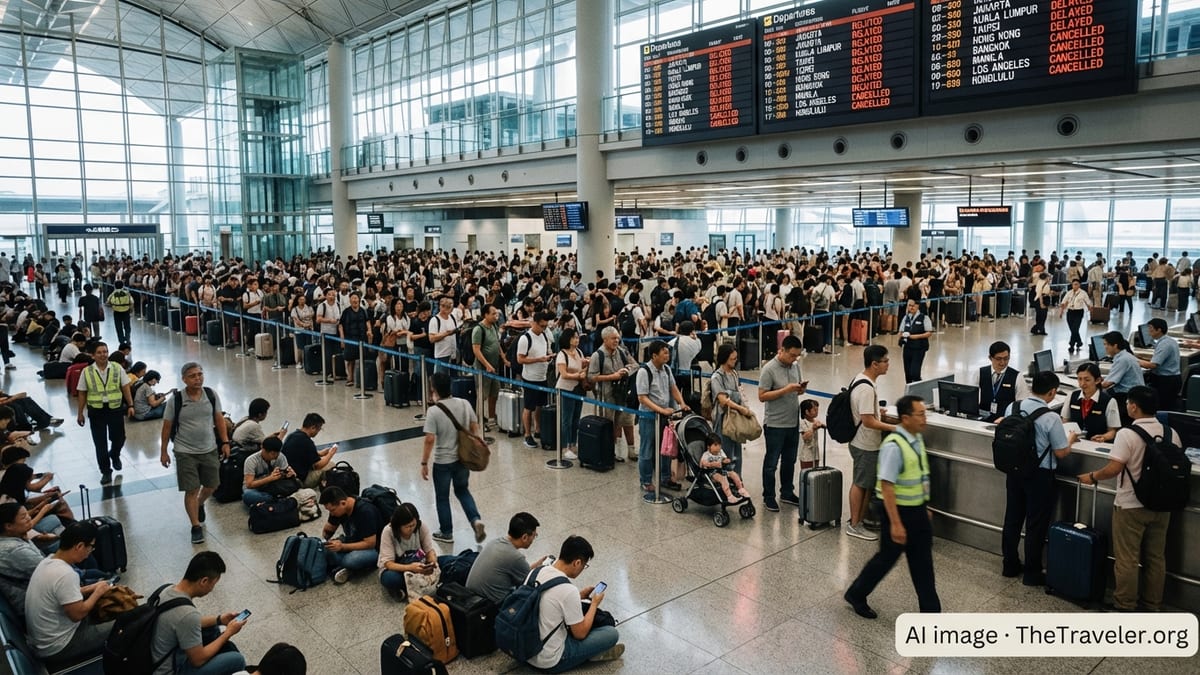
For passengers on the ground, the statistics translate into hours in terminal queues, missed events, and unexpected expenses. Reports from Beijing, Jakarta, and Phnom Penh describe crowded check in areas and transfer zones as travelers wait for new boarding times, alternative routings, or accommodation options. Families, business travelers, and backpackers alike face the same uncertainty when departure boards update repeatedly with new estimated times.
Missed connections are a particular concern at hub airports. A traveler arriving late into Beijing on China Southern may find that an onward flight to a secondary Chinese city has already departed, while those relying on Jakarta for onward domestic connections on Batik services can end up rebooked onto much later flights or re routed through different airports. In Cambodia, tourists planning tight itineraries around temple visits or regional side trips may find themselves shortening stays or rearranging plans at short notice.
Travel forums and social media posts reflect growing frustration over communication and compensation. While some passengers receive meal vouchers or hotel arrangements when delays stretch into overnight waits, others report confusion about their rights, especially when itineraries involve multiple carriers, codeshares, or separate tickets. For travelers who booked complex routes through online agencies, resolving changes can take additional time as airlines and intermediaries coordinate reissues.
The financial impact can also be significant. Extended delays and cancellations can lead to extra nights in hotels, additional ground transport costs, and rebooking fees for missed tours or nonrefundable reservations. For passengers without robust travel insurance, these costs are often borne directly, adding to the sense of disruption and uncertainty.
What Passengers Can Do Right Now
While travelers cannot control broader operational patterns, there are practical steps that can reduce the risk of being stranded when disruptions hit. Aviation industry guidance consistently recommends checking flight status directly on airline channels and airport information boards before leaving for the airport, particularly for flights involving Beijing, Jakarta, Phnom Penh, or busy regional hubs in Indonesia and southern China.
Building longer connection times into itineraries is another key strategy. Rather than booking the shortest possible layover, passengers connecting through major hubs may wish to allow several hours, especially when flying on separate tickets or combining different airlines. This can provide a buffer when an inbound flight is delayed and reduce the risk of missed onward sectors.
Travel experts also stress the value of having a contingency plan. That may include researching alternative routings, being prepared to accept rebooking via a different city, or knowing local accommodation options in case an overnight stay becomes necessary. Keeping essential items in carry on luggage, such as medications, chargers, and a change of clothes, can make an unexpected delay more manageable.
Finally, travelers are encouraged to review the conditions of carriage and relevant consumer protection rules for the countries they are flying in and out of, as these determine eligibility for refunds, rebooking, and in some cases compensation. While regulations vary across jurisdictions, understanding these frameworks in advance can help passengers ask informed questions at the airport and pursue remedies after their journey if needed.