

More news on this day
Passengers across Asia faced widespread disruption today as 57 flights were reportedly cancelled and at least 576 delayed at major hubs including Beijing Daxing, Chengdu Tianfu, Guangzhou Baiyun, Shanghai Hongqiao, Jakarta and Bali, straining airline operations and leaving travelers stranded in terminals for hours.
Get the latest news straight to your inbox!
China’s Mega-Hubs Struggle With High Volumes and Knock-On Delays
Publicly available airport and aviation data indicate that China’s busiest hubs once again bore the brunt of regional disruption, with Beijing Daxing, Chengdu Tianfu, Guangzhou Baiyun and Shanghai Hongqiao all reporting significant clusters of delayed and cancelled services. The figures form part of a wider pattern in which China’s major airports account for a large share of Asia’s daily flight irregularities.
Recent sector summaries focused on Asia show Beijing Daxing handling dozens of delayed departures alongside a handful of cancellations, while Guangzhou Baiyun and Chengdu Tianfu each recorded multiple cancellations and many more late-running flights. Shanghai Hongqiao, a key domestic and regional connector, also contributed a notable number of delayed movements, intensifying congestion across China’s east coast corridor.
Operationally, these irregularities tend to cascade through tightly timed schedules. When high-frequency routes between cities such as Beijing, Shanghai, Guangzhou and Chengdu are disrupted, aircraft and crew rotations are pushed off balance, feeding additional delays into later departures. Aviation analytics covering recent days describe this as a delay-dominant pattern, in which far more flights run late than are formally cancelled, but the passenger impact can be comparable.
China’s airports have experienced strong traffic recovery since 2024, and industry trend bulletins list Guangzhou Baiyun, Chengdu Tianfu and Beijing Daxing among the region’s highest-volume hubs by passenger numbers. That recovery has tightened margins for irregular operations, meaning weather fluctuations, temporary airspace restrictions or local congestion can translate quickly into widespread timetable disruption.
Jakarta and Bali Add to Southeast Asia Bottlenecks
The disruption extended well beyond China, with Jakarta’s Soekarno Hatta and Bali’s main international airport emerging as pressure points for Southeast Asia. Travel industry monitoring and airline advisories in recent days have highlighted Indonesia, and specifically Jakarta and Bali, among the destinations where travelers are being urged to monitor flight status closely due to ongoing schedule volatility.
These Indonesian gateways act as primary entry and exit points for both business and leisure traffic, and any spike in delays or cancellations can affect connections across the wider region. When Jakarta experiences irregular operations, links to other Asian hubs, the Middle East and Australia can quickly become misaligned, forcing airlines to rebook or reroute passengers on already busy services.
Bali, meanwhile, remains one of Asia’s most tourism-dependent airports. Even modest numbers of cancellations can leave large groups of holidaymakers temporarily stranded, particularly during peak outbound and inbound waves. Travel guidance published in recent days has advised passengers with Bali or Jakarta itineraries to confirm any changes with their carriers before leaving for the airport, reflecting persistent uncertainty over day-of-operation schedules.
The combination of heavy leisure demand, slot constraints and limited spare capacity on popular routes means disruption at Bali often reverberates into regional networks, particularly on services to and from China, Singapore and key Australian cities.
Ripple Effects Across Asia’s Densely Connected Networks
Aggregated delay and cancellation statistics from multiple Asia-wide snapshots show that the region’s air travel system is highly interconnected, with irregular operations at a few major hubs quickly spilling into neighboring markets. On days when Chinese airports report several hundred delays alongside dozens of cancellations, additional disruption is frequently observed at airports in Japan, Singapore, Hong Kong and the Middle East, tightening onward connection windows for through passengers.
Recent coverage of Asia’s flight performance has drawn attention to how even relatively small clusters of cancellations at Guangzhou, Beijing Daxing or Chengdu Tianfu can coincide with thousands of delays region-wide. When these are layered on top of weather-related constraints or airspace adjustments affecting hubs such as Dubai, Doha or Abu Dhabi, travelers bound for or transiting through Asia may encounter unexpected rerouting and extended travel times.
Jakarta and Bali sit squarely within this web of connections. Late departures from Indonesia can cause missed links in Shanghai, Guangzhou or Beijing, prompting last-minute hotel stays or complex rebookings. Conversely, upstream delays in China or other Asian countries can leave aircraft and crews arriving late into Jakarta or Denpasar, compressing turnaround times and raising the risk of further schedule slippage.
These dynamics help explain why a specific tally of around 57 cancellations and 576 delays at a handful of major airports can feel far more disruptive on the ground than the raw numbers suggest. Each irregular flight can involve hundreds of passengers, many with onward connections that themselves may be operating near capacity.
Travelers Face Long Queues, Missed Connections and Limited Options
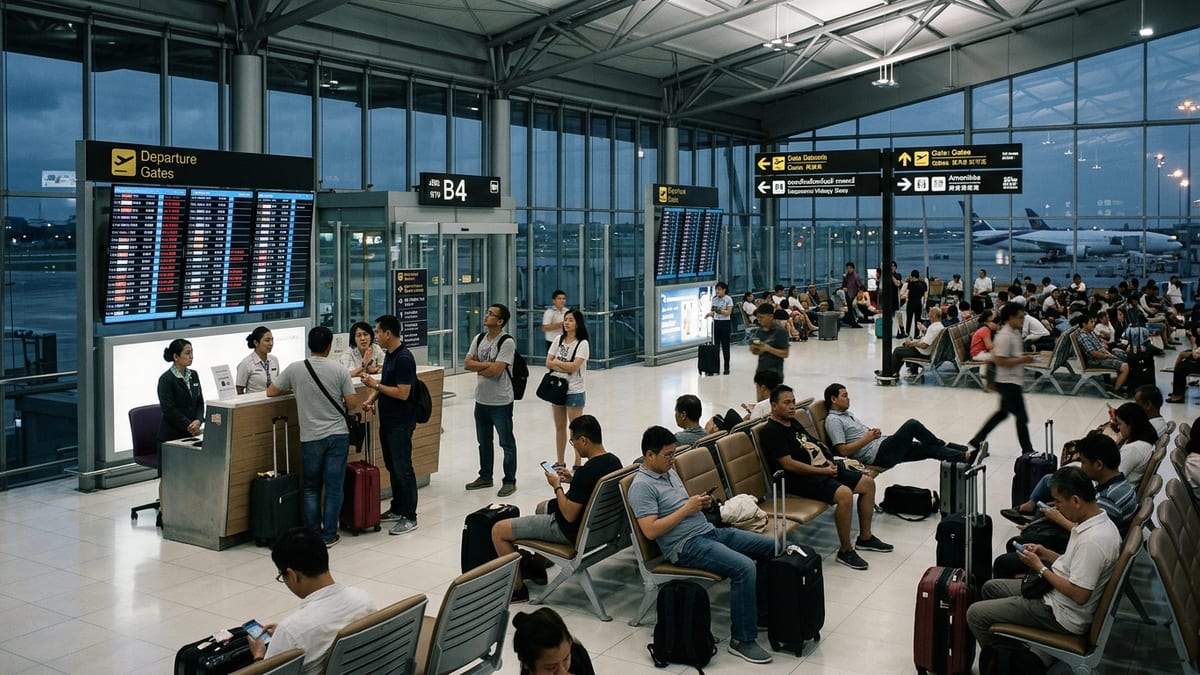
For passengers at the affected airports, the statistical picture translates into very tangible frustrations. Reports and images from recent disruption days at Beijing-area airports, Guangzhou and major Southeast Asian gateways show packed check-in halls, long security lines and crowded boarding gates as airlines work through backlogs of rebookings.
With aircraft and crew availability constrained, options for same-day reaccommodation can be limited, especially on trunk routes where load factors are already high. Passengers whose flights are cancelled outright may be offered departures several hours or even a full day later, while those affected by rolling delays often spend extended periods in departure lounges waiting for updated departure times.
In Bali and Jakarta, the impact can be compounded by the prevalence of international leisure travelers with fixed hotel reservations and tour itineraries. Schedule disruptions on homebound flights may force last-minute extensions of accommodation or changes to ground transport, adding cost and logistical complexity to already long journeys.
Consumer and travel advisories commonly recommend that passengers hold flexible bookings where possible, build in longer connection times when transiting through busy Asian hubs, and keep essential items in carry-on baggage in case checked luggage is delayed or separated during rebooking.
Monitoring Tools and Planning Strategies for Upcoming Trips
As irregular operations continue to surface across Asia’s aviation network, publicly available guidance from airlines, airports and travel platforms emphasizes proactive monitoring and contingency planning. Many carriers now provide real-time flight status updates via apps and messaging services, enabling passengers to track disruptions at hubs such as Beijing Daxing, Guangzhou Baiyun, Shanghai Hongqiao, Jakarta and Bali before setting out for the airport.
Industry-focused travel coverage in recent days has also highlighted the value of checking for airspace or weather advisories across multiple regions, since restrictions far from a passenger’s origin or destination can still influence their route and schedule. The close integration of Asian and Middle Eastern hubs, for example, means a bottleneck in one part of the network can quickly affect flights in another.
Travel planners suggest that those with imminent itineraries through the affected airports consider allowing extra buffer time between connections, especially when linking from short-haul to long-haul services. Where possible, selecting earlier departures in the day can also reduce exposure to knock-on delays that accumulate as schedules compress.
With Asia’s air traffic generally trending upward and major hubs operating near pre-pandemic volumes, episodes like the current mix of 57 cancellations and 576 delays underscore the importance of resilience in individual travel plans. For the foreseeable future, flexible bookings, vigilant monitoring and realistic expectations are likely to remain essential tools for anyone flying through the region’s busiest airports.