

More news on this day
Air travel across Asia has been thrown into disarray after 264 flight cancellations and 3,829 delays in a single day clogged schedules at some of the region’s busiest hubs, stranding passengers and stretching airline operations from East Asia to the Gulf.
Get the latest news straight to your inbox!
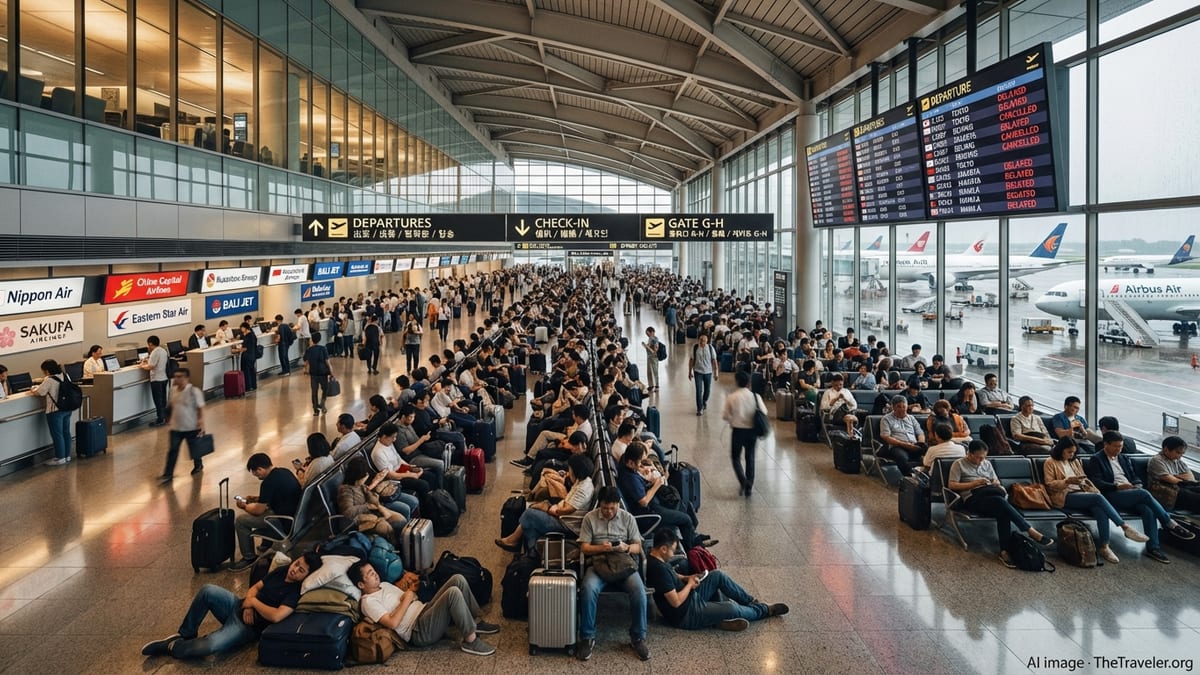
Disruptions Sweep Major Asian Gateways
Published coverage indicates that airports across China, Japan, Singapore, India and Saudi Arabia were among the worst affected, with knock-on disruptions reported at key transit points including Tokyo, Shanghai, Kolkata and Abu Dhabi. The wave of cancellations and delays effectively created a rolling backlog of aircraft and passengers moving through one of the world’s most heavily trafficked aviation corridors.
Flight-tracking snapshots cited in industry reports show that the 264 cancellations were concentrated on short and medium-haul services that feed larger long-haul networks, while the 3,829 delays rippled through both regional and intercontinental operations. This pattern left many travelers facing missed connections, extended layovers and last-minute itinerary changes as carriers attempted to rebalance aircraft and crews.
Several Asian carriers with dense intra-regional networks, including low-cost and full-service operators, appeared prominently in disruption tallies. Publicly available data highlights impacts on airlines such as Batik Air, IndiGo, Air China and FlyDubai, particularly on routes linking major hubs with secondary cities. With so many aircraft out of sequence, schedule recovery in the following days is expected to remain challenging.
Observers note that the timing of the disruption, during a period of elevated demand for both business and leisure travel, amplified the effect. Many routes in North Asia, Southeast Asia and the Gulf are currently operating at or near pre-pandemic capacity, leaving limited slack in networks to absorb sharp, same-day shocks to punctuality.
Weather, Airspace and Operational Strain Converge
Reports point to a mix of factors behind the spike in cancellations and delays. Localized storms and adverse weather conditions in parts of East and South Asia curtailed airport arrival and departure rates, creating early bottlenecks that cascaded through the day. When ground times lengthen due to lightning alerts or low visibility, even brief suspensions can trigger hours of downstream disruption as aircraft miss their scheduled slots.
The region is also contending with broader airspace constraints linked to geopolitical tensions and conflict in West Asia. Aviation analyses show that many Asia to Europe flights are continuing to avoid large portions of airspace over Iran, Iraq and surrounding areas, stretching routings and increasing flight times. These longer trajectories reduce schedule flexibility, narrow turnaround windows and can increase crew-duty pressures, all of which make networks more vulnerable when local weather or technical issues arise.
Operational strain within airlines and at airports is a further contributing factor. Industry commentary across recent months has highlighted persistent staffing gaps in ground handling, maintenance and air traffic management in some markets, even as traffic has rebounded. When capacity is tight, relatively small disruptions can tip a hub into extensive delay patterns, especially at airports that already operate near their runway and terminal limits during peak hours.
In addition, simultaneous disruption episodes in other regions have complicated recovery. Recent waves of delays and cancellations in the Middle East and Europe have absorbed spare aircraft and crew capacity that might otherwise have been redeployed to stabilize Asian schedules, reinforcing the sense of global fragility in airline operations.
Key Hubs Under Pressure From Tokyo to the Gulf
The latest figures place several flagship Asian hubs at the center of the turmoil. In Northeast Asia, major airports serving Tokyo and Shanghai reported some of the most intense congestion, with departure banks repeatedly pushed back as arriving aircraft were held in holding patterns or slowed en route. Even when cancellations were limited, widespread delays at these mega-hubs quickly spread to secondary airports across Japan and China.
In South Asia, Kolkata featured among the airports recording notable disruption, reflecting both local weather effects and its role as a connector between domestic and international services. Delayed departures from such regional hubs can quickly undermine carefully timed connections onto long-haul flights, creating clusters of missed onward journeys that are difficult to re-accommodate at short notice.
Farther west, Abu Dhabi and other Gulf-area airports that function as critical bridges between Asia, Europe and Africa also experienced elevated disruption levels. Publicly available tracking data and travel-industry outlets have recently highlighted how congestion and airspace detours in the wider Middle East are complicating operations at these transfer hubs. When a hub in the Gulf backs up, the impact is felt across networks stretching from East Asia to the Atlantic.
Smaller and mid-sized airports across Asia have not been spared. While they recorded fewer outright cancellations, many reported streams of delayed arrivals and departures as they absorbed late-running aircraft from larger hubs. This dynamic often leaves local travelers facing shifting boarding times, aircraft swaps and gate changes, even if their departure airport is not at the heart of the disruption.
Passenger Impact: Missed Connections and Mounting Costs
For travelers, the combination of 264 cancellations and thousands of delays translates into a broad spectrum of practical problems. Missed international connections are among the most serious, particularly for passengers on multi-leg itineraries spanning Asia, the Middle East and Europe. Once a missed connection occurs at a key hub, rebooking can be constrained by high load factors and limited spare seats, forcing some travelers to wait many hours or even into the following day for alternatives.
Travel-industry advisories recommend that passengers check flight status repeatedly on the day of travel and ensure contact details are updated with airlines or booking platforms, as last-minute retiming and reaccommodation efforts are often processed digitally. Consumer-rights guides also underline the importance of keeping boarding passes, booking confirmations and any written notices of delay or cancellation, which can be relevant for compensation or reimbursement claims in certain jurisdictions.
The financial implications can be significant. While many carriers provide meals, accommodation or vouchers when disruption exceeds certain thresholds, travelers often incur additional costs for rebooked ground transport, missed hotel nights or rearranged tours. Travel insurance policies vary widely in their coverage of such events, and specialized compensation services continue to report rising interest from passengers affected by extended delays and last-minute cancellations worldwide.
Beyond immediate expenses, the broader reputational impact for airlines and airports is also in focus. Frequent flyers and corporate travel managers increasingly scrutinize on-time performance metrics when choosing carriers and routings, particularly on time-sensitive business journeys. Sustained periods of poor punctuality in key Asian hubs could gradually influence future booking patterns toward more resilient networks, where available.
What the Disruptions Signal for Asia’s Aviation Outlook
The latest wave of flight chaos underscores how tightly coupled Asia’s air transport system has become, and how vulnerable it is to overlapping shocks. With traffic volumes approaching or exceeding pre-pandemic levels on many corridors, a growing chorus of aviation analysts has warned that infrastructure, staffing and contingency planning have not always kept pace with the rebound.
At the same time, Asia’s role at the heart of global aviation continues to expand. Many of the world’s busiest international routes, including trunk links connecting East Asia, Southeast Asia, the Gulf and Europe, depend on smooth operations at the very hubs now under pressure. Periods of intense disruption in Asia can therefore reverberate well beyond the region, affecting schedules and connectivity on other continents.
Published commentary suggests that airlines and airports across the region are investing in additional capacity, new terminals and digital tools to manage day-of-operations more effectively. However, those projects will take time to mature, leaving an interim period in which travelers may face intermittent, but sometimes severe, bouts of disruption when weather, airspace and operational problems coincide.
For now, the tally of 264 cancellations and 3,829 delays in a single day stands as a stark illustration of the strain on Asia’s aviation ecosystem. As carriers work to restore regularity to their schedules, passengers planning trips through key hubs in the coming days are being urged by travel advisers and public information channels to build in extra time, remain flexible and stay closely informed as conditions evolve.