

More news on this day
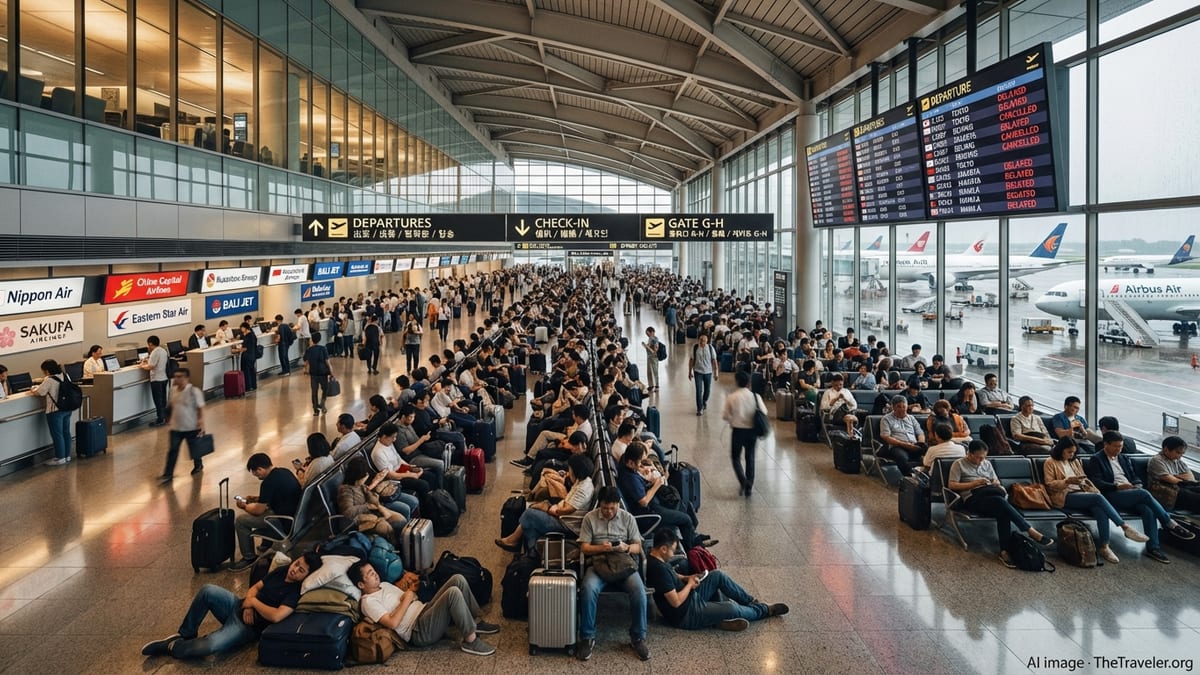
Travelers across Asia are facing extensive delays and cancellations today as a fresh wave of disruptions ripples through some of the region’s busiest airports, snarling connections and leaving terminals crowded with stranded passengers.
Get the latest news straight to your inbox!
Delays Mount Across Tokyo, Hong Kong, Seoul and Singapore
Aggregated flight-status data for April 7 indicates widespread disruption across a dense network of Asian hubs, with hundreds of departures pushed back by an hour or more and dozens of services cancelled outright. Tokyo’s Haneda and Narita airports, Hong Kong International, Seoul Incheon and Singapore Changi are among the most heavily affected, according to aviation trackers and regional media coverage.
Recent tallies compiled by industry outlets show that more than 3,000 flights across Asia were delayed and over 150 cancelled in a single day, with Tokyo Haneda, Hong Kong, Guangzhou, Incheon, Shenzhen and Narita all reporting triple-digit delay counts. These figures underscore how quickly operational stress can spread when several major transfer points experience disruption at the same time.
Reports indicate that departure boards at key hubs have been dominated by late-running services, with knock-on effects stretching across domestic, regional and long haul networks. Travelers making onward connections through Tokyo, Hong Kong, Seoul and Singapore are experiencing missed flights and extended layovers as airlines struggle to absorb the shock.
Publicly available information shows that while some airports are recovering more quickly than others, delays are persisting into the evening peak at several hubs. Even where outright cancellations remain limited, extended turnaround times and congested airspace are combining to slow operations.
Weather, Congestion and Network Fragility Drive Disruption
Published coverage from regional travel outlets links the latest wave of disruption to a mix of adverse weather, tight scheduling and existing strain within Asia’s aviation system. Recent storms, fog and low visibility at several gateways have forced temporary ground stops and reduced arrival and departure rates, creating queues of aircraft both in the air and on the tarmac.
Analysts cited in industry reports note that many short haul carriers in Asia operate aggressive turnaround schedules that leave minimal buffer for disruption. When thunderstorms or air traffic control restrictions begin to cascade through the network, even a short interruption at one hub can rapidly spread to others as aircraft and crew fall out of position.
In parallel, Asia’s airlines are still scaling capacity to meet strong post-pandemic demand while managing elevated fuel costs and complex rerouting around sensitive airspace. Earlier this year, aviation data showed thousands of delayed flights across the wider Asia Pacific region in single days, illustrating how closely balanced capacity and demand have become.
Sector commentary highlights that structural vulnerabilities, rather than a single extraordinary event, are now a key driver of chaos. A combination of congested hubs, high load factors, constrained staffing and increasingly volatile weather patterns means routine irregular operations can escalate into region-wide disruption within hours.
Knock-on Impacts for Long Haul and Transit Passengers
The latest disruption is particularly acute for travelers using Asian hubs as transit points between regions. According to compiled flight-tracking figures, major long haul carriers and alliances rely on airports such as Tokyo Haneda, Narita, Hong Kong, Incheon, Singapore Changi and key Chinese hubs to connect itineraries between North America, Europe, Oceania and the rest of Asia.
When departure banks out of these hubs run late, onward flights often miss their optimal connection windows. Publicly available itineraries show that travelers bound for secondary cities are especially vulnerable, since many rely on a limited number of daily services that can be difficult to rebook once disrupted.
Travel-industry briefings indicate that airlines are responding with a mix of same-day rebooking, overnight accommodation offers where required, and temporary relaxation of change fees on affected routes. However, high load factors on many popular corridors limit the number of spare seats available, prolonging disruption for some travelers by 24 hours or more.
Observers note that for short regional trips, rail or road alternatives may help some passengers bypass overloaded airports. For long haul journeys, however, flying remains the only practical option, leaving travelers largely dependent on airline operational resilience and the flexibility of their tickets and insurance policies.
Passengers Urged to Monitor Flights and Protect Travel Budgets
Consumer guidance from travel risk and finance publications stresses the importance of proactive planning during periods of flight chaos. Passengers are advised to monitor flight status through airline apps and airport information displays, rather than relying solely on original booking confirmations that may not reflect real-time changes.
Financial advice outlets also emphasize documenting expenses when disruption occurs. Receipts for meals, accommodation and local transport can be critical when seeking reimbursement from airlines or claiming under travel insurance policies, particularly where delay thresholds are specified in the small print.
Recent explainers on 2026’s elevated delay rates point out that different jurisdictions and ticket types offer varying levels of protection. Some regions provide stronger entitlements to care and, in certain circumstances, compensation, while in others support is governed mainly by airline policy and individual insurance contracts.
With Asia’s air traffic volumes continuing to grow and major hubs operating close to capacity, analysts suggest that passengers should expect irregular operations to remain a recurring feature of regional travel. The latest bout of chaos across Tokyo, Hong Kong, Seoul, Singapore and China’s busiest airports is being viewed by many observers less as an anomaly and more as a warning about the fragility of the current system.