

More news on this day
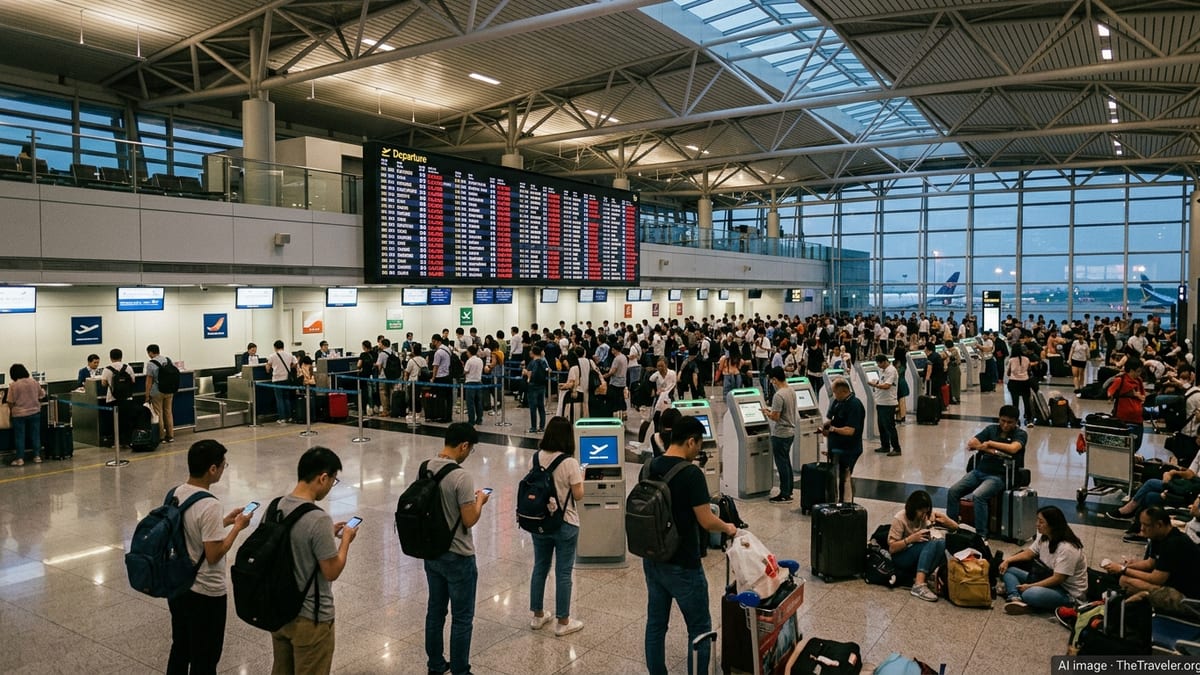
Thousands of passengers across Asia and the Gulf faced long queues, missed connections and overnight airport stays as 1,892 flights were delayed and 88 cancelled in a single day, disrupting operations for carriers including Emirates, Japan Airlines, AirAsia, Malindo Air and others at major hubs such as Bangkok, Dubai and Incheon.
Get the latest news straight to your inbox!
Widespread Disruption Across Asia’s Busiest Hubs
Publicly available flight-tracking data and airport operations dashboards showed extensive knock-on disruption across Thailand, Singapore, Japan, the United Arab Emirates, Malaysia, China, South Korea and Indonesia. The combined total of 1,892 delayed and 88 cancelled services reflects a highly stressed regional network where operational buffers have been eroded by heavy demand, tight aircraft utilisation and complex rerouting around sensitive airspace.
Bangkok, Dubai, and Seoul Incheon were among the hardest hit hubs, with waves of late arrivals cascading into missed departure slots and missed connections. Reports from passengers on social platforms described departure boards heavily populated with delayed notices, particularly for long haul and overnight connections linking Southeast Asia and North Asia with Europe and North America via Gulf and Northeast Asian hubs.
The disruption affected both full service and low cost airlines. Emirates and Japan Airlines saw schedule changes at their key connecting airports, while regional and budget operators such as AirAsia and Malindo Air were impacted on short haul sectors feeding into those hubs. In markets like Thailand and Malaysia, where many travellers rely on multi segment itineraries, delays on early legs quickly snowballed into missed onward flights.
Knock-on Impact for Emirates, Japan Airlines and Low Cost Carriers
Emirates, which operates a large connecting network through Dubai, has already been running a constrained schedule in recent weeks, according to airline notices and independent schedule summaries. With many services from Bangkok, Singapore, Incheon and other Asian cities routed through Dubai, any disruption at the Gulf hub tends to ripple through the network, affecting passengers far beyond the Middle East.
Japan Airlines and other Japanese carriers have also been managing tighter operational windows, particularly at Tokyo area airports where slot availability is limited. Delays on transpacific or intra Asia rotations can rapidly affect departure banks that funnel passengers into evening and overnight long haul services. Passengers bound for North America and Europe reported being reprotected on later flights or rerouted via alternative Asian hubs.
Low cost carriers such as AirAsia and Malaysia based Malindo Air, which typically run their fleets at high daily utilisation, faced particular challenges in recovering from the disruptions. Public timetables and airport status boards indicated multiple late turnarounds and a handful of cancellations on short haul routes linking Thailand, Malaysia, Indonesia and Singapore, where a single delayed aircraft can affect several rotations in one day.
Passengers Stranded, Rebooked and Rerouted
The operational turmoil translated into a difficult travel experience for many passengers. Travellers in Bangkok, Dubai and Incheon shared accounts of waiting hours in customer service queues, struggling to reach airline call centres and being offered rebookings several days later on already busy flights. Some described being provided hotel accommodation or meal vouchers, while others reported having to make their own arrangements as local inventories tightened.
Connections involving multiple airlines were especially vulnerable. Travellers with separate tickets on a mix of regional and long haul carriers often found that a delay on a short haul sector in Southeast Asia caused them to miss a non refundable long haul service from Dubai, Tokyo, Seoul or Singapore. In these cases, publicly available information indicates that options depended heavily on each carrier’s commercial policies, with some passengers able to shift dates or reroute and others facing additional out of pocket costs.
Airports also came under strain as stranded passengers remained airside overnight or queued landside to speak with airline representatives. At some terminals in Bangkok and Dubai, images shared on social channels showed crowded departure halls late into the night. While core airport functions continued, the combination of full flights and limited spare capacity meant that even small schedule changes had outsized effects on travellers’ plans.
Operational and Geopolitical Pressures Behind the Delays
Operational data and regional aviation analysis suggest that the current disruption is being driven by a mix of factors rather than a single incident. Airlines in Asia and the Gulf have been rebuilding capacity in response to strong demand, often operating tight schedules with limited spare aircraft and crews. Any technical issue, adverse weather cell or late inbound flight can trigger a chain reaction of delays, particularly at slot constrained hubs.
Geopolitical tensions and evolving airspace restrictions in parts of the Middle East have also complicated flight planning between Asia, Europe and Africa. Reroutings to avoid certain regions increase flight times, fuel burn and crew duty hours, leaving less margin for recovery when things go wrong. Carriers that rely heavily on long haul connecting traffic through Dubai or other Gulf gateways are especially exposed to these constraints.
In East Asia, periodic weather systems and busy seasonal travel periods have added further pressure. Japan, South Korea and eastern China frequently experience congestion related to storm systems or low visibility, which can force temporary ground stops or flow control measures. When such conditions coincide with already tight schedules, they amplify the likelihood of widespread delays.
What Travelers Can Expect in the Coming Days
Based on recent schedule adjustments and historical recovery patterns, industry analysts expect airlines to stabilise operations gradually over the coming days, but warn that residual disruptions are likely to persist on certain routes. Connecting itineraries through Dubai, Bangkok, Incheon and major Southeast Asian hubs may continue to face elevated risk of delay while airlines reposition aircraft and crews.
Public guidance from airlines and airport operators consistently urges passengers to monitor flight status closely on official channels and to allow extra time for connections, especially when itineraries involve separate tickets or transfers between different carriers. Travellers are also advised to review the terms and conditions of their bookings, including eligibility for rebooking, refunds or assistance in the event of long delays or cancellations.
For now, the experience of thousands of passengers across Asia and the Gulf underlines the fragility of a highly interconnected aviation network. With demand rebounding and external pressures continuing, even a short burst of disruption can leave travellers from Bangkok to Dubai and Incheon to Jakarta facing hours of uncertainty before they finally get airborne.