

More news on this day
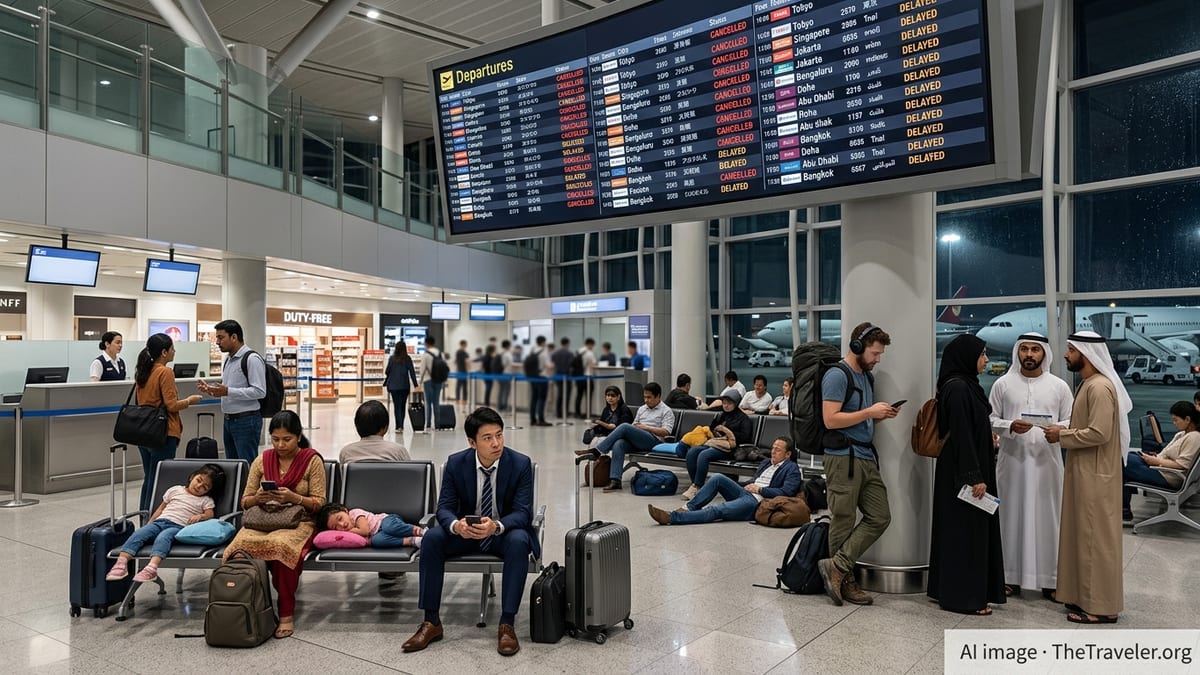
Air travel across Asia experienced intense disruption as 3,072 delays and 154 cancellations rippled through major hubs from Tokyo and Seoul to Hong Kong and Manila, stranding thousands of passengers and straining already pressured airline operations.
Get the latest news straight to your inbox!
Major Asian Hubs Buckle Under Mounting Disruptions
Publicly available airport and flight-tracking data indicate that a broad swath of Asia’s busiest hubs recorded elevated disruption levels, with Tokyo, Hong Kong and several large Chinese airports among the hardest hit. Tokyo Haneda alone reportedly saw hundreds of delayed flights and more than a dozen cancellations in a single operating window, underlining the scale of the knock-on congestion across Japan’s aviation network.
Hong Kong International Airport, a critical connector for Northeast and Southeast Asia, also logged a high number of delayed departures and arrivals, with ripple effects on long haul services linking to Europe, North America and Australia. Guangzhou, Shenzhen, Hangzhou and other mainland Chinese hubs reported similar patterns of rolling delays and targeted cancellations as airlines attempted to reset schedules.
In South Korea, Seoul’s Incheon International Airport, a key transit point for flights between Asia, North America and Europe, registered more than 200 delays alongside a smaller number of cancellations. Manila’s Ninoy Aquino International Airport and Singapore Changi Airport added to the regional picture of strain, with dozens of flights arriving or departing behind schedule and a limited number removed from schedules altogether.
Smaller but strategically important airports such as Urumqi, Lanzhou and regional Japanese fields reported relatively fewer delayed flights but a disproportionate share of outright cancellations, suggesting that airlines focused cuts on thinner routes to preserve capacity on core trunk services.
Weather, Congestion and Operational Pressures Converge
Available reporting points to a familiar combination of factors driving the latest wave of disruption across Asian skies. Localized weather systems, from low visibility and thunderstorms to strong winds, continue to trigger ground holds and rerouting in several markets. Even modest weather events can quickly cascade at slot-constrained hubs where runway and gate capacity are already operating near peak levels.
Operational complexity is compounding the challenge. Airlines and airports in the region are still recalibrating staffing, aircraft rotations and maintenance windows to match resurgent demand. Any unplanned disruption, such as a technical inspection or crew time limitation, can therefore result in larger schedule knock-ons than before the pandemic recovery period.
Air traffic management constraints remain another underlying pressure point. Airspace bottlenecks, temporary route restrictions and sequencing delays at busy control sectors continue to slow traffic flows, particularly on transcontinental routes that rely on precise timing to minimize congestion over shared corridors. When upstream flights arrive late to Asian hubs, departing services often have to wait for aircraft and crew, pushing delays into subsequent waves of departures.
Recent episodes in other regions, including large-scale interruption events linked to IT outages and regional airspace tensions, have underscored how quickly aviation networks can become imbalanced. Analysts note that Asia’s current disruption metrics, while not unprecedented, highlight how little slack remains in global scheduling systems when multiple stressors appear at once.
Wide Airline and Passenger Impact Across the Region
The tally of 3,072 delayed flights and 154 cancellations touches a broad mix of full service and low cost carriers, according to aggregated operational data. Flag carriers such as Cathay Pacific, Japan Airlines, All Nippon Airways, Korean Air and Air China appear prominently in the affected schedules, reflecting their large presence at the most disrupted hubs. Regional and low cost operators that rely on tight turnarounds have also faced challenges keeping aircraft rotations on time.
For travelers, the operational picture has translated into hours-long waits in terminals, missed connections and compressed rebooking options, especially on heavily booked regional and long haul services. Passengers connecting through Tokyo, Seoul, Hong Kong and major Chinese gateways have had to navigate sudden gate changes, rolling departure estimates and, in some cases, overnight stays when onward flights departed without them.
Publicly available information on airline responses shows a mix of rebooking assistance, meal vouchers and hotel arrangements in cases of longer delays or cancellations, varying by carrier and jurisdiction. Travelers on multi-leg itineraries, particularly those linking Asia with Europe or North America, face greater complexity when one delayed segment jeopardizes subsequent sectors operated by alliance or codeshare partners.
Industry observers note that business travelers and tour groups have been especially exposed to the latest disruption, with some itineraries compressed into shorter windows and leaving little flexibility to absorb missed meetings, start dates or cruise departures. Online travel forums and social media posts from passengers highlight crowded customer service counters and long waits to secure alternative flights on popular city pairs.
Asia’s Disruptions Add to a Global Pattern of Flight Chaos
The latest figures out of Asia align with a broader pattern of aviation turbulence seen across other regions in recent weeks. Europe has reported elevated levels of delays and cancellations tied to weather, airspace restrictions and capacity issues at major hubs, while parts of the Middle East have experienced episodic disruption linked to security-related airspace adjustments and rerouting.
Australia has also grappled with its own schedule challenges, with recent days bringing dozens of cancellations and more than a hundred delays at Sydney, Melbourne and Brisbane as carriers including Qantas and partner airlines contended with congestion and operational constraints. These regional flare ups, while distinct in their causes, collectively underline how sensitive interconnected flight networks remain to localized shocks.
Industry commentary suggests that Asia’s position at the crossroads of global traffic flows magnifies the impact of any disruption within the region. When major Asian hubs encounter prolonged departure and arrival backlogs, the effects often extend to connecting banks of flights in Europe, the Middle East, North America and Oceania, complicating crew planning and aircraft utilization far beyond the original delay points.
Analysts argue that what is being seen in Asia is not an isolated crisis but another illustration of a global aviation ecosystem still searching for a stable operating rhythm. With demand close to or above pre-pandemic levels in many markets and infrastructure upgrades progressing more slowly, even routine operational issues can escalate into multi-day schedule realignments.
What Travelers Can Do as Disruptions Persist
Travel advisories and expert commentary emphasize that passengers flying through Asian hubs in the near term should plan for potential irregular operations. Checking flight status frequently, enabling airline app notifications and monitoring airport information displays remain basic but essential steps, particularly for those with tight connections or same-day onward ground transport.
Travel management guidance also recommends building additional buffer time into itineraries, especially when connecting between separate tickets or different airlines. Longer connection windows can provide a margin of safety if an inbound flight is delayed, reducing the risk of misconnecting and losing downstream segments. Where possible, travelers are encouraged to keep critical items and one night of essentials in carry-on bags in case checked luggage is delayed or separated during rebooking.
For those yet to book, some corporate travel programs advise prioritizing routings that minimize the number of connections and avoid pairing two highly congested hubs on the same itinerary. While such strategies cannot eliminate the risk of delays or cancellations, they can reduce exposure to complex rebookings and overnight disruptions.
With Asia’s latest figures highlighting more than 3,000 delayed flights and over 150 cancellations in a compressed time frame, travel planners and passengers alike are being reminded that flexibility remains one of the most valuable assets in the current aviation environment.