

More news on this day
Thousands of air travelers across Asia are facing extensive disruption today as airports in Thailand, Singapore, Japan, the United Arab Emirates, India, Indonesia and China collectively report 4,319 delayed flights and 189 cancellations, impacting operations for Etihad, Japan Airlines, Air China, Thai Airways and a long list of other regional and international carriers.
Get the latest news straight to your inbox!
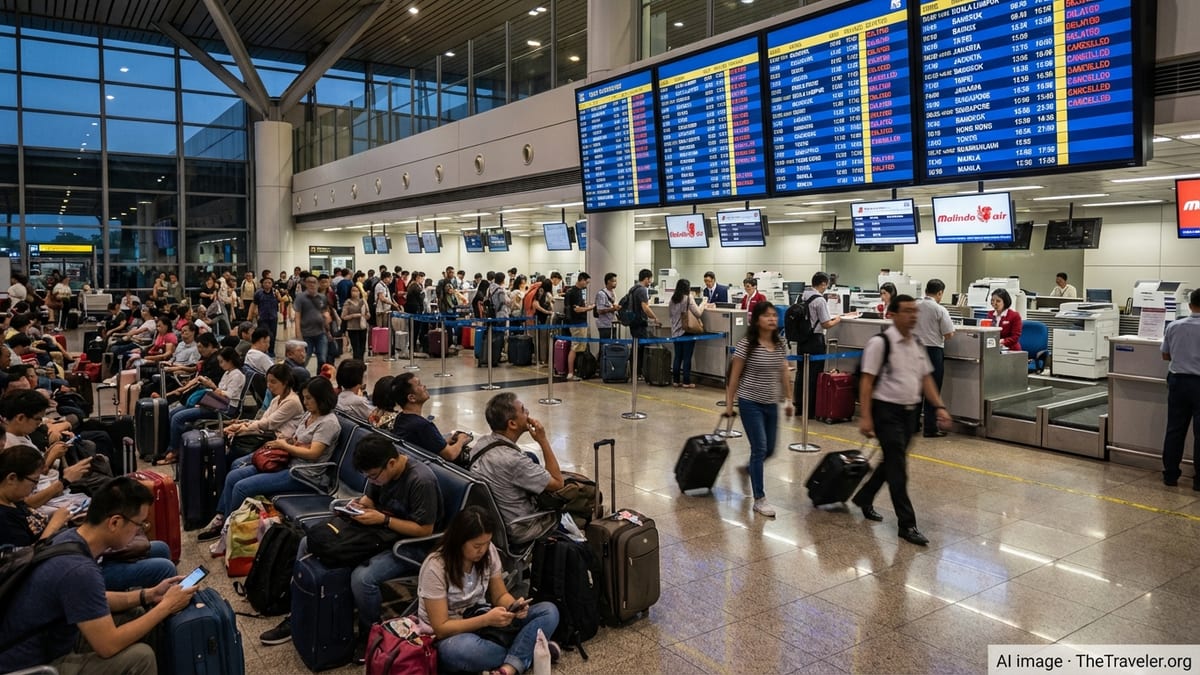
Widespread Disruption Across Major Asian Hubs
Flight data aggregators tracking operations on April 10 indicate that delays and cancellations are concentrated at some of Asia’s busiest international gateways, including Beijing, Tokyo, Dubai, Bangkok, Singapore, Mumbai and Jakarta. The figures suggest a heavy knock-on effect for both regional and long-haul connections, with passengers stuck in terminals or diverted onto alternative routings at short notice.
Publicly available information shows that delayed departures account for the vast majority of interruptions, but the nearly 200 outright cancellations recorded today are forcing many travelers to rebook days later or reroute through less congested airports. The disruption is being felt on both intra-Asia services and intercontinental flights linking Asia to Europe, the Middle East and North America, placing additional strain on already tight peak-season schedules.
Operational summaries indicate that carriers using major hubs such as Beijing Capital, Tokyo Haneda and Dubai International are among the hardest hit. These airports act as critical connection points for itineraries that stitch together multiple legs across Asia and beyond, so extended delays on early-morning and midday departures have cascaded into missed connections and a growing backlog of stranded travelers as the day progresses.
The number of affected passengers is difficult to quantify precisely, but based on typical widebody and narrowbody aircraft loads on trunk routes across the region, today’s disruption likely involves many tens of thousands of people having their travel plans upended, with some facing long waits for accommodation, meal vouchers and rebooking options.
Airlines Under Pressure From Capacity Limits and Route Changes
Carriers operating across Asia and the Gulf are contending with an unusual mix of factors, including capacity caps, route suspensions and volatile demand linked to geopolitical tensions. Recent published coverage on the Middle East conflict shows that Dubai authorities have restricted many foreign airlines to a single round-trip per day into the emirate’s airports during the current summer scheduling period, constraining the ability of Asian carriers to absorb irregular operations or add extra sections when delays start to stack up.
Publicly available airline updates show that Etihad, based in Abu Dhabi, continues to adjust its schedules and ticketing policies in response to the evolving situation, offering more flexible rebooking options on affected services. At the same time, other Gulf and Asian airlines, including those based in India and Southeast Asia, are navigating suspensions or frequency reductions on routes into the wider West Asia region, making it harder to reposition aircraft and crews when disruptions spread across the network.
In Southeast Asia, route suspensions and capacity adjustments tied to higher operating costs are adding a further layer of fragility. Recent reports out of Thailand describe selective cuts to both regional and long-haul routes by Thai carriers following fuel price surges, while some low-cost operators have scaled back flights from Bangkok to Chinese and Middle Eastern destinations. These structural reductions leave fewer spare aircraft and limited schedule padding to recover from a day like today, when thousands of flights are already running late across the region.
Japan Airlines, Air China, Thai Airways and other full-service Asian carriers also continue to balance strong demand on core routes with the operational realities of crew duty limits, airspace restrictions and congested hub airports. Even when these airlines maintain most of their planned schedules, the margins for absorbing weather delays, technical issues or congested airspace slots are thin, and the result is a rapid buildup of late-running services once the first wave of disruptions hits.
Dubai, Beijing and Tokyo Emerge as Critical Bottlenecks
Today’s figures highlight how quickly disruption can accumulate at a handful of key hubs. In the Gulf, Dubai and Abu Dhabi serve as major transit points for passengers traveling between Asia, Europe and Africa. Earlier this month, regional travel coverage documented hundreds of delayed and cancelled flights at these airports over a single day, particularly affecting flydubai, Etihad and several African and South Asian carriers. Those earlier backlogs, combined with ongoing capacity caps on foreign airlines, mean today’s delays are occurring in a system that is already stretched.
In East Asia, Beijing and Tokyo are facing their own operational stresses. Beijing’s role as a primary hub for Air China, together with substantial operations from other Chinese and international airlines, means that any disruption, whether due to weather, airspace management or ground-handling constraints, rapidly affects large numbers of connecting itineraries. Reports this week on Chinese and regional flight disruption show that even modest numbers of cancellations and delays in and out of Beijing can produce widespread knock-on effects across secondary Chinese cities and onward international services.
Tokyo Haneda and Narita, which together handle a dense mix of domestic Japanese flights and international services for Japan Airlines and other global carriers, are also highly sensitive to bottlenecks. Crowded departure and arrival banks make it difficult to recover punctuality once a few waves of flights are pushed back. When early services depart late, subsequent rotations for the same aircraft can experience cascading delays, particularly on long-haul routes that cannot easily be shortened or rescheduled.
This combination of constraints across Dubai, Beijing and Tokyo has left many passengers stranded partway through multi-leg journeys, often with limited alternative routings. Travelers bound for Europe or North America via the Gulf, or for secondary Asian cities via Chinese and Japanese hubs, are among those most likely to face last-minute changes and overnight stays.
Passenger Experience: Long Queues, Uncertain Timelines and Limited Options
Images and descriptions circulating in regional media show crowded departure halls and lengthy check-in and security queues at several of the affected airports. With 4,319 delayed flights across the day’s schedules, many travelers are spending hours at boarding gates only to see departure times pushed back repeatedly. For those whose flights have been cancelled outright, competition for remaining seats on later services is intense, particularly on routes already operating under frequency caps or temporary suspensions.
Reports indicate that some passengers have been provided hotel accommodation and meal vouchers, especially in cases of overnight delays or missed connections. However, assistance varies significantly between airlines and airports, depending on local regulations, carrier policies and the specific causes of disruption. In some jurisdictions, compensation frameworks apply when delays are within the airline’s control, while in others, travelers must rely primarily on the goodwill and discretionary support of the carrier.
The disruption is particularly challenging for travelers connecting between multiple carriers, for instance combining an Asian airline with a Gulf carrier on separate tickets. In such cases, missed connections may not be protected, leaving passengers to negotiate new arrangements with more than one airline. With major hubs like Dubai, Beijing and Tokyo all experiencing pressure, finding same-day alternatives is increasingly difficult as the day’s disruptions ripple outward.
Families, business travelers and tourists alike are affected, with some forced to cut short trips or miss key events. Travel planners note that tightly timed itineraries, such as same-day long-haul connections with short layovers, are especially vulnerable in the current environment of recurring regional disruptions.
What Travelers Can Do Amid Ongoing Volatility
As today’s events underline the fragility of the regional aviation network, consumer advocates and travel experts are emphasizing preparation and flexibility. Public guidance shared through news outlets and airline advisories encourages passengers to monitor flight status tools closely on the day of travel, sign up for airline notifications and allow extra time at the airport to navigate potential queues and last-minute gate changes.
Travel advice published in recent days recommends that passengers on complex journeys consider building in longer connection times, particularly when transiting through hubs that have seen repeated disruption such as Dubai, Beijing and Tokyo. Where possible, booking through-tickets on a single airline or alliance can offer better protection for missed connections, since the operating carrier has clearer responsibility to rebook affected travelers.
For those already affected today, guidance from passenger-rights organizations highlights the importance of keeping boarding passes, receipts and any written communication from airlines about delays or cancellations. This documentation can be critical when seeking reimbursements for out-of-pocket expenses or claiming compensation where local rules permit it.
With conflict-related airspace restrictions, capacity limits and cost pressures unlikely to ease in the short term, analysts expect further pockets of disruption across Asia’s air network in the weeks ahead. Travelers heading through Thailand, Singapore, Japan, the UAE, India, Indonesia and China may therefore face continuing uncertainty, even as airlines work to stabilize schedules and rebuild resilience into their operations.