

More news on this day
Air travel across Asia and the Gulf faced another bruising day as publicly available data showed more than 500 flights cancelled and over 5,000 delayed, disrupting schedules in South Korea, China, Japan, India, the United Arab Emirates and beyond, and hitting carriers such as All Nippon, Batik Air, China Eastern and FlyDubai at major hubs including Beijing, Jakarta, Delhi and Dubai.
Get the latest news straight to your inbox!
Fresh Wave of Disruptions Across Asian Skies
Published aviation dashboards and regional travel coverage on April 5 indicate that a new wave of operational disruption swept across Asia, with hundreds of cancellations and thousands of delays logged in a single trading day for the region’s airlines. Aggregated figures from multiple airport and flight-tracking feeds point to more than 514 cancellations and in excess of 5,200 delays across the continent and nearby Gulf gateways.
The latest turbulence follows a series of difficult operational days for Asian carriers in late March and early April, when various reports documented several thousand delays and hundreds of cancellations concentrated in Chinese, Japanese, Korean, Indian and Southeast Asian hubs. The pattern has extended into the weekend, suggesting that congestion, weather and network constraints are continuing to ripple through schedules rather than being confined to an isolated event.
While disruption levels fluctuate by hour and airport, the scale of today’s cumulative impact is significant for both passengers and airlines. The figures place Asia once again among the most affected regions globally for same day schedule reliability, with knock-on effects likely to continue into the start of the coming week as aircraft and crews fall out of position.
Industry commentators note that the current numbers sit on top of a broader backdrop of route suspensions and rerouting tied to geopolitical tensions in the Middle East and ongoing airspace constraints, which have already forced some carriers to thin out or reconfigure their Asia and Gulf networks this spring.
Hubs from Beijing to Dubai Under Pressure
Reports tracking airport level performance show that the disruption is concentrated around a familiar group of major hubs, including Beijing Capital and Beijing Daxing in China, Tokyo’s Haneda in Japan, Seoul’s Incheon in South Korea, Delhi and Bengaluru in India, Jakarta in Indonesia and Dubai in the United Arab Emirates. Across these airports, delays often far outnumber outright cancellations, but together they account for a substantial share of today’s regional totals.
In China, a cluster of large coastal and inland airports has again featured prominently in cancellation statistics this week, with Shenzhen, Guangzhou and Shanghai’s dual airports repeatedly ranking among the highest for cancelled and delayed departures. Beijing’s two main gateways remain heavily used transit points for both domestic and international routes, amplifying the effect of even modest schedule slippage.
Tokyo Haneda and Seoul Incheon continue to handle dense short haul and regional traffic alongside long haul connections, leaving them vulnerable when weather or upstream congestion narrows operational buffers. Flight performance snapshots from recent days highlight high three digit daily delay counts at Haneda in particular, making the airport one of the most affected in Asia by volume.
In the Gulf, Dubai’s role as a critical bridge between Asia, Europe and Africa means that disruption there often has outsized consequences. Travel industry briefings in recent weeks have already noted capacity adjustments and route suspensions on flights into Dubai linked to regional geopolitical tensions, and today’s data show that additional same day delays and cancellations are now adding to that pressure.
Major Carriers Feel the Strain
The rolling disruption is touching a wide range of airlines, from full service network carriers to low cost operators. According to compiled performance tables from regional travel outlets, Japanese and Korean brands such as All Nippon and ANA Wings, along with Korean operators, have logged notable levels of delayed and cancelled services as weather and congestion have affected their primary hubs.
In Southeast Asia, Indonesia’s Batik Air has emerged repeatedly in delay and cancellation roundups focused on Jakarta and other Indonesian gateways. These flights play a key role in connecting secondary cities within Indonesia and linking them to larger regional hubs, so localized schedule issues can quickly ripple outward for connecting passengers.
Chinese mainline and subsidiary carriers, including China Eastern and other state linked airlines, continue to bear a significant share of the disruption simply by virtue of their scale and concentration at some of the region’s most delay prone airports. Recent daily breakdowns show Chinese airports leading regional tallies for combined cancellations and delays, ensuring that the country’s big three airlines remain central to any analysis of Asia’s current reliability challenges.
In the Gulf, FlyDubai features among the airlines affected by today’s operational snags, operating in parallel with larger Gulf network carriers that are still adjusting schedules around Middle East conflict zones. Publicly available airline notices and media coverage over the past two weeks show carriers trimming or suspending certain Dubai and wider West Asia routes, leaving less slack in the system when irregular operations occur.
Weather, Congestion and Geopolitics Combine
Travel and aviation reports suggest that no single factor fully explains the current spike in disruption. Short term weather systems have been cited in recent days around several Northeast Asian and Southeast Asian hubs, triggering flow control measures and forcing airlines to slow down departures. When such weather coincides with peak travel periods, departure banks can quickly back up.
At the same time, chronic congestion at major Asian airports continues to erode on time performance. Slot constrained hubs in Tokyo, Seoul, Beijing and Shanghai have long operated with thin margins for recovery when something goes wrong. With traffic volumes in many markets now at or above pre pandemic levels, minor schedule perturbations can snowball into wider gridlock more easily than before.
Geopolitics is adding another layer of complexity. Coverage from Middle East and South Asian outlets has highlighted ongoing airspace restrictions and conflict related detours that have forced carriers to abandon certain direct routings, increase flight times and in several cases suspend services entirely on specific city pairs. These adjustments reduce the flexibility airlines have to reshuffle aircraft and crews when same day irregularities emerge elsewhere in their networks.
Industry analysts point out that the combination of weather, structural congestion and route restrictions is especially challenging for airlines that depend heavily on banked hub operations, where large numbers of flights are scheduled to connect within tight windows. When even a portion of those inbound flights are delayed, the impact cascades across outbound services and onward connections.
Travellers Face Longer Journeys and Uncertain Itineraries
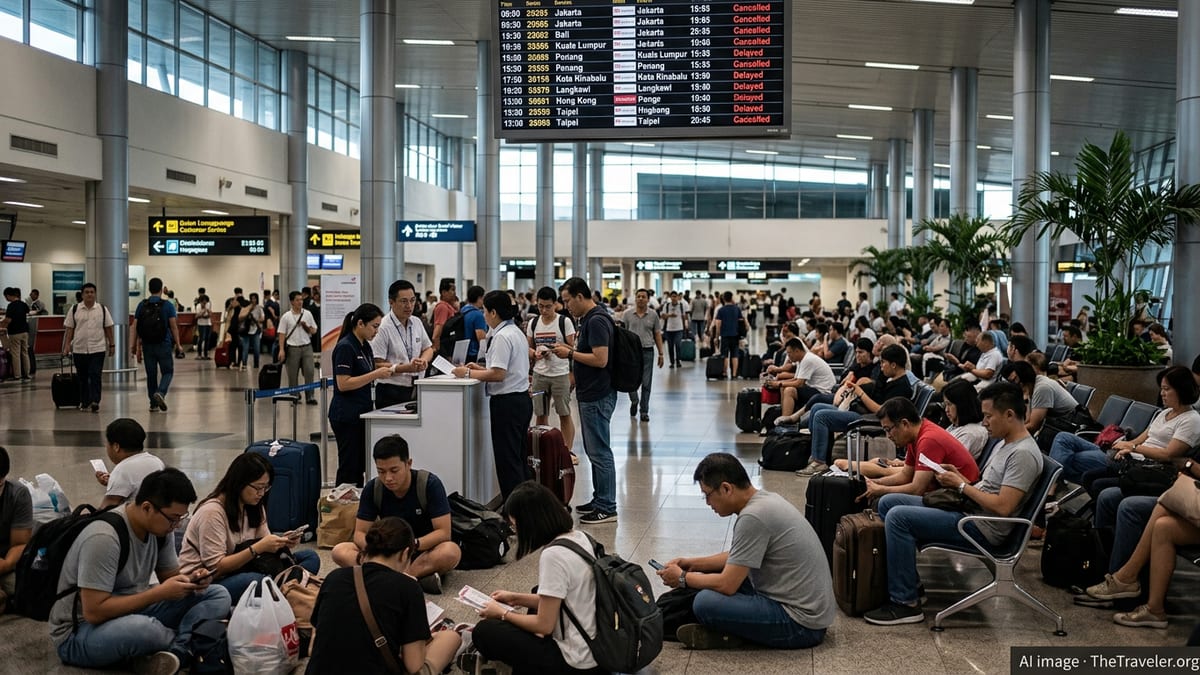
For passengers, the immediate consequences of today’s figures are visible in crowded terminals, long customer service queues and rapidly changing departure boards from Beijing to Dubai. With more than 5,000 flights reported delayed in the region, missed connections and extended layovers have become a recurring feature for travelers transiting the largest hubs.
Consumer focused advisories emerging from travel media and aviation blogs in recent weeks have consistently urged passengers flying through Asian and Gulf hubs to build in additional connection time, monitor airline apps closely and prepare contingency plans if onward legs are disrupted. The spike in delays and cancellations today is likely to reinforce that message, particularly for those with tight same day connections.
There are also financial implications. Separate analyses published in late March have warned that repeated disruption and capacity constraints on certain Asia to Europe and Asia to Middle East corridors are contributing to higher fares, especially on routes where airlines have suspended or reduced services due to regional conflicts. With aircraft and crews already stretched, large scale day of disruption makes it harder for carriers to re accommodate passengers swiftly without resorting to more expensive options.
For now, industry observers expect operational conditions to remain volatile in the short term as airlines continue to balance high demand with infrastructure limits and external geopolitical pressures. Travelers heading through Beijing, Jakarta, Delhi, Dubai and other major Asian hubs in the coming days are being advised by public information sources to keep a close eye on schedules and to assume that conditions can change with little notice.