

More news on this day
Air travel across Asia is facing renewed turmoil as more than 600 flights are canceled or heavily disrupted at major hubs this week, snarling long-haul connections and leaving thousands of passengers stranded from Tokyo and Seoul to Singapore, Delhi and the Gulf.
Get the latest news straight to your inbox!
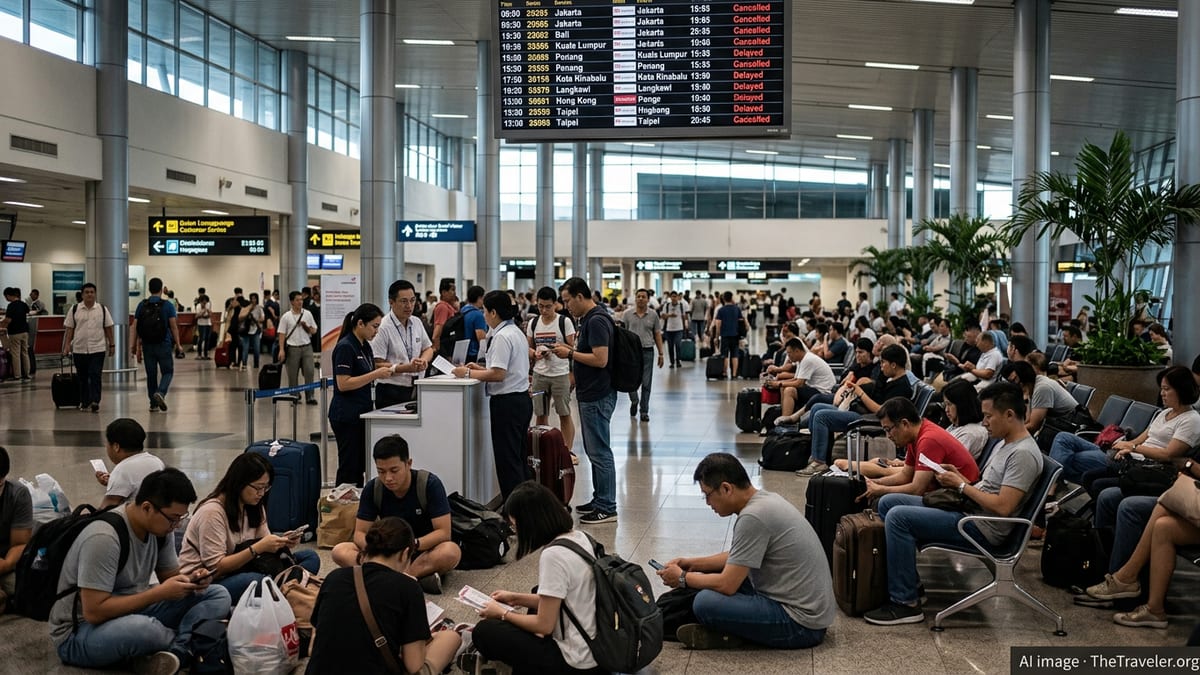
Major Asian Gateways Struggle Under Mounting Disruptions
Publicly available data from flight tracking platforms and industry reports indicate that key Asian hubs have collectively seen well over 600 cancellations in recent days, alongside thousands of delays. The pressure is concentrated at Tokyo’s Haneda and Narita airports, Seoul Incheon, Singapore Changi, major mainland Chinese gateways such as Beijing and Shanghai, and fast-growing transit centers in India and the Gulf.
Recent tallies show daily cancellations in the hundreds at times, with one snapshot highlighting more than 150 cancellations and more than 3,000 delays at airports across Japan, South Korea, Singapore, China, the Philippines and Hong Kong on a single day. Separate regional roundups for the first week of April point to additional days where cancellations across Asia and adjoining Middle Eastern hubs have exceeded 250 flights, suggesting a sustained pattern rather than an isolated operational glitch.
While disruption levels vary from airport to airport, the broader picture shows Asia’s role as a global connector amplifying the impact. A canceled or significantly delayed departure out of Tokyo or Guangzhou can cascade into missed onward flights in Singapore or Doha, magnifying the number of travelers affected beyond the headline cancellation figures.
The scale of the current disruption is particularly striking given that many airlines in the region have been rebuilding capacity to or above pre-pandemic levels. Schedules remain tightly packed, and spare aircraft and crew are limited, leaving little buffer when several stress factors hit at the same time.
Weather, War and Operational Strain Combine
Published coverage across the region traces the flight chaos to a convergence of factors rather than a single root cause. Seasonal storms and strong winds over parts of East Asia have periodically slowed arrival and departure rates at major airports, forcing traffic control to meter takeoffs and landings and triggering knock-on delays through the day.
At the same time, the conflict in the Middle East has led to extensive airspace closures and temporary suspensions of operations at several Gulf hubs. Industry and government advisories describe daily cancellations in the thousands across Middle Eastern airspace during the height of the crisis, with Dubai and Abu Dhabi among the airports affected. Many long-haul services between Asia and Europe are now operating on lengthened routings, adding more than an hour to some flight times and complicating aircraft rotations.
For Asian carriers and airports, these detours have effectively tightened aircraft availability. A flight that spends an extra two or three hours in the air due to a diversion around closed airspace returns late to its home hub, pushing back its next departure slot or forcing a cancellation if the crew reaches legal duty limits. Aviation analysts note that such schedule stretching can rapidly erode resilience when fleets and pilot rosters are already finely balanced.
Operational fragilities at individual airlines add another layer. Recent history has seen large-scale scheduling crises at major low cost carriers in India, with hundreds of flights canceled in a matter of days after crew rostering issues collided with new duty-time rules. Although those episodes were concentrated in one country, they exposed how quickly staffing and regulatory pressures can spill into regional disruption when carriers operate dense networks across Asia.
Hubs From Tokyo to Singapore Feel the Ripple Effects
Airports data compiled in recent days shows Tokyo Haneda and Narita consistently appearing near the top of regional disruption tables, with some daily reports citing hundreds of delays and clusters of cancellations. Heavy traffic, tightly banked international departures and the city’s importance as a North Asia hub mean even modest weather or airspace constraints can quickly back flights up at the terminals.
Across the Yellow Sea, Seoul’s Incheon International Airport faces similar challenges as a key transfer point for transpacific and regional routes. Travelers transiting through Incheon have reported extended connection times as airlines pad schedules or retime flights to accommodate longer routings toward Europe and the Middle East.
In Southeast Asia, Singapore Changi remains one of the best-performing hubs in terms of outright cancellations but has still recorded significant waves of delays tied to upstream disruptions. Publicly available aviation data shows days with more than 100 delayed flights at Changi alone, reflecting late-arriving aircraft from Japan, China and India rather than local infrastructure problems.
Mainland Chinese airports feature prominently in disruption tallies as well. Beijing Capital and Daxing, Shanghai Pudong and Hongqiao, Guangzhou, Shenzhen and several secondary cities have all logged high double or triple-digit delay counts on recent days, with some also reporting clusters of cancellations. Where these airports feed into regional hubs in Singapore, Bangkok, Kuala Lumpur or the Gulf, issues in one market propagate across multiple time zones.
Middle East Turmoil Amplifies Asia’s Flight Shockwaves
The shock to air travel from the conflict centered on Iran, Israel and surrounding states is particularly acute for Asia because many of the region’s long-haul passengers depend on Gulf super-hubs. Open-source summaries of the crisis describe extended closures or severe capacity reductions at key Middle Eastern airports, with airlines such as Emirates, Etihad and Qatar Airways temporarily suspending large portions of their operations.
For travelers starting their journeys in Asia, these Gulf hubs normally provide dense one-stop connectivity to Europe, Africa and the Americas. With parts of that network offline or operating at sharply reduced capacity, Asian origin passengers are being rebooked through alternative hubs in Europe, Central Asia or via longer transpacific routings. Each reconfiguration draws on scarce spare seats and narrows options for those caught by cascading cancellations on the day of travel.
Consultancy briefings and airline notices reviewed by travel media describe Saudi Arabian airspace as one of the few remaining major East West corridors currently fully open, concentrating traffic through already busy skies. The result is heavier congestion along a narrower set of routes linking Asia to Europe and North America, which in turn raises the risk of further delays when weather or technical issues arise.
For Asian hubs that depend heavily on transfer traffic, this environment is doubly challenging. Not only are some long haul flows reduced or rerouted, but irregular operations increase the administrative burden of rebooking, handling missed connections and accommodating stranded travelers in cities already close to capacity during peak travel periods.
Passengers Face Uncertainty as Airlines Adjust Schedules
As disruptions accumulate, airlines across Asia are moving beyond ad hoc day-of-operations changes and into more deliberate schedule adjustments. Publicly available timetables and route notices show some carriers trimming frequencies on marginal routes, swapping to smaller aircraft on certain services or suspending selected flights into the Middle East through at least late April.
These preemptive cuts are intended to restore a measure of operational reliability, but they also mean fewer seats in the market at a time of strong demand. Travel trade publications report that some leisure and visiting friends and relatives routes in Southeast Asia and South Asia are particularly exposed, as airlines prioritize aircraft for higher-yield intercontinental services.
For passengers, the immediate effect is a landscape of uncertainty. Even when a flight remains on the schedule, published coverage and traveler forums emphasize the importance of checking status repeatedly in the 24 hours before departure and again on the way to the airport. Same day cancellations and rolling delay announcements have become common enough that many travelers are building in extra connection time and considering overnight stopovers where possible.
Looking ahead, aviation analysts cited in regional media expect the pattern of elevated cancellations and delays to persist as long as Middle Eastern airspace constraints remain significant and seasonal weather continues to buffet key Asian hubs. While the exact daily tally will fluctuate, the current convergence of geopolitical tension, capacity constraints and operational strain suggests that Asia’s skies are likely to remain turbulent for weeks to come.